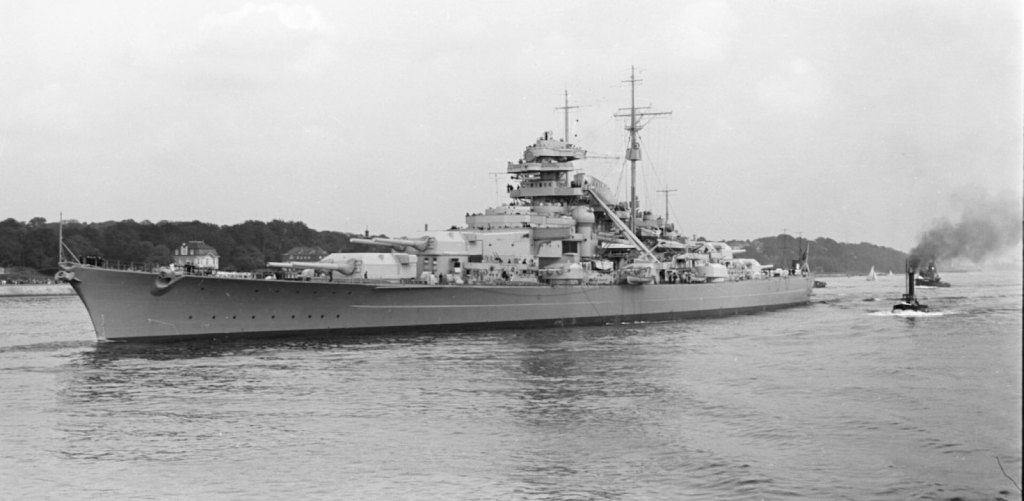
Bismarck was the first of two German battleships of her class, built by Blohm & Voss at Hamburg and commissioned in August 1940. She made one operational sortie. In May 1941 she sailed with the heavy cruiser Prinz Eugen to attack Allied shipping in the Atlantic, sank the battlecruiser Hood in the Denmark Strait, and was herself sunk three days later after a torpedo jammed her rudders.
This article covers the ship’s design, the operation known as Rheinübung, the final battle on 27 May 1941 and the wreck located by Robert Ballard’s expedition in June 1989. The main sources are the technical and historical pages of the KBismarck research site, a wartime study by the US Office of Naval Intelligence, accounts published by the Royal Navy and the war diary of the submarine U-556.
| Type | Battleship, Bismarck class |
| Builder | Blohm & Voss, Hamburg |
| Laid down | 1 July 1936 |
| Launched | 14 February 1939 |
| Commissioned | 24 August 1940 |
| Length overall | 250.5 m |
| Beam | 36 m |
| Displacement | 43,978 t standard; 51,760 t full load (metric) |
| Main armament | Eight 38 cm guns in four twin turrets |
| Machinery | 12 Wagner boilers, three turbine sets, three shafts |
| Crew on the sortie | More than 2,200 |
| Sunk | 27 May 1941, North Atlantic |
| Survivors | 115 |
| Wreck found | 8 June 1989, at about 4,790 m |
Size and weight
The Germans publicly gave Bismarck’s standard displacement as 35,000 tons, the limit of the interwar treaties. The ONI study written during the war already noted that her deep displacement was not far short of 50,000 tons. KBismarck’s technical data gives 43,978 metric tonnes standard and 51,760 tonnes at full load, with a maximum of 53,486 tonnes.
Those figures describe different loading conditions, and comparisons with other ships only make sense when the same condition and unit are used. KBismarck gives her overall length as 250.5 m, her beam as 36 m and her maximum draught as 10.55 m. The construction cost is recorded as 196.8 million Reichsmarks.
Armament and protection
The main armament was eight 38 cm guns in four twin turrets, two forward and two aft. The secondary battery of twelve 15 cm guns was separate from the sixteen 10.5 cm anti-aircraft guns, so the ship carried two medium-calibre systems rather than one dual-purpose battery. Lighter anti-aircraft weapons of 3.7 cm and 2 cm calibre completed the outfit, and she carried four Arado Ar 196 seaplanes.
The main armour belt was 320 mm thick. Behind it, an armour deck of 80 to 120 mm formed a second layer of protection over the machinery and magazines. According to KBismarck, the armoured citadel covered about 70 per cent of the waterline length, 170.7 m, and the armour weighed 19,082 tonnes. Areas outside the citadel, including the steering gear aft, had much less protection.

Machinery and endurance
Twelve Wagner high-pressure boilers supplied steam to three Blohm & Voss turbine sets driving three shafts. On trials she reached 30.12 knots with 150,170 shaft horsepower. Her fuel capacity was about 7,900 tonnes. KBismarck gives her endurance as 8,525 nautical miles at 19 knots, falling to 4,500 miles at 28 knots.
For a ship intended to raid commerce, those endurance figures mattered as much as her top speed. Running at high speed to escape or catch an enemy used fuel quickly, and any damage that cut off part of the fuel supply shortened the time she could stay at sea. Both problems affected Bismarck within days of leaving port.
Operation Rheinübung
Bismarck left Gotenhafen, now Gdynia, early on 19 May 1941 and joined Prinz Eugen. Admiral Günther Lütjens commanded the operation from Bismarck, whose captain was Ernst Lindemann. The ONI study quotes Lütjens telling the crew that their objective was commerce raiding in the Atlantic. Besides the crew there were about 75 staff and some 80 men assigned as prize crews.
On 21 May the German ships entered the fjords near Bergen, and Bismarck anchored in the Grimstadfjord. That afternoon an RAF Spitfire photographed her at anchor. The German ships sailed again that evening. On 23 May the cruisers Suffolk and Norfolk found them in the Denmark Strait, between Iceland and Greenland, and shadowed them by radar.
The Denmark Strait action
Early on 24 May the battlecruiser Hood and the new battleship Prince of Wales engaged the German ships. At about 0600 a salvo from Bismarck hit Hood, which blew up and sank within minutes. More than 1,400 men were killed; three survived and were picked up by the destroyer Electra. Prince of Wales was damaged and broke off the action.
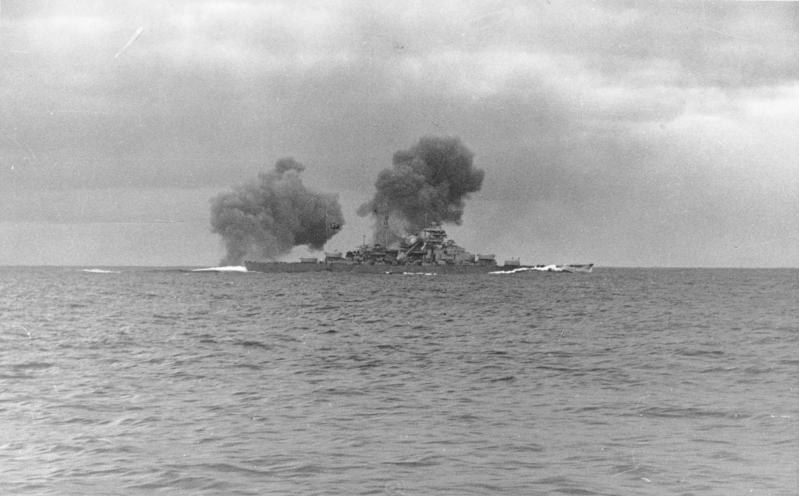
Before disengaging, Prince of Wales hit Bismarck three times with 14-inch shells. The ONI study, written with wartime information, attributes hits to Hood, but later research by KBismarck credits all three to Prince of Wales. One shell flooded an electrical plant and let water into a boiler room. Another passed through the bow, letting in about 1,000 tonnes of water and cutting off several hundred tonnes of fuel.
Bismarck’s speed was reduced to 28 knots, she was down by the bow, and she was leaving a trail of oil. Lütjens abandoned the raid on shipping and decided to make for Saint-Nazaire in occupied France for repairs. Prinz Eugen was detached to continue on her own, and Bismarck reduced speed to save fuel.
The air attacks of 24 to 26 May
Around midnight on 24 May, eight Swordfish torpedo bombers of 825 Squadron from the carrier Victorious attacked. One torpedo hit amidships on the starboard side; Bismarck reported it as of no significance. At 0310 on 25 May she turned away and the British lost contact. Later that morning Lütjens signalled that British radar had made it impossible to shake off the shadowers in the Denmark Strait. For more than a day the British did not know where she was.
At 1010 on 26 May an RAF Catalina flying boat found her again, and aircraft from the carrier Ark Royal took over the shadowing. An afternoon strike by Swordfish from Ark Royal mistakenly attacked the cruiser Sheffield, which was shadowing Bismarck, and many of the torpedoes failed to work properly.
At 1903 Bismarck signalled that her fuel situation was urgent. A second strike of 15 Swordfish attacked between 2047 and 2115 that evening, in poor weather and failing light. Two torpedoes hit. One struck the stern on the starboard side and jammed both rudders at 12 degrees to port. Bismarck reported that she was no longer manoeuvrable. Her divers and engineers could not free the rudders, and attempts to steer with the propellers failed.
U-556 was close to the scene. Her commander, Herbert Wohlfarth, recorded that evening that a battleship of the King George V class and a carrier he took to be Ark Royal had come into view at short range. He had no torpedoes left from his patrol, and his fuel was too low to keep up for long. He tried to shadow and report the British ships instead.
The final battle on 27 May
On the morning of 27 May the battleships Rodney and King George V closed in. Rodney opened fire at 0847, King George V a minute later, and the heavy cruisers Norfolk and Dorsetshire joined in. Bismarck replied with her forward turrets, but British hits put her turrets out of action one after another. By about 0931 her main guns were silent. Captain Lindemann gave the order to scuttle and abandon ship.
The British ships kept firing at short range until about 1022, by when Bismarck was burning and listing heavily. Dorsetshire then fired torpedoes into both sides. Bismarck capsized and sank by the stern at about 1039, according to KBismarck, or 1037 in the ONI study, at around 48 degrees 09 minutes north, 16 degrees 07 minutes west.
Whether the British torpedoes or the scuttling charges caused the sinking has long been argued. By the time either took effect, gunfire had already destroyed the ship as a fighting unit and she could not have reached port. The sources used here do not settle which flooding came first, and this account does not try to.
Rescue and survivors

Dorsetshire and the destroyer Maori began picking men out of the water, at about 13 degrees Celsius. Dorsetshire recovered 86 and Maori 25, but they left the area when a submarine was reported. That evening U-74 rescued three more, and the next day the German weather ship Sachsenwald found two others. KBismarck’s figures give 115 survivors out of more than 2,200 men aboard.
The ONI study gives 110 survivors picked up by the British ships, a lower figure than the later count of 111 by Dorsetshire and Maori. This article uses KBismarck’s crew research for the total. The Spanish heavy cruiser Canarias, which sailed from Ferrol to search for survivors, recovered only the bodies of two sailors.
The wreck
Robert Ballard’s first search, in 1988, did not find the ship. His second expedition located her on 8 June 1989, after covering an area of about 200 square miles. The Woods Hole Oceanographic Institution states that its towed imaging vehicle Argo made the find. The wreck lies about 470 miles west of Brest, at a depth given by KBismarck as 4,790 m.
The hull is upright and buried in sediment to about the designed waterline. A small part of the stern broke away at frame 10.5. The four main turrets fell out as the ship rolled over and lie upside down on the seabed, but the secondary turrets and most anti-aircraft guns remain in place. Later expeditions used crewed submersibles, including one led by James Cameron in 2002.
The wreck shows the condition of the ship after battle, sinking, descent and impact with the bottom. A photograph of a hole does not date it, and buried parts of the hull cannot be examined. Germany regards itself as the owner of the wreck, which lies in international waters, and treats it as a war grave. Entry to the hull and any recovery require the German government’s consent.
Timeline
| Date | Event |
|---|---|
| 1 July 1936 | Laid down at Blohm & Voss, Hamburg |
| 14 February 1939 | Launched |
| 24 August 1940 | Commissioned |
| 19 May 1941 | Sails from Gotenhafen with Prinz Eugen |
| 21 May 1941 | Photographed by the RAF near Bergen |
| 24 May 1941 | Denmark Strait action; Hood sunk and Bismarck hit three times |
| 26 May 1941 | Ark Royal’s Swordfish jam her rudders |
| 27 May 1941 | Sunk after the final battle; 115 survivors |
| 8 June 1989 | Wreck located by Robert Ballard’s expedition |
Sources and further reading
- KBismarck, Bismarck technical characteristics. Dimensions, displacement, protection, armament and machinery.
- KBismarck, The Battle of the Denmark Strait. Hits on Bismarck and the loss of Hood.
- KBismarck, The last battle of the Bismarck. Final action, sinking time and rescue.
- KBismarck, Bismarck history. Daily chronology of the sortie.
- KBismarck, Bismarck crew. Crew strength during Rheinübung.
- US Office of Naval Intelligence, The Cruise of the Bismarck, republished by the Naval Historical Foundation. Wartime study; some details superseded.
- Royal Navy, 80th anniversary of Swordfish strike on Bismarck, 2021.
- Royal Navy, 820 Squadron toast heroes who crippled the Bismarck, 2016.
- Royal Navy, Prince of Wales remembers her forebears, 2022. Losses in Hood.
- KBismarck, U-556 war diary, 26 and 27 May 1941. German text with English translation.
- KBismarck, The wreck of the Bismarck. Discovery, condition and status of the site.
- Woods Hole Oceanographic Institution, Ships and technology used during the Titanic expeditions. Argo and the 1989 find.
Image credits. Featured image: Bismarck in 1940, the year she was commissioned into the Kriegsmarine. Photo: Bundesarchiv, Bild 193-04-1-26, photographer unknown, Wikimedia Commons, CC BY-SA 3.0 de. Other photographs are credited in their captions.
Have a correction or a photograph that helps identify this ship? Contact contact@shipsarchive.com.


