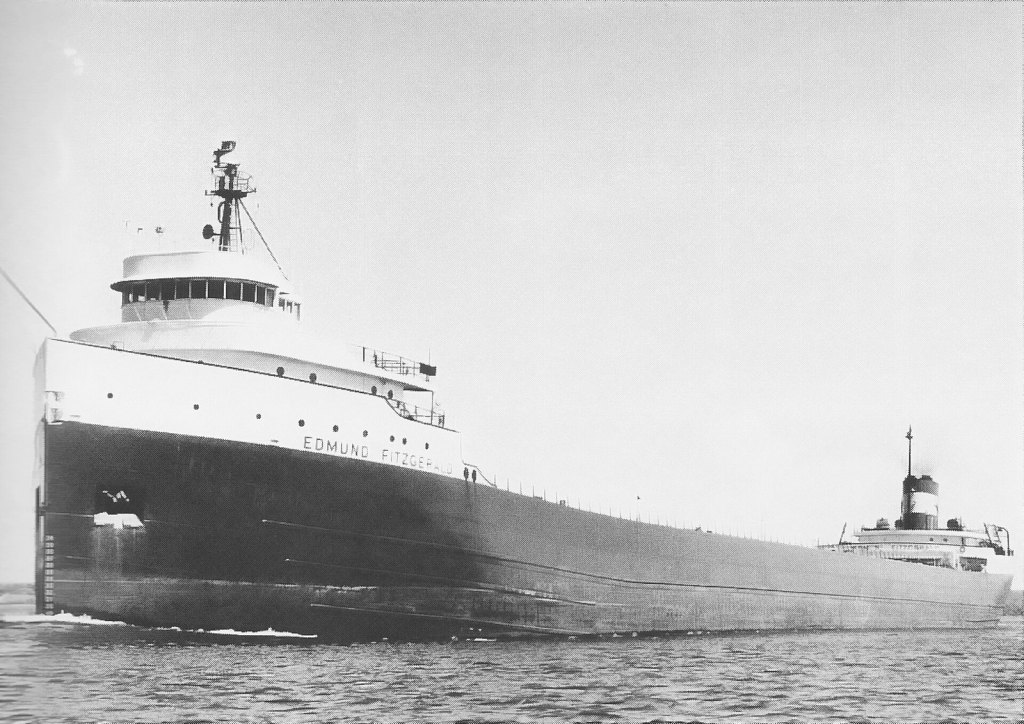
On the evening of 10 November 1975 the Great Lakes bulk carrier Edmund Fitzgerald sank in a storm on Lake Superior, about 17 miles from Whitefish Point, Michigan. She was carrying 26,116 long tons of taconite pellets from Superior, Wisconsin, to Detroit. All 29 men aboard died. No distress call was heard, and no bodies were recovered.
This article covers the ship, her last voyage, the search and the survey of the wreck, and the findings of the US Coast Guard and the National Transportation Safety Board. The two inquiries agreed that the cargo hold flooded but differed on how, and one member of the NTSB dissented. The main sources are the NTSB report of 1978 and the Great Lakes Shipwreck Historical Society.
| Type | Great Lakes bulk carrier, straight-decker |
| Builder | Great Lakes Engineering Works, River Rouge, Michigan |
| Keel laid | 7 August 1957, Hull No. 301 |
| Launched | 8 June 1958 |
| Owner | Northwestern Mutual Life Insurance Company |
| Operator | Columbia Transportation Division, Oglebay Norton |
| Length overall | 729 ft (222.2 m) |
| Breadth | 75 ft (22.9 m) |
| Gross tonnage | 13,632 |
| Machinery | Steam turbine, 7,500 hp |
| Last cargo | 26,116 long tons of taconite pellets |
| Lost | 10 November 1975, eastern Lake Superior |
| Crew lost | 29 |
The ship
Edmund Fitzgerald was ordered by the Northwestern Mutual Life Insurance Company of Milwaukee as a maximum-sized lake carrier and named after its president and chairman. She was laid down on 7 August 1957 and launched on 8 June 1958. Northwestern Mutual chartered her permanently to the Columbia Transportation Division of the Oglebay Norton Company of Cleveland, which ran her.
At 729 ft, the historical society records, she was the largest ship on the Great Lakes until 1971. Her usual route ran from Silver Bay, Minnesota, where she loaded taconite, to steel mills around Detroit and Toledo. Like most lake freighters of her time she had her pilothouse forward and her machinery aft, with a long cargo hold between them. She was a straight-decker, without her own self-unloading gear.
The cargo hold was divided by two screen bulkheads, which separated the cargo but were not watertight. Ballast tanks and tunnels ran along each side. Hatch covers on the weather deck closed the hold. The NTSB later treated the condition of those covers, and the lack of watertight division inside the hold, as central to the loss.
The last voyage
At about 0830 on 9 November 1975 the ship began loading 26,116 long tons of taconite pellets at the Burlington Northern Railroad dock No. 1 in Superior, Wisconsin. Taconite pellets are a processed iron-ore product, rolled into small balls and fired. Shore staff saw the crew replacing the hatch covers after loading. Captain Ernest McSorley sailed at 1415, bound for Zug Island, Detroit.
The Arthur M. Anderson, under Captain Bernie Cooper, left Two Harbors, Minnesota, that afternoon with a similar cargo. The two ships kept in radio contact, between 10 and 20 miles apart. After storm warnings were issued early on 10 November, the masters agreed to take a northerly course across the lake, using the Canadian shore for shelter, before turning south-east towards Whitefish Bay.

Damage and the final hours
In the early afternoon of 10 November the Fitzgerald passed Caribou Island. Captain Cooper later said that he watched her on radar pass much too close to Six Fathom Shoal, north of the island. At about 1530 McSorley radioed the Anderson that he had a fence rail down, two vents lost or damaged, and a list. He said he was slowing down so the Anderson could close the distance, and that both pumps were running.
At about 1610 the Fitzgerald reported that both her radars were out of action and asked the Anderson to keep track of her and give navigational help. The weather worsened through the afternoon. Cooper reported steady winds of 58 knots with gusts to 70, and seas of 18 to 25 feet. At about 1720 a wave smashed the Anderson’s starboard lifeboat.
At 1910 the Anderson’s first mate, Clark, told the Fitzgerald about a ship 9 miles ahead of her and asked how she was getting on with her problems. The reply was “We are holding our own.” It was the last message. The NTSB puts the sinking at about 1915. When the Anderson’s radar was checked at about 1920 there was no contact.
The search
The visibility improved, and the Anderson could see lights more than 20 miles away, but there was no sign of the Fitzgerald. After trying to raise her by radio, the Anderson told the Coast Guard at 2032 that she might have suffered a casualty. The Anderson turned back into the storm to search, and the William Clay Ford came out from the shelter of Whitefish Bay to join her.
The Coast Guard sent a fixed-wing aircraft and the cutters Naugatuck and Woodrush. The Anderson’s crew found the Fitzgerald’s two lifeboats and other debris, but there were no survivors. On 14 November a US Navy aircraft with a magnetic anomaly detector found a strong contact 17 miles north-northwest of Whitefish Point. Over the following days Woodrush located two large pieces of wreckage there by side-scan sonar.
The wreck
In May 1976 the Navy’s unmanned CURV III vehicle surveyed the wreck from Woodrush. The NTSB records 12 dives, 43,255 ft of videotape and 985 colour photographs; the historical society gives rounded figures of 43,000 ft and 900. On 20 May 1976 the name Edmund Fitzgerald was seen upside down on the stern. The NTSB gives the depth as 530 ft, the historical society 535 ft.
The wreck lies in Canadian waters, just north of the international boundary. It consists of an upright bow section 276 ft long, an upside-down stern section, and debris from a missing midship portion of about 200 ft. Hatch covers were missing from hatches Nos. 7 and 8. The rudder and propeller of the stern section were undamaged.
The Coast Guard’s findings
The Coast Guard Marine Board of Investigation reported in 1977. It said that the cause could not be determined conclusively, but that the most probable cause was the loss of buoyancy and stability from massive flooding of the cargo hold. That flooding, it found, most likely came through ineffective hatch closures as boarding seas ran along the spar deck.
In its view the ship dived into a wall of water and never recovered, breaking up either as she plunged or when she struck the bottom. The suggestion that the hatch covers had not been properly secured was strongly disputed. The Lake Carriers’ Association wrote to the NTSB in September 1977 and favoured Captain Cooper’s account that the ship had passed over the shoal.
The NTSB’s findings and the dissent
The NTSB adopted its report on 4 May 1978. It found the probable cause to be sudden massive flooding of the cargo hold when one or more hatch covers collapsed. Before that, it said, water had entered the ballast tanks and tunnel through topside damage, and the hold through hatch covers that were not weathertight. This reduced her freeboard and gave her a list.
Heavy seas boarding the deck at that reduced freeboard then put enough load on the hatch covers to collapse them. The Board calculated that by about 1915 her freeboard at hatch No. 1 could have been near zero. Contributing factors were the lack of watertight bulkheads in the hold and the reductions in freeboard allowed by amendments to the Great Lakes load line rules in 1969, 1971 and 1973.
The Board considered grounding on the shoal near Caribou Island and found that damage from it would probably have extended to the bottom plating of the stern section, which was seen to be intact. One member, Philip Hogue, dissented. He held that shoaling was the most probable first cause, followed by progressive flooding that was not detected. The chairman, James King, filed a statement answering his points.

The bell and the memorial
The NTSB recommended that the Coast Guard make sure, at annual inspections, that hatch covers, coamings and vents on Great Lakes ships were in good repair and could be made weathertight. The Great Lakes Shipwreck Historical Society later led three expeditions to the wreck, in 1989, 1994 and 1995.
On 4 July 1995 the ship’s 200 lb bronze bell was recovered, in an expedition with the National Geographic Society, the Canadian Navy, Sony and the Sault Ste. Marie Tribe of Chippewa Indians. It is displayed at the Great Lakes Shipwreck Museum at Whitefish Point as a memorial to the crew. The museum holds a memorial ceremony every year on 10 November.
The exact sequence of the ship’s last minutes is not known and may never be. The inquiries agree that the hold flooded and that the ship sank quickly in severe weather; they differ on how the water first got in. What is not in doubt is that all 29 men aboard were lost with her.
Timeline
| Date | Event |
|---|---|
| 7 August 1957 | Keel laid at River Rouge, Michigan |
| 8 June 1958 | Launched |
| 9 November 1975 | Loads taconite at Superior, Wisconsin, and sails at 1415 |
| 10 November 1975 | Reports damage and a list at about 1530; last message at 1910; sinks at about 1915 |
| 14 November 1975 | Navy aircraft detects a magnetic contact at the wreck site |
| 20 May 1976 | Name seen on the stern during the CURV III survey |
| April 1977 | Coast Guard Marine Board report released |
| 4 May 1978 | NTSB adopts its report |
| 4 July 1995 | Bell recovered from the wreck |
Sources and further reading
- National Transportation Safety Board, Marine Accident Report NTSB-MAR-78-03: SS Edmund Fitzgerald sinking in Lake Superior, November 10, 1975, 1978. Includes the concurring and dissenting statements.
- Great Lakes Shipwreck Historical Society, Edmund Fitzgerald. Construction, ownership, final cargo and the bell.
- Sean Ley, Great Lakes Shipwreck Historical Society, The Fateful Journey. Voyage, radio messages, search, survey and the dispute over the cause.
- US Coast Guard, Marine casualty report: SS Edmund Fitzgerald, TRID record and abstract, 1977.
- National Weather Service, Aberdeen, This Day in Weather History: November 10. The storm of 9 to 11 November 1975.
Image credits. Featured image: Edmund Fitzgerald under way, in a photograph from the US Army Corps of Engineers. Photo: US Army Corps of Engineers, Wikimedia Commons, Public domain. Other photographs are credited in their captions.
Have a correction or a photograph that helps identify this ship? Contact contact@shipsarchive.com.


.jpg)
