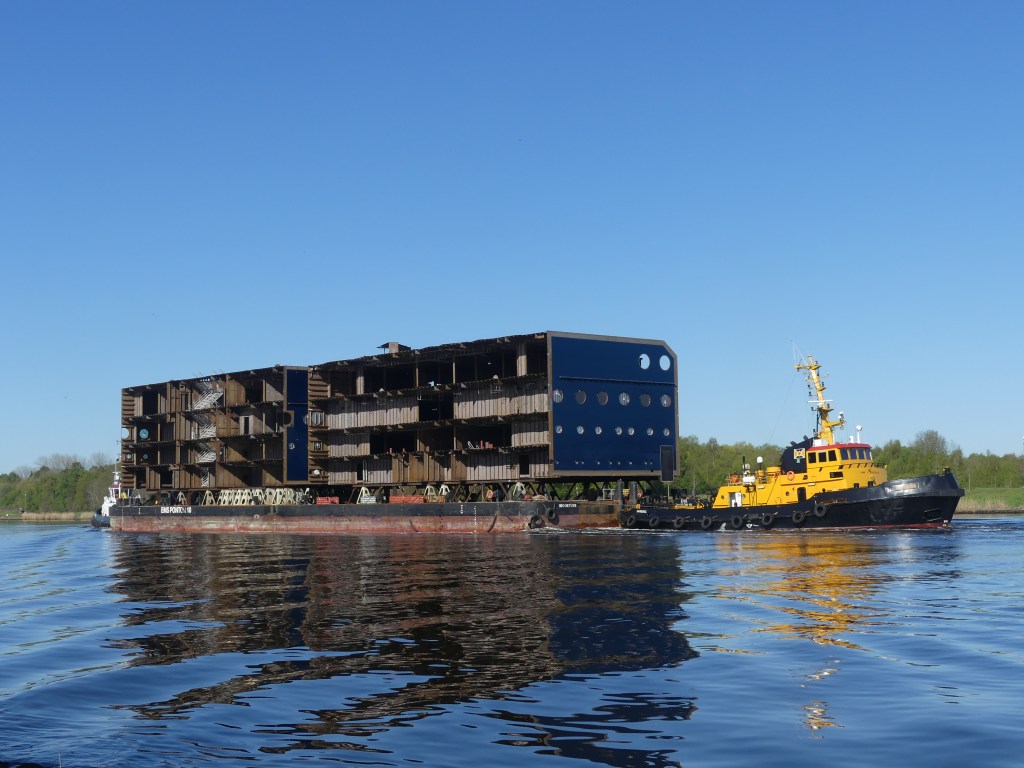
Ship sections identified by the photographer as Disney Believe, carried through the Kiel Canal on May 1, 2026. HenSti / Wikimedia Commons, CC BY-SA 4.0. No changes.
Disney Believe has reached a stage at which a substantial part of the ship can float outside the building dock while other parts remain under construction. That is the significance of the September and October milestones at Papenburg. They show the organisation of a modular build, rather than the launch of a finished cruise ship.
Disney’s construction log records the first of three gigablocks floating out on 18 September 2026. It identifies that section as the midship portion. Meyer Werft’s English-language 7 October release places it at the outfitting pier and links the coin ceremony to assembly of the second gigablock. The fourth Wish-class vessel is scheduled for delivery in 2027.
| Fact | Detail |
|---|---|
| Ship | Disney Believe |
| Builder | Meyer Werft, Papenburg |
| Class position | Fourth Wish-class ship |
| Announced size | 144,000 GT |
| Staterooms | 1,256 |
| Fuel | LNG |
| Maiden voyage | Scheduled 18 December 2027 |
Contents: The milestone sequence · From panels to gigablocks · Outfitting before assembly · What the particulars mean · LNG and emissions · The route to service · Sources
A keel ceremony after part of the ship is afloat
A keel-laying ceremony can sound like the start of construction, which makes its appearance after a float-out seem contradictory. In a modular programme, the ceremony does not mean that steelwork elsewhere has only just begun. Disney’s log entry dated 5 October describes work on the second gigablock after the first had left the dock. The chronology is therefore consistent with several stages of production being visible at once.
The dates need careful handling. Disney labels its ceremony entry 5 October; the builder’s English release is dated 7 October, while its German archive lists the announcement on 6 October. Those publication labels should not be forced into a single supposedly verified event date. The sound conclusion is that early-October announcements marked assembly of the second large section.
Similarly, the first section’s float-out does not establish that the bow, stern or the ship’s full systems were ready. Disney identifies the forward section as next in the sequence, followed by the aft section. The useful question is therefore which assembly has reached which stage, rather than whether the ship as a whole has been “launched”.
There is a practical reason this vocabulary matters. A date associated with one part of a build can spread rapidly into general ship lists, where it is later mistaken for delivery or entry into service. A construction log is more valuable when it preserves those distinctions. For Disney Believe, section float-out, assembly ceremony, delivery and maiden voyage are separate events.
From steel panels to a gigablock
Meyer Werft’s description of its production process starts with steel sheets cut and welded into panels. Profiles, supporting members and walls turn those panels into sections. Sections are then assembled into larger blocks, with electrical installations and piping introduced before the final joining stages. The yard’s general explanation should not be read as an exact block inventory for Disney Believe, but it establishes the manufacturing hierarchy.
“Gigablock” describes a much larger assembly within that hierarchy. It is not a claim that the vessel has been fabricated from three monolithic pieces of steel. The large section already contains many smaller structural units and numerous interfaces between trades. What appears as one floating object outside the hall is the result of accumulated fabrication and outfitting work.
The US Government Accountability Office’s study of commercial shipbuilding, which included a visit to Meyer Werft, provides useful independent context. It describes steel cutting, block fabrication, outfitting, erection, launch, trials and delivery as distinct stages. Its general process account dates from 2009 and is not a progress report on this ship, but the explanation helps separate production activities that publicity often compresses into one milestone.
This method also changes the meaning of “inside the ship”. During early fabrication, a future compartment may be open on several sides and accessible directly from a workshop floor. Once joined into a larger structure, it becomes enclosed by neighbouring spaces. The finished vessel’s boundaries emerge gradually, while work that will eventually be hidden is completed in the open.
Why equipment goes in before the sections meet
The GAO report explains that block outfitting can include pipes, equipment brackets, cable supports and ladders. Access is a principal advantage. Equipment can be placed before permanent surrounding structure makes the same operation more difficult. In some construction sequences, blocks can be worked on upside down so that welding and installation occur in more convenient orientations.
That is general shipbuilding practice documented by the report, not a claim that every Disney Believe block was inverted or outfitted to the same degree. It explains why the first floating section should not be thought of as an empty steel shell. Disney’s own account describes substantial plumbing and wiring already incorporated into its gigablock approach.
Early installation also increases the importance of design coordination. A pipe route, a structural opening and the equipment it serves must agree before surrounding structure closes access. The GAO identifies stable design information and a developed three-dimensional product model as important features of successful commercial construction. Its analysis links incomplete information to out-of-sequence work and rework.
For a cruise ship, that coordination extends across functions that look quite different to a passenger. Accommodation, circulation spaces, machinery services and entertainment areas share a physical structure. A change to one space can affect routes through another. The engineering significance of modular construction is that these relationships must be resolved across boundaries between assemblies, not just within each individual room.
Joining large sections consequently involves more than welding their outer edges. Structural continuity and the connections between installed systems must both be achieved. A completed local installation is not yet proof that an entire shipboard system works from end to end. The later testing programme has to address the assembled vessel, including interfaces that did not exist when individual sections were first built.
The builder says its covered dock is more than 500 metres long. That establishes the scale of the facility, but does not justify calculating an unused percentage of the dock or a production rate from public photographs. For this project, the verified observation is that one gigablock has moved to the outfitting pier while assembly of another proceeds. The division of work is more informative than an unsupported estimate of overall completion.
Reading the confirmed technical particulars
Meyer Werft gives Disney Believe 1,256 staterooms and 144,000 GT, and identifies Disney Wish, Disney Treasure and Disney Destiny as her preceding sisters. These figures establish the announced scale and class relationship. They do not supply an engine specification, displacement, maximum passenger count or detailed machinery arrangement. Those particulars should be added only when separately documented.
Gross tonnage is especially easy to mishandle alongside construction photographs. The International Maritime Organization’s explanation defines it as a function of the moulded volume of enclosed spaces. It is not the ship’s weight. Writing that Disney Believe “weighs 144,000 tonnes” would therefore turn a verified figure into a false statement.
A gigablock’s quoted mass is a different quantity again. Disney’s general explanation says such sections can weigh more than 31,000 tons, but does not clearly establish that as the measured mass of this particular midship section. It cannot be multiplied by three to derive the finished ship’s displacement, or compared directly with gross tonnage to calculate a construction percentage.
The same restraint applies to class continuity. A fourth ship benefits from an established design family, but shared class identity does not demonstrate that all equipment and internal arrangements are identical. The GAO’s broader finding is that reusing designs can reduce uncertainty. It is not evidence that a particular modification to Disney Believe has already been tested or accepted.
What LNG confirms, and what it leaves open
The builder confirms LNG propulsion and promotes lower emissions compared with conventional propulsion. That is a fuel and marketing statement, not a full lifecycle assessment of Disney Believe. No ship-specific greenhouse-gas reduction percentage is established by the construction announcement.
The IMO’s lifecycle framework distinguishes fuel production and supply from its use aboard ship, and includes carbon dioxide, methane and nitrous oxide. A claim restricted to one part of that chain cannot establish the result across the whole chain. Fuel origin and actual machinery performance therefore matter to any broader comparison.
For readers following the build, the useful position is precise: LNG is announced; complete decarbonisation is not demonstrated. Nor does the announcement identify enough machinery detail to assign a methane-slip rate or a verified voyage-emissions figure. Those would require evidence beyond the fuel label and the yard’s release.
The route from floating section to passenger service
Disney’s 7 October reveal schedules the maiden voyage for 18 December 2027 from Port Everglades, Fort Lauderdale. It also announces an Encanto stage adaptation, Frozen-themed dining and a Moana-inspired Grand Hall. These are planned passenger offerings, not facilities already operating aboard a delivered ship.
The construction and entertainment announcements intersect physically, but they answer different questions. A venue reveal describes the intended experience. A yard milestone describes a stage in producing the vessel that will contain it. Neither alone establishes readiness for passengers. The gap between an attractive interior rendering and an accepted installation includes fabrication, integration and testing.
The GAO’s construction sequence places dock and sea trials before delivery. Those stages are important because assembled systems must demonstrate their operation, rather than merely exist as installed equipment. The public sources checked do not give Disney Believe’s detailed trial dates or acceptance programme. They establish a 2027 delivery plan and a later scheduled inaugural departure, without warranting a claim that either has occurred.
The October news is therefore useful for something more specific than a preview of another cruise holiday. It offers a view of how a large passenger ship occupies several states of completion at the same time. A floating midship section, a second assembly under construction and a future voyage date can all be accurate descriptions of one project. Keeping each tied to its own milestone is the clearest way to follow what happens next.
Sources and further reading
- Meyer Werft, English keel-laying release, 7 October 2026: https://www.meyerwerft.de/en/press/press_detail/kiellegung_der_disney_believe
- Meyer Werft, German archive, announcement labelled 6 October: https://www.meyerwerft.de/de/presse/pressearchiv
- Disney Cruise Line, ship’s log, updated 8 October 2026, including dated construction entries: https://disneyparksblog.com/dcl/meet-the-disney-believe-the-next-disney-cruise-line-ship/
- Disney Cruise Line, ship reveal and inaugural voyage, 7 October 2026: https://disneyparksblog.com/dcl/what-is-on-disney-believe-ship/
- Meyer Werft, production process: https://www.meyerwerft.de/en/career/production
- US GAO, GAO-09-322, 13 May 2009, historical industry-process context: https://www.gao.gov/assets/a289537.html
- IMO, tonnage convention and definitions: https://www.imo.org/en/about/conventions/pages/international-convention-on-tonnage-measurement-of-ships.aspx
- IMO, marine-fuel lifecycle assessment framework: https://www.imo.org/en/ourwork/environment/pages/lifecycle-ghg—carbon-intensity-guidelines.aspx?trk=article-ssr-frontend-pulse_little-text-block
Related reading: Oasis of the Seas: The Cruise Ship with a Split Superstructure


