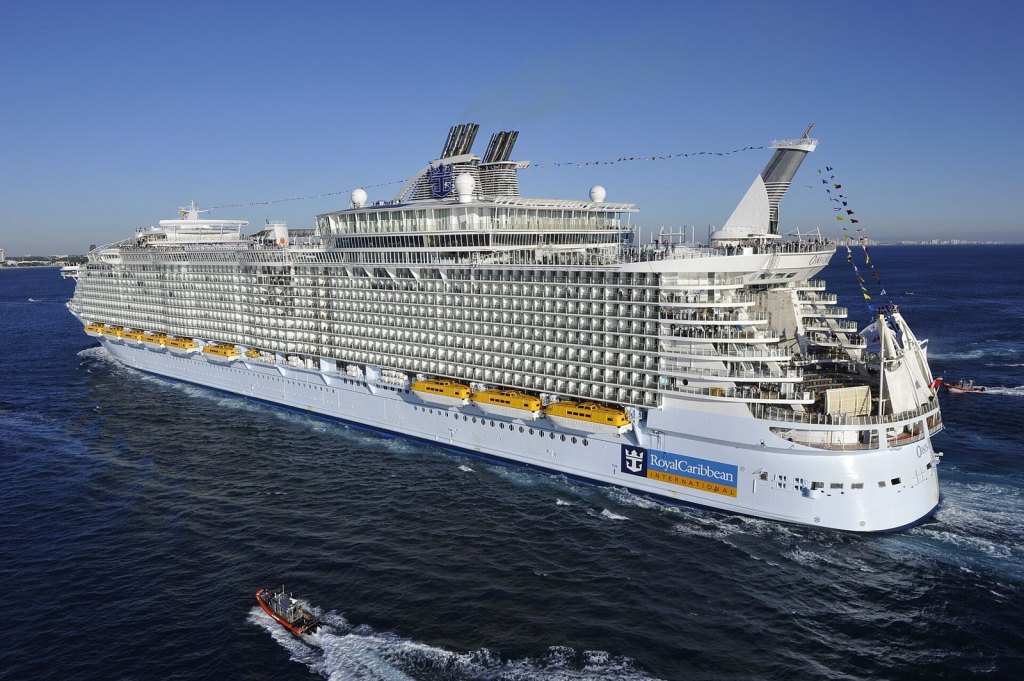
When Oasis of the Seas was delivered in October 2009 she was the largest passenger ship in the world. Her size was less unusual than her shape. Above the hull, her superstructure is divided along the centre line into two tall blocks of cabins, with an open court between them that is planted as a park.
That single decision shaped almost everything else about the ship. It created a new kind of balcony cabin facing inwards, and it raised questions about wind, ventilation, power supply, passenger movement and evacuation that a conventional enclosed block would not have posed. This article follows those consequences, using the owner’s, designers’ and suppliers’ own records.
| IMO number | 9383936 |
| Owner | Royal Caribbean International |
| Builder | STX Europe, Turku, Finland |
| Delivered | 28 October 2009 |
| Length overall | 362 m |
| Beam | 47 m |
| Draught | 9.2 m |
| Gross tonnage | 225,282 |
| Passengers | About 5,400 at double occupancy |
| Cabins | About 2,700 |
| Main engines | Six Wärtsilä 46 diesel generators, over 96 MW |
| Propulsion | Three ABB podded azimuth units of 20 MW each |
| Sister ship | Allure of the Seas, delivered October 2010 |
Project Genesis
The ship was developed under the code name Project Genesis and ordered from the Turku yard, then owned by Aker Yards and later part of STX Europe. Royal Caribbean described her at delivery as nearly six years in the making. Associated Press reported in 2008 that each ship of the class would cost more than $1 billion to build.
The first feature revealed, on 15 April 2008, was Central Park. Royal Caribbean announced that the centre of the ship would open to the sky, with planted gardens running the length of a football field. The release also mentioned irrigation, drainage and micro-climate control. It was the first of seven neighbourhoods, each intended to give passengers a different setting on board.
The announcement placed the park on Deck 8, 19 m wide and 100 m long, with 334 cabins overlooking it, 254 of them with balconies, in walls rising six decks high. One bar, the Rising Tide, was designed to move through three decks between the park and the public spaces below. From the start, the open court was planned as part of the accommodation.

What is actually split
The division is in the superstructure only. Oasis has a single hull and a single machinery installation, and the enclosed decks of the lower ship run continuously beneath the open court. She is not a catamaran, and seawater does not pass between the two halves. Deltamarin, which worked on the design, records its work on the general arrangement of the lower part of the vessel.
Central Park lies roughly amidships. Further aft, the gap between the two blocks continues as the Boardwalk, a family area with a carousel that leads to the AquaTheater at the stern, an open-air amphitheatre that serves as a pool by day and a theatre by night. Royal Caribbean treated the two as separate neighbourhoods, and their surroundings differ.
The 2010 annual report filed by Royal Caribbean Cruises Ltd. with the United States Securities and Exchange Commission lists the seven neighbourhoods and notes balcony cabins facing some of them. It gives the class about 5,400 berths and 2,700 cabins over 16 decks. Kongsberg’s account of the ship gives 18 decks, probably counting differently.
A second set of balconies
The commercial logic is stated plainly in the same filing. The design allowed a greater percentage of cabins with verandas and outside views, which, in the company’s words, provide for premium pricing. Kongsberg reported more than 2,000 balconies in all, together with 28 two-storey loft suites.
A balcony over Central Park is not the same as one facing the sea. Its outlook is planting, paths and the cabins opposite, and its privacy depends on the width of the court and the position of the balconies across it. Royal Caribbean sold these as a distinct category, rather than pretending that every outside cabin offered the same view.

The park itself sits on the ship’s structure, several decks above the waterline. Wärtsilä’s delivery account counted 12,175 plants, 62 vines and 56 trees and bamboos. Soil, water and drainage all add weight and services high in the ship, and the planting has to survive salt air and the movement of a vessel at sea.
The 2008 announcement named some of the planting: black olive, Cuban laurel and bamboo among the trees, some expected to grow more than two and a half decks tall. Two arched glass domes, the Crystal Canopies, were set into the park floor to bring daylight into the enclosed public spaces below, and an on-site horticulturist was planned to look after the gardens.
Wind in the canyon
An open court between tall blocks is not automatically sheltered. Wind can accelerate, turn and form eddies between high walls, and a ship under way creates its own airflow. Deltamarin’s record of its work lists wind and microclimate studies using computational fluid dynamics, together with an analysis of passenger comfort on open decks.
Wind matters for handling as well as comfort. Captain William Wright, who took the ship across the Atlantic on her delivery voyage, told Kongsberg that she has about 15,000 square metres of sail area. Manoeuvring in and out of busy ports in strong winds needed a powerful propulsion control system, which Kongsberg supplied with a dynamic positioning system.
Power beneath the neighbourhoods
Oasis is diesel electric. Wärtsilä supplied six engines of its 46 series, three with 12 cylinders and three with 16, producing more than 96 MW between them. The engines drive generators, and the electricity serves both propulsion and the hotel load. Wärtsilä noted that after propulsion, air conditioning is the largest consumer of power on board.
Propulsion is by three podded azimuth units supplied by ABB, each of 20 MW according to Kongsberg. Because the electric motors sit in pods outside the hull, there are no long shaft lines through the after part of the ship. Four bow thrusters, which Wärtsilä gives as 5.5 MW each, assist in harbour.
Kongsberg also supplied power management, machinery automation and the automation for heating, ventilation and air conditioning. A park-facing cabin depends on the same electrical and ventilation systems as any other, however different its view. The neighbourhood idea above deck rests on conventional engineering below it.
Safety in the arrangement
Deltamarin worked on the project with the consultancy Safety at Sea. Its recorded tasks included subdivision and stability reviews, survivability analysis and model testing, fire safety assessment and a study of the safety level of the design. It also took part in the team that developed prototype high-capacity lifeboats for the class.
Moving people safely was a design problem in its own right. Kai Levander, of STX Europe, told Kongsberg that the designers had to rethink how passengers and crew moved around a ship of this size, both for safety and to avoid congestion. A neighbourhood name helps people find their way, but routes, stairs and assembly points still had to work for some 8,000 people on board.

Delivery and service
Oasis of the Seas was handed over at Turku on 28 October 2009 and sailed for Florida two days later under Captain Wright. She arrived at Port Everglades, Fort Lauderdale, her home port, in November and began cruising in the Caribbean in December. Her sister Allure of the Seas followed from the same yard in October 2010.
Figures for her capacity are often confused. About 5,400 passengers is the double-occupancy figure used by the owner. With extra berths filled, Kongsberg gave about 6,300 passengers, and Wärtsilä gave a crew of 2,165. These are different measures, not contradictory ones, and published totals depend on which is meant.
The 2019 refit
In 2019, for her tenth anniversary, Oasis underwent a refit that Royal Caribbean described as a $165 million amplification, lasting 63 days. It added the Ultimate Abyss slide, the Perfect Storm waterslides, a new children’s water play area and new bars, restaurants and entertainment venues. She returned to service from Miami on 24 November 2019.
The refit changed many public spaces but not the basic arrangement. Photographs of the ship need dating for that reason, since features added in 2019 were not part of her original fitting out. The split superstructure, the park and the Boardwalk remain, and they still explain how the ship works more clearly than her size alone.
Timeline
| Date | Event |
|---|---|
| 15 April 2008 | Central Park revealed for Project Genesis |
| 26 July 2009 | Fitting out at Turku |
| 28 October 2009 | Delivered at Turku |
| 30 October 2009 | Sails for Florida |
| November 2009 | Arrives at Port Everglades |
| December 2009 | Enters service in the Caribbean |
| October 2010 | Sister ship Allure of the Seas delivered |
| 2019 | Refit lasting 63 days |
| 24 November 2019 | Returns to service from Miami |
Sources and further reading
- Cruise Industry News, Royal Caribbean unveils first architectural marvel onboard Project Genesis, 15 April 2008. Owner’s announcement of Central Park.
- Associated Press via NBC News, Largest cruise ship to feature Central Park, 17 April 2008.
- Deltamarin, Oasis of the Seas. Designer’s scope of work and main dimensions.
- Cruise Industry News, Royal Caribbean takes delivery of Oasis of the Seas, 28 October 2009.
- Royal Caribbean Cruises Ltd., Annual report on Form 10-K for 2010. Berths, cabins, neighbourhoods and veranda cabins.
- Kongsberg Maritime, The size matters. Interviews on design, propulsion control and passenger movement.
- Wärtsilä, Wärtsilä powers Royal Caribbean’s Oasis of the Seas, 28 October 2009.
- Royal Caribbean International via PR Newswire, Oasis of the Seas set for Royal Caribbean’s largest amplification yet, 21 May 2019.
Image credits. Featured image: Oasis of the Seas arriving at Port Everglades, Fort Lauderdale, at the end of her delivery voyage on 13 November 2009. Photo: Barry Bena, U.S. Coast Guard, Wikimedia Commons, Public domain. Other photographs are credited in their captions.
Have a correction or a photograph that helps identify this ship? Contact contact@shipsarchive.com.


.jpg)