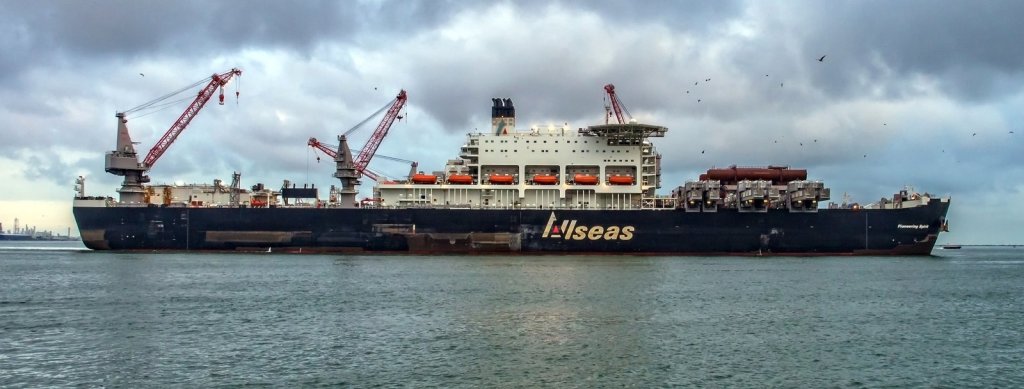
Pioneering Spirit at Maasvlakte 2, Rotterdam, on 6 August 2016, showing the vessel's early operating configuration. Photo: BsnarF1, via Wikimedia Commons, CC BY 2.0. Cropped and optimised by the Commons uploader; watermark removed in the Commons version. Resized and compressed for publication. Image source. Rights and reuse.
The decisive movement in an offshore platform removal may last only seconds. It follows a much longer sequence of preparation, positioning and controlled transfer of weight, and it precedes another demanding operation: bringing the structure safely to a receiving facility.
Pioneering Spirit was designed around that complete sequence. Her split bow can surround a platform support while lifting beams take the topsides load. Separate equipment handles steel jackets at the stern, and another arrangement supports pipeline installation. These are different engineering tasks sharing one vessel, not interchangeable uses of a single crane.
Allseas marked ten years since the first commercial Yme single lift in August 2026. The more revealing measure of the vessel’s development is how her equipment connects offshore work with transport and shore facilities. A successful separation is only one stage in delivering a structure to its next location.
| Item | Allseas published rating or dimension |
|---|---|
| Hull length and breadth | 382 metres; 124 metres |
| Bow slot | 122 metres long; 59 metres wide |
| Equipped overall length | 477 metres, including stinger and lifting beams |
| Topsides capacity | Up to 60,000 tonnes |
| Jacket capacity | Up to 20,000 tonnes |
| S-lay tension capacity | 2,000 tonnes |
| Positioning | 12 azimuth thrusters; DP3 |
Contents: Three structures, different problems · Preparation and positioning · The topsides lift · Reading the Brent Delta record · Jackets and installation · Transport to shore · Pipelay is a separate operation · Capacity and future interfaces · Related reading · Sources
Topsides, jackets and concrete bases are different structures
The topsides contain a platform’s working facilities: equipment, decks, services and, depending on the installation, accommodation or drilling systems. Their support may be a steel jacket extending to the seabed or a concrete gravity-based structure. Removing the topsides does not mean that everything below them is removed at the same time.
A steel jacket is an open framework whose connections to the seabed must be addressed before recovery. Its lifting geometry, submerged condition and centre of gravity differ from those of the topsides. A concrete gravity-based structure presents another set of mass, buoyancy and foundation issues.
These distinctions explain the separate ratings on Allseas’ vessel page. The 60,000-tonne topsides capacity is not a universal allowance for any object carried anywhere on the ship. The jacket system has its own 20,000-tonne rating and operating arrangement.
The 2026 specification lists a 382-metre hull. The longer 477-metre equipped measurement includes projecting lifting beams and the stinger. Both dimensions can be valid when their boundaries are stated; mixing them without explanation makes comparisons misleading.
The offshore operation begins before the ship arrives
A structure prepared for removal needs a credible account of its mass, centre of gravity and load paths. Equipment, fluids and modifications accumulated over its working life can change those properties. A lifting plan must establish how the load will enter the temporary lifting arrangement and whether the remaining structure can carry it.
Services crossing the separation boundary also need attention. Pipes, cables and structural connections cannot be assumed to release merely because the lifting system has sufficient capacity. Preparation creates a defined interface between what is leaving and what is staying.
For Pioneering Spirit, the bow slot allows the vessel to approach around the platform support. The ship must then hold a suitable position while the beams are brought into place. Twelve azimuth thrusters support dynamic positioning, with DP3 denoting a demanding redundancy standard. That designation does not mean the ship is motionless or unaffected by weather.
Positioning and motion compensation solve related but different problems. Dynamic positioning controls the vessel’s location and heading. Compensation at the lifting equipment manages relative movement where the ship meets the structure. Neither can remove the need for an appropriate weather window and clear operating limits.
Preparation is therefore not a minor prelude to the lift. It creates the conditions in which a brief separation movement can be controlled rather than improvised.
The topsides system controls contact before separation
Allseas describes 16 topsides lifting beams with three-axis motion compensation and a four-metre fast-lift stroke. The equipment first has to engage the prepared lifting points and establish the intended distribution of load.
The difficulty is not simply producing an upward force. Before separation, the topsides remain associated with a fixed offshore support while the vessel moves in waves. The lifting interface must accommodate that relative motion without imposing uncontrolled loads on either side.
As load transfers to the ship, ballast management changes the vessel’s buoyant condition. The fast-lift stage then provides rapid separation and clearance. Once the structure is free, the operating problem changes again: it is now a transported load that must remain supported during the voyage.
Speed is useful at the separation stage because prolonged near-contact between a moving vessel and a fixed support creates hazards. But a fast stroke is useful only after the preparation, engagement and load transfer have reached the required state.
This explains why a short video can give an incomplete account. The visible upward movement may be the easiest part to recognise, while the slower work has already established the structural and operational conditions that make it possible.
Brent Delta shows why the final engineering record matters
Shell’s Brent Delta close-out report gives an estimated lifting mass of 23,500 tonnes, with an uncertainty of plus or minus 5%. It records 8 hours 56 minutes to position the beams after entering the 500-metre zone and a 15-second fast lift.
The report describes progressive deballasting to transfer load, hydraulic separation and further deballasting to gain clearance. These are different phases, not alternative descriptions of one instantaneous action. Its figures also differ from publicity accounts using 24,200 tonnes and ten seconds; the final close-out record is the more appropriate basis for this engineering account.
The contrast between hours of positioning and seconds of separation is instructive. The operation minimised the duration of a critical transition, not the need for careful preparation. The weather window also had to accommodate the subsequent voyage, rather than merely the instant when the topsides left their support.
More generally, a quoted lifting mass needs a measurement basis. An estimate with stated uncertainty is more informative than a seemingly exact headline number whose basis is unclear. Capacity, estimated project mass and later dismantling records answer different questions and should retain their own labels.
Jackets use the stern system, while installation reverses the objective
Pioneering Spirit’s jacket arrangement uses two 170-metre lifting beams at the stern. Allseas describes a sequence in which the jacket is lifted after pile cutting, brought into alignment with the beams and reclined for transport. This is distinct from lifting topsides through the bow slot.
The Ninian Northern project demonstrates the separation of tasks. The topsides were removed in 2020 and the jacket in 2022. Lerwick Port Authority’s contemporary account, dated 22 April 2022, describes an 8,500-tonne, 83-metre jacket arriving for dismantling. That attributed figure avoids silently choosing between inconsistent figures elsewhere.
Installation has a different end condition from removal. Instead of leaving a support clear, the vessel must place a new structure on its intended interface and transfer the weight into the permanent arrangement. Accurate landing is not the same as completing every connection needed for operation.
For example, Equinor reported the installation of Johan Sverdrup’s 22,000-tonne drilling topsides in 2018. The company said the topsides were 85% tested, with hook-up still required. Extensive preparation ashore had reduced offshore work; it had not eliminated it.
Allseas also records the installation of West White Rose’s 23,000-tonne topsides on 16 July 2025. Each project is an achieved operation with its own interface and conditions, not proof that every structure below the headline capacity can be lifted without modification.
A deep-water lift still needs a route to land
The vessel that performs the offshore lift need not be the vessel that reaches the final quay. Draught, channel depth, berth geometry and load-in arrangements can make a separate transport interface essential.
Iron Lady provides a barge interface for transferring large structures between Pioneering Spirit and shore facilities. Its usefulness lies in connecting different operating environments: the offshore lifting vessel and the shallower or more constrained route to a receiving site.
Transferring a topsides changes its supports. Engineers must account for where the weight enters the barge and later the shore arrangement, rather than assuming a structure strong enough for its working life is automatically suitable for every transport condition.
The receiving facility also has to accommodate dismantling, handling and material treatment. Single-lift removal concentrates a large amount of work ashore. That can reduce offshore exposure and improve access, but it creates requirements for space, equipment and a controlled dismantling sequence.
The commercial value of the method therefore depends on a chain of compatible interfaces. A ship with spare lifting capacity is not enough if the load cannot be transferred or accepted at the destination.
S-lay tension is not another platform lifting rating
Pioneering Spirit’s 2,000-tonne S-lay tension capacity refers to holding and controlling a pipeline during installation. It should not be added to the topsides capacity or described as a smaller platform crane.
In Allseas’ explanation of offshore pipelay, pipe sections are assembled aboard and the growing line is lowered towards the seabed. In S-lay, the supported and suspended portions form the characteristic change in curvature between the vessel and the seabed.
The stinger supports the departing pipe, while tension helps control its suspended shape. Excessive bending can damage a pipeline even if its material is strong in other forms of loading. Installation therefore requires control of geometry and forces as the vessel advances.
This task explains why the same hull can be useful for heavy construction and pipelay without those operations being mechanically identical. Positioning, space and power are shared capabilities. The equipment that engages the load and controls its movement is specific to the job.
Capacity is useful only when the whole operation fits
The current 60,000-tonne topsides rating supersedes the older 48,000-tonne figure still encountered in historical descriptions. A rated limit nevertheless remains different from a particular completed lift. Geometry, structural condition, environmental limits and transport arrangements all matter alongside mass.
Allseas’ 22 September 2026 announcement about Grand Tour illustrates further work on those interfaces. Steel cutting began at Guangzhou Shipyard International on 16 September, with delivery scheduled for the first quarter of 2028. The vessel was under construction, not already delivered.
The proposed transport vessel is intended to fit within Pioneering Spirit’s bow slot for direct transfer. Its significance is the planned connection between transport and installation, rather than another isolated size claim.
Pioneering Spirit’s engineering achievement is the coordination of preparation, controlled separation, support and onward movement. Calling the operation a single lift describes how a structure crosses one critical boundary. Understanding the vessel requires following what happens on both sides of that boundary, all the way from the offshore support to the next secure destination.
Related reading
The Disney Believe gigablock construction article provides a related example of moving work into larger prepared assemblies. The useful comparison concerns load paths and interfaces; shipyard assembly and offshore platform lifting remain different operations.
Sources
- Allseas: Pioneering Spirit and 2026 vessel specification.
- Allseas: heavy-lift equipment and ten years of single-lift operations.
- Shell: Brent Delta topsides decommissioning close-out report.
- Equinor: Johan Sverdrup drilling platform installation, 2018.
- Lerwick Port Authority: Ninian Northern jacket arrival, 2022.
- Allseas: West White Rose topsides installation, Iron Lady and offshore pipelay.
- Allseas: first steel cut for Grand Tour, 22 September 2026.


_009.jpg)