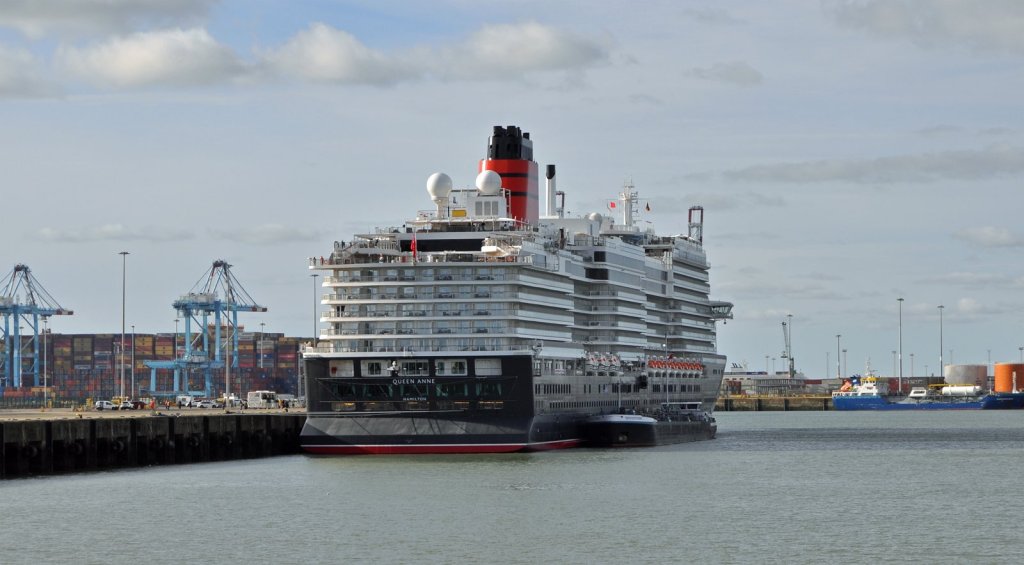
Queen Anne at Zeebrugge on 13 October 2024. Photograph by Marc Ryckaert, via Wikimedia Commons, CC BY 4.0. Resized and compressed for web display; no crop. Image source. Rights and reuse.
Queen Anne has to perform two demanding jobs at once. She must move thousands of people between ports, while supplying the accommodation, catering, ventilation and public spaces that make the voyage itself the product. The machinery cannot be understood separately from the hotel, and the hotel cannot be understood separately from the itinerary.
Cunard accepted delivery at Marghera on 19 April 2024. The maiden departure from Southampton followed on 3 May. Cunard identifies Queen Anne as its 249th ship, with hull ancestry in the Pinnacle class. Her historical branding sits above a thoroughly modern cruise-ship arrangement.
The most useful way to read her specifications is as a set of design choices. Installed power is a capability, service speed is an operating reference, and shore-power equipment is one part of a connection involving both vessel and port. None is a measurement of what happens on every voyage.
| Item | Builder’s published figure |
|---|---|
| Length overall | 322.3 metres |
| Moulded breadth | 35.60 metres |
| Scantling draught | 8.30 metres |
| Gross tonnage | 114,188 |
| Passenger cabins | 1,498 |
| Machinery | Four 12,600 kW generating sets; two 14,500 kW propulsion pods |
| Service speed | 18.3 knots |
Contents: Reading the dimensions · The electrical power system · Pods and manoeuvring · Accommodation and layout · Speed and schedules · Shore power in practice · Assessing efficiency · Related reading · Sources
Read the dimensions before comparing the ships
The figures in the table come from Fincantieri’s Queen Anne specification. Cunard also publishes rounded figures, including 113,000 gross tonnage and a length of 322.5 metres. These should retain their source labels rather than being assembled into a supposedly definitive hybrid specification.
The builder uses the older abbreviation GRT beside its gross-tonnage figure. Modern gross tonnage is calculated from enclosed volume under the International Convention on Tonnage Measurement of Ships. It is not the ship’s weight, payload or displacement. A large public interior increases enclosed volume without meaning that the vessel carries the same number of tonnes of material.
Moulded breadth and scantling draught also describe particular engineering boundaries. The latter is a design draught used in structural assessment, not a report of the draught observed on an individual sailing. Actual immersion depends on the vessel’s loading condition.
These distinctions become useful when comparing Queen Anne with older passenger ships. A higher gross tonnage does not by itself establish greater fuel consumption, deeper immersion or superior seakeeping. Those require different evidence. A specification table is the start of a comparison, not its conclusion.
Diesel-electric machinery joins transport and hotel demand
Fincantieri lists four 12V43C generating sets, each rated at 12,600 kW. Their arithmetic total is 50.4 MW. The two propulsion pods total 29 MW. Those are installed ratings, not a claim that the ship continuously generates 50.4 MW or consumes 29 MW in propulsion.
In a diesel-electric arrangement, diesel engines drive generators. Electricity then supplies propulsion motors and other consumers through the distribution system. Wärtsilä’s technical description of diesel-electric propulsion explains the separation between the generating engines and the propellers.
That separation allows machinery placement and operating combinations to be chosen around the ship’s needs. Generating engines do not have to turn at the propeller’s speed. The electrical system can serve both propulsion and accommodation, with the available generating plant managed to meet demand and required operating margins.
This flexibility comes with conversion equipment, controls and distribution arrangements that must themselves remain dependable. Multiple generating sets provide options for maintenance and load management, but the reliability of the whole plant also depends on switchboards, protection and supporting services.
It is tempting to subtract 29 MW from 50.4 MW and call the remainder the hotel load. That would be wrong. The subtraction only compares two installed capacities. Actual propulsion demand varies, generators need not all be running, and electrical losses and operating reserves matter. A measured hotel load would require operating data for a defined condition.
At sea, propulsion and hotel services compete for available power within the vessel’s operating limits. Alongside, propulsion demand largely disappears while many accommodation services continue. Diesel-electric machinery is valuable partly because these two operating conditions are so different.
Propulsion pods change how thrust is directed
Queen Anne’s two pods put the propulsion motors in units outside the main hull. Azimuthing pod systems can turn the thrust direction, combining propulsion with a substantial steering function. ABB’s description of podded propulsion explains the underlying arrangement.
For a cruise ship making frequent port calls, directional thrust is operationally useful. Manoeuvring is not confined to a long passage at steady speed. Arrival, departure and controlled movement near a berth are recurring parts of the voyage, with wind acting on a substantial above-water area.
The engineering trade-off is that the system includes large electrical machines, bearings, seals, control equipment and underwater units. Their inspection and maintenance requirements form part of the operating plan. Manoeuvrability should not be confused with freedom from weather or port restrictions.
Nor does pod power directly reveal stopping distance or turning performance. Those depend on loading, speed, water depth, control settings and environmental conditions. The published rating tells a reader what the installed propulsion motors can deliver at their rated condition; it does not replace a manoeuvring trial.
Accommodation is part of the engineering brief
The October 2024 deck plan shows how passenger cabins, restaurants, entertainment spaces and open decks occupy different parts of the ship. This distribution is more than a matter of interior decoration. It creates routes for people and services, concentrates demand at particular times and influences how the ship feels in daily use.
Cabins need reliable ventilation, water and drainage. Restaurants require food storage, preparation and service routes. Public rooms need sufficient circulation space when events end or meals begin. A ship’s passenger capacity therefore depends on much more than fitting beds inside a hull.
The Pavilion’s retractable roof is an especially clear example of design responding to an itinerary. An outdoor-style leisure area becomes more usable across changing weather conditions when it can be enclosed. The roof changes the relationship between the space and the weather; it does not remove the need to manage temperature, humidity and ventilation.
Accommodation demand also changes through the day. Catering activity, lighting and cooling needs do not necessarily peak together. The machinery must respond to this changing profile while maintaining essential services and passenger comfort.
Pinnacle-class ancestry provides a starting point for the vessel’s design, but it does not make every ship built from that lineage identical. Cunard’s room arrangement, accommodation categories and service expectations shape how the platform is used. Common ancestry can coexist with a distinct operating product.
Service speed belongs to a schedule
Fincantieri gives a service speed of 18.3 knots, while Cunard’s published material gives a maximum of 22 knots. A service figure and a maximum answer different questions. Neither should be used as a claim about the average speed of an entire cruise.
An itinerary allocates time between passages and port stays. If a ship spends longer alongside, the available passage time may become shorter. Recovering that time through higher speed can require a disproportionate increase in propulsion power. The IMO GreenVoyage2050 discussion of speed management identifies speed as an important influence on fuel demand.
There is no single universal percentage saving that can be assigned to Queen Anne from those published speeds. Weather, loading, route and machinery operation affect the result. Hotel services also consume energy over time, so a longer passage changes more than the propulsion calculation.
Queen Anne’s cruise-ship role should not be presented as an inability to cross oceans. The distinction from a liner concerns design emphasis and intended service, not a simple boundary between ocean-capable and coastal vessels. Cruise itineraries place considerable value on accommodation, destination access and varied passenger activities.
The practical question is how the ship’s available speed supports a particular programme without making unnecessary demands on fuel and machinery. A headline maximum describes a capability. A well-planned operating schedule determines how often that capability is needed.
Shore-power equipment does not prove a connection
Carnival’s 2024 sustainability report, page 12, lists Queen Anne’s shore-power equipment alongside exhaust-heat recovery, variable-frequency-drive chillers and galley ventilation measures. These identify installed features, not measured emissions for a particular visit.
Shore power allows electricity from land to supply shipboard demand while alongside. Its use depends on a suitable berth, compatible electrical and physical arrangements, sufficient supply and successful operational connection. The IMO’s shore-power explanation also makes clear that environmental performance depends partly on how the electricity is generated.
A useful documented example is Queen Anne’s Brooklyn call on 18 January 2025. The New York terminal connection log, page 2, records no connection. Its note states that compatibility was assessed on the ship’s first call and that she was deemed incompatible.
That entry establishes the outcome of that visit. It does not demonstrate a permanent defect, identify every technical reason or prove that later connections elsewhere were impossible. Extending a dated port observation into a universal judgement would discard precisely the operational detail that makes the log useful.
Three separate questions therefore matter: was equipment installed, could it work with this berth, and was it actually used? A sound account keeps all three visible. Even a successful connection would not make the ship’s entire voyage emission-free.
Judge efficiency by operating evidence
Heat recovery and variable-speed equipment address different parts of the energy balance. Recovering useful exhaust heat can displace heat that would otherwise have to be produced separately. Adjusting machinery speed to demand can avoid unnecessary operation at a fixed high output. The size of the benefit depends on conditions and control.
To assess Queen Anne’s performance rigorously, a reader would need a defined voyage or port stay, energy consumption, passenger occupancy and a clear emissions boundary. Per-passenger figures, total fuel figures and port air-quality effects are related measures, but they are not interchangeable.
Queen Anne is best understood as a coordinated transport and accommodation system. Her electrical machinery offers operational flexibility; her public spaces support varied itineraries; her environmental equipment creates opportunities for savings. Actual results emerge when those capabilities meet a real schedule, loading condition and port infrastructure.
Related reading
The RMS Queen Mary archive article provides historical context for Cunard’s passenger-ship identity. Comparing the purpose of accommodation and the demands of scheduled transport is more informative than treating gross tonnage as a measure of like-for-like performance.
Sources
- Fincantieri: Queen Anne technical particulars.
- Cunard: delivery of Queen Anne and Queen Anne in numbers.
- Cunard: October 2024 deck plan.
- Wärtsilä: diesel-electric propulsion; ABB: Azipod propulsion.
- IMO: tonnage measurement convention; speed management and shore power.
- Carnival Corporation: 2024 sustainability report, page 12.
- Cruise NYC: Brooklyn shore-power connection log, page 2.


