When war broke out in September 1939, Queen Mary was the fastest ship on the North Atlantic and one of the two largest. Within eight months she was carrying Australian soldiers. By 1946 she had moved troops across three oceans, carried a Prime Minister and thousands of prisoners, cut a British cruiser in two and brought home the wives and children of American servicemen.
Her value lay in a combination that no purpose built transport could match: speed, size and the internal organisation of a large passenger liner. This article follows how that civilian design was adapted, and what the surviving records say about each stage.
| Name | RMS Queen Mary; HMT Queen Mary in war service |
| Builder | John Brown & Co., Clydebank |
| Keel laid | 1 December 1930 |
| Launched | 26 September 1934, by Queen Mary |
| Maiden voyage | 27 May 1936, Southampton to New York |
| Length | 1,019½ ft (310.7 m) |
| Gross tonnage | About 81,000 |
| Machinery | 27 boilers, Parsons geared turbines, four screws |
| Service speed | 28.5 knots |
| War service | May 1940 to September 1946 |
| Largest load | 15,740 troops and 943 crew, July 1943 |
| Last voyage | Southampton to Long Beach, 31 October to 9 December 1967 |
A liner built for speed
Work on Queen Mary began at Clydebank on 1 December 1930. The Depression stopped it on 11 December 1931, and the unfinished hull stood idle until 3 April 1934. Queen Mary launched the ship on 26 September 1934, and Cunard White Star took delivery on 12 May 1936.
She left Southampton on her maiden voyage at 16:33 on 27 May 1936 and reached New York on 1 June. In August 1936, on her sixth round voyage, she took the Blue Riband for the fastest Atlantic crossing from the French liner Normandie. She lost it the following year, won it back in August 1938 and held it until SS United States took it in 1952.
Her 27 boilers fed Parsons single reduction geared turbines driving four screws, for a service speed of 28.5 knots. That speed was the reason the Admiralty wanted her. A ship that could outrun a submerged U-boat could cross without waiting for a convoy.
Laid up in New York, rebuilt in Sydney
Queen Mary reached New York in the first days of September 1939 and was held there. She sailed on 21 March 1940 without passengers, by way of Trinidad, Cape Town and Fremantle, and arrived in Sydney on 16 April.
Cockatoo Docks & Engineering refitted her there. Furniture, carpets and artwork went ashore into store. Bunks and hammocks went into cabins and public rooms, and the ship’s capacity rose from 2,140 passengers to about 5,500 troops. She was armed with an old 6-inch gun, and anti-aircraft guns and Oerlikons were added as the war went on.
The guns needed trained crews. The Naval Historical Society of Australia records Petty Officer Arthur Dawn Tate joining as the first Australian gunlayer on 3 May 1940 and serving until 1 March 1943. On the North Atlantic run she later carried a Lieutenant Commander RNVR as gunnery officer and some seventy naval gunners, with Tate still among them.
The work was finished on 3 May. Her first troop voyage left Sydney the next day in convoy US3 with Andes, Aquitania, Empress of Britain, Empress of Canada, Empress of Japan and Mauretania. The convoy was diverted by way of the Cape and arrived off Gourock, at the mouth of the Clyde, on 16 June 1940, after 43 days.

Trooping in the Indian Ocean
For most of the next year Queen Mary worked from Australia. She was dry docked at Singapore from 5 August to 16 September 1940. In January 1941 she sailed from Fremantle to Trincomalee with Queen Elizabeth and Aquitania under cruiser escort, a passage recorded in a painting by Frank Norton held by the Australian War Memorial.
On 18 February 1941 she landed about 5,750 men of the Australian 8th Division at Singapore, including the 22nd Brigade. A memorial photograph shows them being received by Lieutenant General L. V. Bond and the Governor, Sir Shenton Thomas.
The memorial also holds Major A. E. Reed’s report on her fifth voyage, from 6 April to 17 June 1941, between Australia and the Middle East. Reports of this kind show trooping for what it was: a continuous administrative effort of embarkation, feeding, discipline and disembarkation, voyage after voyage.
The American troop lift
After Pearl Harbor her work shifted to American troops. She sailed from Boston on 18 February 1942 with 8,398 troops and 905 crew and reached Sydney on 28 March. In May 1942 she carried 9,880 troops, and in August 15,125 troops of the 1st Armored Division with 863 crew.
Loads on that scale depended on routine as much as on space. Feeding, washing, boat drill and simple movement around the ship had to be scheduled for thousands of men at once, with the original kitchens, stairways and passageways of a liner built for about 2,100 passengers.
The highest figure came on the eastbound crossing of 25 to 30 July 1943: 15,740 troops and 943 crew, 16,683 people in all. That total includes the crew. It is the largest number of people carried in one ship, not the normal load of every voyage.
The loss of HMS Curacoa
On 2 October 1942 Queen Mary was approaching the Clyde with about 11,000 American troops. The anti-aircraft cruiser Curacoa had joined that morning to cover the last stage. The liner was following zigzag pattern No. 8 and making good about 26.5 knots. Curacoa, with a top speed of about 25 knots, was trying to keep station ahead of her.
The two ships were converging slowly on almost parallel courses, and neither bridge recognised the danger until a minute or two before impact. Shortly before 14:12, about 40 miles north of Tory Island, Queen Mary struck Curacoa on the port side near the stern and cut her in two. The cruiser sank almost at once.
The 1949 naval account used here gives 331 dead out of a crew of 430. Other published counts range up to 338, and the Maritime Archaeology Trust paper listed below gives 239, which appears to be an error.
The civil case took more than six years. When the Admiralty sued Cunard White Star, Mr Justice Pilcher held in January 1947 that Curacoa alone was to blame. The Court of Appeal changed that in July 1947 to two thirds Curacoa and one third Queen Mary, and the House of Lords upheld the apportionment on 8 February 1949. The accounts agree on what happened; the courts were deciding how responsibility should be shared.
Queen Mary continued to the Clyde with her bow crushed. About seventy tons of cement were used to patch it at Gourock. She then crossed to Boston, where a new bow was fitted between 14 October and 2 November 1942.

The long voyage and the Atlantic shuttle
Between 23 December 1942 and 22 April 1943 she made what the ship’s own chronology calls the long voyage: from Gourock round the Cape to Suez, on to Sydney and back. It was her last major Indian Ocean deployment.
She then went back to the Atlantic. From 5 to 11 May 1943 she carried Winston Churchill from Gourock to New York for talks with President Roosevelt, with about 5,000 German prisoners of war also aboard. He crossed in her again from 5 to 9 August 1943, this time to Halifax on his way to the Quebec Conference.
Bringing people home
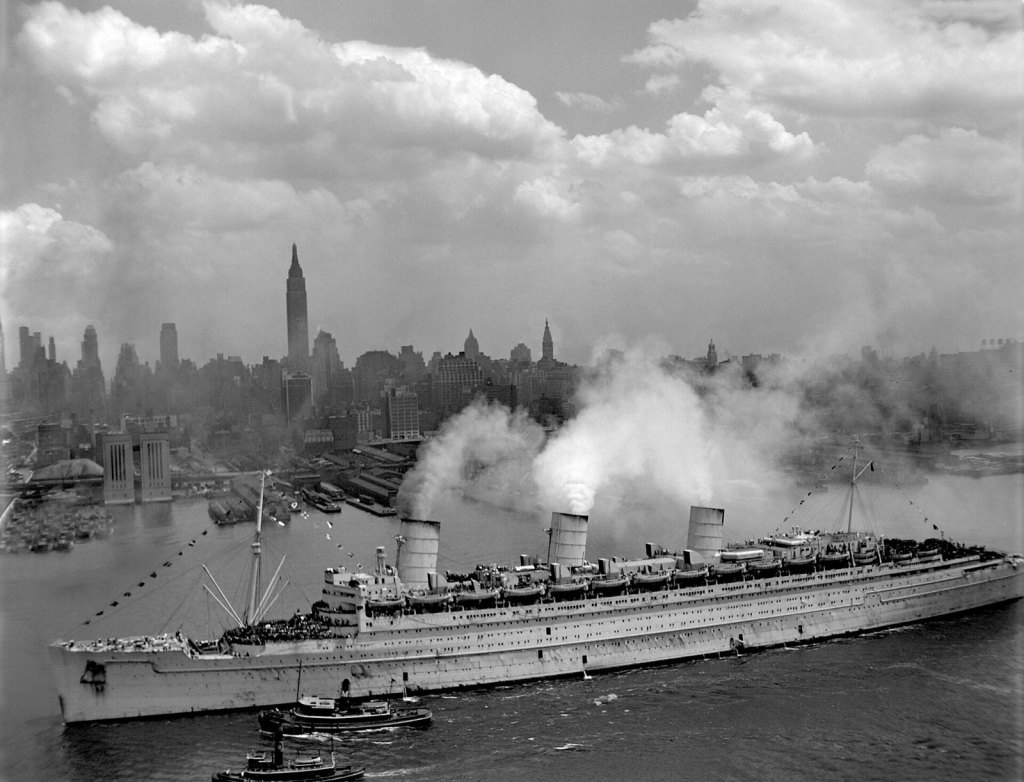
Victory in Europe reversed the direction of traffic. On 20 June 1945 a US Navy photographer recorded her arriving in New York with thousands of returning troops, her decks lined with men.
The war brides followed. SS Argentina carried the first party from Southampton on 26 January 1946, and Queen Mary sailed with the next in February. Her six voyages between 3 February and 19 May 1946 carried 12,886 wives and children to New York, and further voyages to Canada followed between May and September.
Her last military voyage ran from 24 to 27 September 1946. The ship’s chronology credits her with about 810,000 military passengers during the war.
Back to Cunard, then to California
Restoration at Southampton ran from February to July 1947, and she returned to commercial service on 31 July 1947. The furniture and fittings stored in 1940 had to be found, repaired and refitted alongside new work.
Air travel ended the express liner trade. Queen Mary was sold to the City of Long Beach for 3.45 million dollars and left Southampton for the last time on 31 October 1967. She arrived at Long Beach on 9 December 1967, having carried about 2.2 million passengers in peacetime.
The ship at Long Beach is therefore several ships in one hull. Her public rooms reflect 1936 and the 1947 restoration, her hull carries the bow fitted at Boston in 1942, and much of her later fitting out dates from her years as a hotel and museum.

Timeline
| Date | Event |
|---|---|
| 1 December 1930 | Keel laid at Clydebank. |
| 26 September 1934 | Launched by Queen Mary. |
| 27 May 1936 | Maiden voyage from Southampton. |
| 21 March 1940 | Leaves New York for Sydney. |
| 4 May 1940 | First troop voyage leaves Sydney. |
| 18 February 1941 | Lands Australian 8th Division troops at Singapore. |
| 2 October 1942 | Collision with HMS Curacoa, which sinks with heavy loss of life. |
| 25 to 30 July 1943 | Carries 15,740 troops and 943 crew. |
| 20 June 1945 | Arrives in New York with returning troops. |
| 3 February 1946 | First of six war bride voyages to New York. |
| 31 July 1947 | Returns to commercial service. |
| 9 December 1967 | Arrives at Long Beach after her last voyage. |
Sources and further reading
- The Queen Mary, Ship History. Construction, war service, war brides and retirement.
- The Queen Mary, Timeline, Stats and Fun Facts. Voyage dates, troop and crew figures, repair dates.
- The Queen Mary, Ship comparison. Dimensions, tonnage, machinery and speed.
- Naval Historical Society of Australia, Queens at War. Sydney conversion, armament and Australian gun crews.
- Australian War Memorial, HMT Queen Mary, painting by Frank Norton. Fremantle to Trincomalee, January 1941.
- Australian War Memorial, Arrival at Singapore, 18 February 1941. Official photograph and caption.
- Australian War Memorial, Major A. E. Reed, report on the fifth voyage, AWM54 963/14/6. Digitised official record.
- Navigation and Direction Bulletin, December 1949, The collision between HMS Curacoa and RMS Queen Mary, reproduced by commsmuseum.co.uk. Courses, speeds, casualties and the court judgments.
- Roger Burns, The Ships of Operation War Bride, Maritime Archaeology Trust. Sailings from Southampton, 1946.
- Wikimedia Commons, US Navy photograph, New York, 20 June 1945. National Archives identifier 521011.
Image credits. Featured image: Queen Mary arriving in New York on 20 June 1945 with thousands of American troops returning from Europe. US Navy photograph. Photo: US Navy, National Archives, Wikimedia Commons, Public domain. Other photographs are credited in their captions.
Have a correction or a photograph that helps identify this ship? Contact contact@shipsarchive.com.