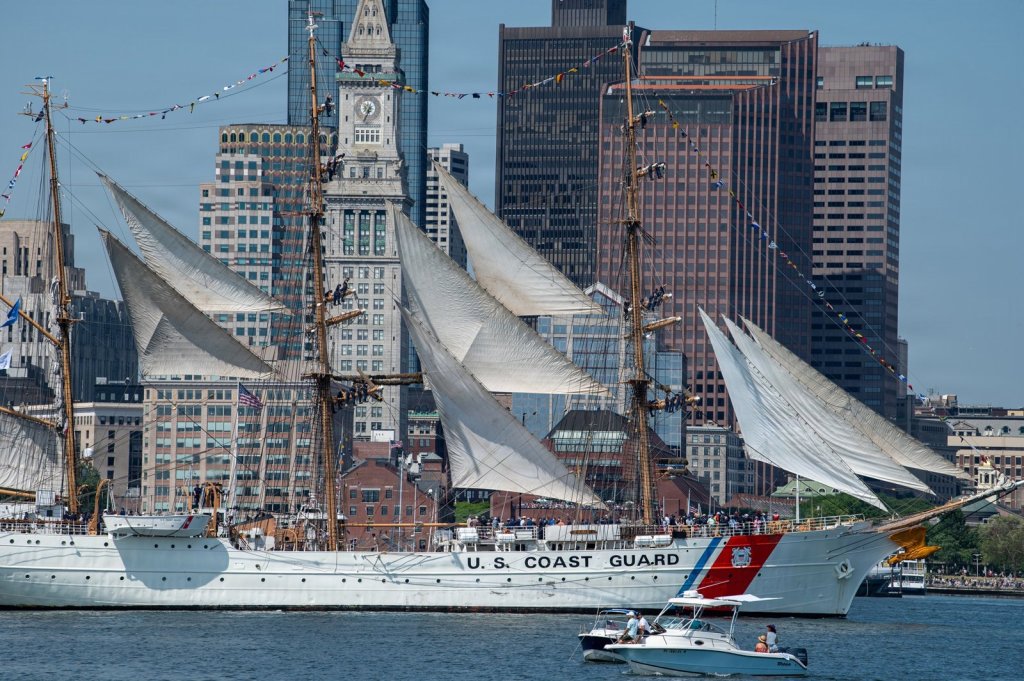
USCGC Eagle in Boston Harbour during the Sail250 parade on 11 July 2026. U.S. Coast Guard photograph by Petty Officer 3rd Class Alexander Gray, via DVIDS. Public domain. Resized and compressed for web display; no crop. Image source. Rights and reuse.
The appearance of U.S. Department of War (DoW) visual information does not imply or constitute DoW endorsement.
On a modern ship, a single control can conceal a complicated sequence of machinery responses. Aboard USCGC Eagle, much of the work remains visible. People handle lines, yards turn, sails change shape and the ship responds to the combined effect of wind, water and coordinated action.
That visibility gives the barque a training purpose beyond preserving traditional seamanship. Cadets can connect an order with its execution, observe the consequences and discover why a team must share the same understanding before a manoeuvre begins. The rig makes interdependence tangible.
Eagle is also a working Coast Guard vessel with a long and difficult historical inheritance. Built in Germany in 1936, she entered United States Coast Guard service in 1946. Her educational role now combines a historic sailing platform with contemporary navigation, machinery and safety responsibilities.
| Item | Coast Guard record |
|---|---|
| Length | 295 feet, as listed by the Academy |
| Rig | Three-masted barque |
| Sail plan | 23 sails; 22,227 square feet of sail area |
| Rigging | Approximately six miles |
| Builder and original name | Blohm & Voss, Hamburg, 1936; Horst Wessel |
| Coast Guard commissioning | 15 May 1946 |
| Home port | New London, Connecticut |
Contents: Why the barque rig matters · Handling the working rig · Watchkeeping and judgement · Cadet responsibility · A maintained historic vessel · Sail250 in retrospect · The limits of the classroom · Related reading · Sources
Why the barque rig matters
Eagle’s foremast and mainmast carry square sails, while the mizzen is rigged with fore-and-aft sails. That combination defines the three-masted barque arrangement. The term square refers to the sail’s relationship to its yard and the rig, rather than requiring each sail to be a geometrically perfect square.
The Coast Guard Academy’s current particulars give 23 sails and 22,227 square feet of sail area. These figures describe the sail plan, not a requirement to carry every sail in every condition. Sail selection is part of managing the ship.
The rig offers several related lessons. Sail area affects the forces available, but the direction of those forces depends on wind and trim. The distribution of sail also matters because the ship must remain balanced and controllable, not merely driven forward.
An officer cannot reduce sailing to an instruction to add more canvas. More force may increase speed, but it also changes loads and can make control more demanding. Reducing or rearranging sail can be the more useful response when conditions change.
This gives cadets a direct encounter with a broader maritime principle: useful power is power that can be controlled within the vessel’s circumstances. The same judgement is relevant when the power comes from machinery rather than wind.
Standing and running rigging do different work
Standing rigging supports the masts and resists the loads imposed on them. Running rigging consists of the lines used to control sails and yards. Confusing the two obscures the basic arrangement: some parts hold the system in position, while others allow the crew to alter it.
Bracing turns a yard to change its angle relative to the ship. Sail handling includes setting, adjusting and taking in canvas. Furling secures a sail after it has been taken in. These are related operations, but they are not interchangeable names for pulling a rope.
The Nautical Institute’s international sail-training handbook provides general context for the skills involved. It should not be read as evidence that Eagle operates under another organisation’s certification scheme.
On a large rig, the sequence matters as much as the effort. A line may need to be eased while another is hauled. People at separate positions must understand which movement is intended and when to begin or stop. Uncoordinated strength cannot substitute for a shared plan.
This is an explanation of the training principle, not a set of instructions for an unsupervised sail evolution. Actual handling depends on the vessel’s procedures, conditions and professional supervision. The risk associated with loaded lines and work aloft makes that distinction essential.
The educational benefit is that communication has a visible result. An unclear order may produce hesitation or conflicting action. A clear order, understood and confirmed, allows several people to contribute to one controlled movement. Cadets learn that leadership includes listening for evidence that the team is ready.
Watchkeeping connects the rig to the wider situation
Sail handling is only one part of operating Eagle. The ship still needs a continuous navigational watch, a reliable understanding of position and a plan for nearby traffic, changing weather and restricted water. A well-trimmed rig does not make an unsafe course acceptable.
The Academy’s nautical-science curriculum places seamanship within a progression of professional learning. Practical experience gives students a setting in which classroom concepts have consequences: a course must be followed, a change detected and a developing situation communicated.
At the helm, there is a difference between the requested heading and the ship’s actual response. Wind, waves and the vessel’s momentum affect how that response develops. Learning to observe those effects is more useful than imagining that a helm order acts immediately and in isolation.
Watch relief adds another lesson. The person taking over needs more than a position on a chart. They need to understand what the ship is doing, what has changed and what deserves attention next. Continuity depends on passing an operational picture, not simply exchanging places.
Fatigue and repetition are also part of a seagoing environment. A task can remain important after it has become familiar. The point of repeated watchkeeping is to build dependable habits without allowing routine to replace active observation.
These principles transfer to powered cutters. The controls and equipment differ, but officers still have to evaluate information, anticipate vessel response and communicate before a small uncertainty becomes a larger operational problem.
Responsibility changes as cadets progress
The Academy’s description of the Eagle experience distinguishes the roles of junior and senior cadets. Underclass cadets undertake work normally associated with the enlisted crew, including helm watch. Upperclass cadets take leadership responsibilities comparable to those of junior officers.
That progression gives future officers experience from both sides of an order. A cadet who has carried out demanding deck work can better understand the preparation, time and clarity needed when later coordinating others. The training value is strongest when responsibility remains connected to real understanding of the task.
Professional crew and instructors are central to the arrangement. Cadet leadership does not turn the ship into an unsupervised exercise. Expertise is needed to set boundaries, correct errors and help trainees explain why an operation succeeded or became difficult.
There is an important difference between participation and responsibility. Being present during an evolution does not ensure that every trainee understood it. Effective learning requires a recognisable contribution and feedback on that contribution, rather than assuming that a busy deck automatically produces capable officers.
The barque makes that question unusually visible. Many hands can complete a task, but instructors must still determine whether individuals can identify their own role and explain how it fitted into the whole operation.
Historic appearance depends on modern maintenance
The Coast Guard Historian’s account records Eagle’s construction as Horst Wessel at Blohm & Voss in Hamburg in 1936 and her Coast Guard commissioning on 15 May 1946. That origin belongs in the ship’s history; her later service should not erase it.
Continuing to train at sea requires renewal as well as preservation. The Coast Guard’s 2018 service-life extension announcement records major work that included propulsion replacement.
The Coast Guard Yard’s 2023 report identifies an MTU replacement installed in 2018. Consequently, an older engine list naming Caterpillar cannot simply be copied as a verified description of the current plant.
Further work during October 2024 to January 2025 is described in the summer 2025 logistics newsletter. Maintenance records provide a better basis for describing a working historic vessel than an undated specification repeated across secondary sites.
Auxiliary propulsion does not undermine the purpose of sail training. It gives the ship another means of operation when the circumstances call for it. A training platform must reach ports, support its programme and operate safely; historical authenticity is not a reason to disregard those obligations.
Sail250 was a completed 2026 programme
Eagle’s announced Sail250 calls included New Orleans, Norfolk, Baltimore, New York City and Boston. By October 2026, these were past events, not an upcoming itinerary for visitors to follow.
The Coast Guard’s completion report of 17 July 2026 states that the wider celebration concluded on 16 July. It credits Eagle with approximately 60,000 visitors across the five ports. That is a service-reported total, not an independently audited attendance figure.
The public role is distinct from, but connected to, training. Visitors encounter an operating ship and its crew rather than a static representation of maritime work. For trainees, public engagement creates another occasion to explain what the vessel does and why it remains in service.
However, attendance is not a measure of educational effectiveness. A successful public programme shows reach. Assessing training requires evidence about the responsibilities cadets undertook and the skills they developed. The two purposes can support each other without being measured in the same way.
The ship provides opportunities; the programme determines their value
In a January 2026 Proceedings essay, Teegan Cordova argued for smaller trainee groups, greater individual responsibility and more sustained opportunities to learn from the professional crew. These were the author’s recommendations, not an announcement of adopted Coast Guard policy.
The argument raises a useful question for any practical training platform: how much meaningful work does each trainee actually perform? A large group can distribute effort efficiently, but it can also make individual participation difficult to assess. More time aboard is not automatically more responsibility.
Eagle’s case for continued use therefore rests on the quality of the learning she enables. The rig exposes teamwork, judgement and the consequences of orders in a direct way. Instructors can connect those experiences to the responsibilities of officers who will later use very different technology.
The enduring lesson is not that older machinery is inherently a better teacher. It is that a well-run sailing vessel makes relationships between people, forces and decisions unusually clear. Eagle remains valuable when those visible relationships become habits of observation and accountable leadership that cadets carry into the rest of their service.
Related reading
The Cutty Sark archive article offers a useful contrast between a preserved commercial sailing ship and a barque maintained for active training. Their rigs belong to related traditions, but their present-day purposes create different conservation and operating choices.
Sources
- Coast Guard Academy: Eagle particulars, training experience and nautical-science curriculum.
- Coast Guard Historian: Eagle.
- Nautical Institute: International Sail Endorsement Scheme handbook, general sail-training context.
- Coast Guard: 2018 service-life extension; Coast Guard Yard report, 2023; logistics newsletter, summer 2025.
- Coast Guard: Sail250 completion report, 17 July 2026.
- Teegan Cordova: The Benefits of the Barque, Proceedings, January 2026.

