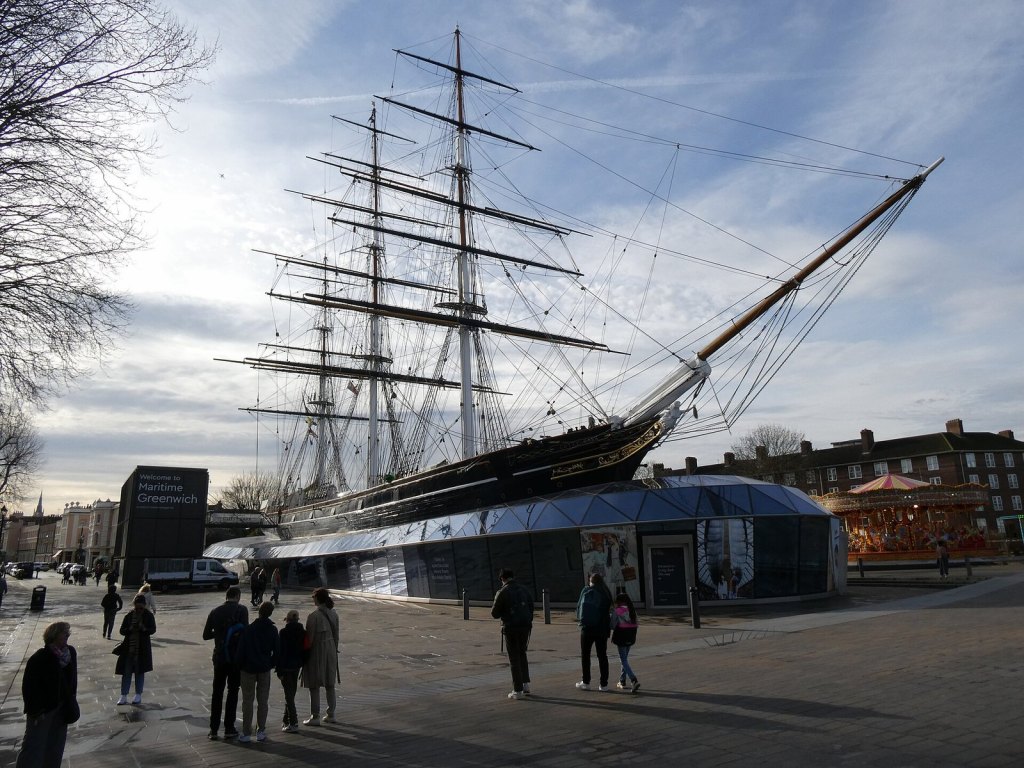
Cutty Sark was built in 1869 to bring tea from China to London as fast as possible. She is remembered as a tea clipper, but her best passages came later, carrying wool from Australia. She then worked for 27 years under the Portuguese flag before being saved, restored and placed in a dry berth at Greenwich.
Royal Museums Greenwich, which cares for her, describes her as the world’s sole surviving tea clipper. Her history is well documented through the museum’s records, its histories of her captains, and the register of National Historic Ships UK.
| Owner | John Willis, London |
| Designer | Hercules Linton |
| Builder | Scott & Linton, Dumbarton; completed by creditors |
| Launched | 22 November 1869 |
| Construction | Composite: iron frame, teak and rock elm planking |
| Hull sheathing | Copper and zinc alloy |
| Gross tonnage | 963 |
| Hull length | 212.5 ft (64.8 m) |
| Beam | 36 ft (11 m) |
| Sail area | 32,000 sq ft (2,976 m²), 32 sails |
| Main mast | 152 ft (47 m) |
| Later names | Ferreira, 1895 to 1922; Maria do Amparo, 1922 to 1923 |
| Location | Dry berth, Greenwich, since 1954 |
Built for a race
Tea had become a mass commodity in Britain by the mid-19th century. After the Opium Wars opened more Chinese ports, a fashion grew for the first tea of each season. The first ship home could command the best prices, and a premium of 10 shillings a ton was paid on the winning ship’s cargo.
John Willis wanted the fastest cargo ship afloat. He gave the contract to Scott & Linton of Dumbarton, a new and inexperienced firm. Delays bankrupted the builders, and the ship had to be finished by a group of creditors. She cost £16,150.
Hercules Linton gave her a sharp bow, a narrow hull and a very large sail plan. The hull was composite, with teak and rock elm planking fixed to an iron frame and sheathed below the waterline in copper and zinc alloy. The rigging used wire instead of rope. She could carry about 10,000 tea chests.
The name comes from Robert Burns’s poem Tam o’ Shanter. A cutty sark is a short undergarment worn by Nannie, the young witch who chases Tam. Nannie is the ship’s figurehead. The present figurehead, carved by Andy Peters, was fitted on 11 June 2021.

The tea years
The Suez Canal opened in the same week as her launch. It cut more than 3,000 miles from the voyage to China for steamships, but sailing ships could not use it well because of the winds and the tolls. Royal Museums Greenwich records that nearly 60 sailing ships made the China voyage in 1870, and only nine by 1877.
On her first voyage she left London in February 1870 for Shanghai. The museum’s history gives 15 February and its fact sheet 16 February. She loaded 1,305,812 lb of tea and returned to London on 13 October. She made eight tea voyages in all, collecting her last Chinese tea cargo in 1877, and she never became the fastest ship in that trade.
The rudder of 1872
Her best-known tea passage was against Thermopylae in 1872. Near the Cape of Good Hope she lost her rudder in a storm. Robert Willis, the owner’s brother, ordered Captain George Moodie to put into Cape Town for repairs. Moodie refused and had a temporary jury rudder made and fitted at sea.
The carpenter, Henry Henderson, built it. A photograph of 1872 in the museum’s archive shows him standing over the rudder he made. The ship reached London about a week behind her rival. Robert Willis complained to his brother, and Moodie resigned.
Between tea and wool
After the tea trade, the ship took whatever cargo she could find. Her captains in these years had mixed fortunes. William Tiptaft died of dysentery at Shanghai in 1878. His successor, James Wallace, took his own life at sea in 1880, after allowing a mate accused of killing a crewman to escape. William Bruce lost the confidence of his crew and had his certificate suspended after an inquiry at New York.
Frederick Moore then took command and found the ship badly in need of repair. A folder of accounts from 1882 to 1884 in the museum’s collection records calls at Samarang, Madras and Cocanada, along with towage, supplies and repairs. It also notes that this Moore was not the Francis Moore who had commanded on the 1872 to 1873 voyage.
The wool trade
In 1883 the ship entered the Australian wool trade under Frederick Moore. She left Newcastle, New South Wales, in December 1883 with wool and tallow and reached London in March 1884. The passage of 83 days was the best of the year, beating every ship that sailed at about the same time by 25 days or more.

Richard Woodget took command in 1885. To reach the strongest winds on the homeward run by Cape Horn, he sailed further south than earlier masters, accepting icebergs and severe gales. In 1886 he brought the ship from Sydney to London in 73 days, a passage the museum describes as record-breaking.
For the best wool passage of 1885, Willis awarded the ship a masthead vane cut from steel in the shape of a shirt, a cutty sark. Originally gilded, it was fitted at the main truck and is now in the museum’s collection. Woodget also took up photography, and his pictures are an important record of life aboard.
More than 650 men from over 30 nations served in the ship. An average voyage carried 28 crew, sometimes as few as 19. The oldest recorded sailor was 56 and the youngest was 14.
Ferreira
Steamers moved into the wool trade in the 1890s, and in 1895 Willis sold the ship to a Lisbon company, which renamed her Ferreira. She carried general cargo between Portugal, its African colonies, South America and the southern United States.
In late April 1916 she left Lourenço Marques with coal for Mossamedes, with a crew of only 18. From 1 May she met storms off South Africa, and the coal shifted repeatedly. Captain da Sousa had to cut away most of the masts and rigging. A steamer towed her into Table Bay on 14 May 1916.
The passing steamer Kia Ora, bound for Sydney, declined to tow her and advised the captain to scuttle the ship. Da Sousa refused. Two days later, as she drifted towards Cape Agulhas, another steamer took her in tow. His log names it as the Blue Funnel Line’s Indraghira, then known as Eurylochus.
Repairs were estimated at £2,250, against an insured value of £700. With wood for masts and yards scarce in wartime, the owners re-rigged her as a barquentine, which needed fewer yards and fewer crew. She did not leave Table Bay until January 1918.

Return to Britain
In 1922, after the ship had put into Falmouth for repairs, the retired sea captain Wilfred Dowman recognised her. He and his wife Catharine bought her, paying more than she had been worth in 1895. Her name was restored in 1923, and in 1924 she reopened at Falmouth as a cadet training ship and visitor attraction.
After Dowman’s death, Catharine Dowman gave the ship in 1938 to the Incorporated Thames Nautical Training College at Greenhithe, where she served as a training ship until after the Second World War. In 1952 Frank Carr, Director of the National Maritime Museum, formed the Cutty Sark Preservation Society, with the support of the Duke of Edinburgh.
In 1954 the ship was towed into a specially built dry dock at Greenwich. After restoration she was opened to visitors by the Queen in 1957. The stern decoration fitted then was based on the 1872 photograph and sketches by Linton, with some conjecture.
That decoration had changed several times. Linton’s first design, showing Nannie with devils playing bagpipes, was thought too risqué and abandoned early. As Ferreira the stern carried only her name, her port and a gilded star. At Greenhithe it had a new design by Sir Geoffrey Callender. The present carving is by Tommy Turner of R. H. Green & Silley Weir.
Fire and conservation
By the 1990s the hull had serious structural problems. A conservation project began in 2006, supported by a Heritage Lottery Fund grant of £13 million, and much original material was removed for treatment. In May 2007 fire swept through all three decks. Because so much fabric had already been taken off, little original material was lost.
The Queen reopened the ship on 25 April 2012. To preserve the shape of the hull, she was raised three metres above the floor of the dock, so visitors can walk beneath her.
Timeline
| Date | Event |
|---|---|
| 22 November 1869 | Launched at Dumbarton |
| February 1870 | Sails on her first voyage to Shanghai |
| 1872 | Loses her rudder racing Thermopylae; jury rudder fitted at sea |
| 1877 | Loads her last Chinese tea cargo |
| December 1883 | Sails from Newcastle, NSW, with her first wool cargo |
| 1885 | Richard Woodget takes command |
| 1886 | Sydney to London in 73 days |
| 1895 | Sold to Portuguese owners and renamed Ferreira |
| May 1916 | Dismasted off South Africa; later re-rigged as a barquentine |
| 1922 | Bought by Wilfred Dowman |
| 1923 | Name Cutty Sark restored |
| 1938 | Given to the Thames Nautical Training College |
| 1954 | Moved into dry dock at Greenwich |
| 1957 | Opened to the public |
| May 2007 | Fire during conservation work |
| 25 April 2012 | Reopened after conservation |
Sources and further reading
- Royal Museums Greenwich, History of Cutty Sark.
- Royal Museums Greenwich, Cutty Sark and the tea trade.
- Royal Museums Greenwich, Cutty Sark facts pack.
- Royal Museums Greenwich, Cutty Sark, object ZBA7518.
- National Historic Ships UK, Cutty Sark, register entry 438.
- Royal Museums Greenwich, Cutty Sark’s stern gingerbread, 17 July 2018.
- Royal Museums Greenwich, A history of Cutty Sark in 10 pictures.
- Royal Museums Greenwich, Ephemera relating to voyages of Cutty Sark, LUB/12.
- Royal Museums Greenwich, Cutty Sark’s mast and rigging.
- Royal Museums Greenwich, Meet the captains of Cutty Sark.
- Royal Museums Greenwich, Cutty Sark emblem, ZBA7752.
Image credits. Featured image: Cutty Sark in her dry berth at Greenwich in February 2024. Photo: Gareth James, Wikimedia Commons, CC BY-SA 2.0. Other photographs are credited in their captions.
Have a correction or a photograph that helps identify this ship? Contact contact@shipsarchive.com.


.jpg)
