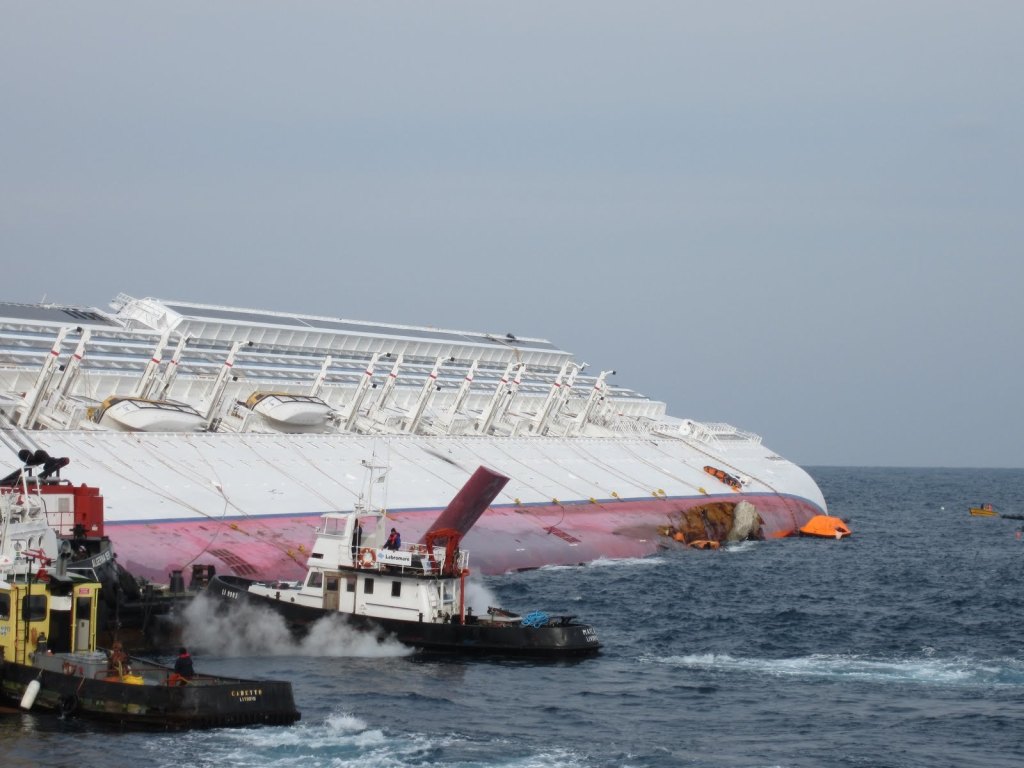
Costa Concordia was lost through a navigational decision, not a structural failure. On the night of 13 January 2012 she was taken close to the island of Giglio at about 15.5 knots and struck a rock that opened five adjacent watertight compartments, flooding the spaces that held her generators and propulsion motors. Thirty two people died. The wreck that settled on the island’s rocky shelf then became the subject of the largest passenger ship salvage ever attempted, which removed the hull in one piece. The hull was towed to Genoa in July 2014 and entered the final dry dock in September 2016; dismantling and recycling were completed in July 2017.
Contents
| Name | Costa Concordia |
| Type | Cruise ship |
| IMO number | 9320544 |
| Operator | Costa Crociere |
| Builder | Fincantieri, Sestri Ponente, Genoa |
| Delivered | 30 June 2006 |
| Gross tonnage | About 112,000 (builder’s figure) |
| Length overall | 290 metres |
| Beam | 35.5 metres |
| Passenger cabins | 1,502 |
| Casualty | 13 January 2012, Isola del Giglio, Tuscany |
| People aboard | 4,229: 3,206 passengers and 1,023 crew |
| Deaths | 32 |
| Wreck removal | Titan Salvage and Micoperi, for Costa Crociere |
| Dismantling | Saipem and San Giorgio del Porto, Genoa; completed July 2017 |
A ship built for scale
Fincantieri delivered Costa Concordia from its Sestri Ponente yard in Genoa on 30 June 2006, and she was christened at Civitavecchia the following week. The builder’s figures give a gross tonnage of about 112,000, a length of 290 metres, a beam of 35.5 metres and 1,502 passenger cabins. At delivery she was the largest passenger ship under the Italian flag. Her diesel electric plant was arranged in a row of watertight compartments along the lower hull, with generators, propulsion motors and their transformers and pumps grouped close together. As the investigators later found, that grouping governed how much of the ship a single breach could disable.
The grounding
On 13 January 2012 the ship left Civitavecchia for Savona with 4,229 people aboard. The Italian Marine Casualties Investigative Body found that the master had planned to pass Giglio at an unsafe distance, at night and at high speed, about 15.5 knots, in good weather. The danger was recognised too late. At 21:45:07 local time the port side struck the rocks known as Le Scole. Speed fell to about 8 knots and both propulsion motors were lost.
Watertight compartments 4 to 8 flooded. Between them they held the main thrust bearings, the propulsion motors, all six main diesel generators and the ballast and bilge pumps. The ship had been designed to survive flooding of two adjacent compartments; five was far beyond that standard. The emergency generator started but could not reliably supply the systems needed, and the rudder remained jammed hard to starboard. Carried by wind and current, the ship turned and grounded off Giglio Porto at around 23:00, already heeling about 15 degrees.
The report records the delay that followed. The seriousness of the flooding was reported to the master after about 16 minutes, but the general emergency alarm was not raised until 22:33:26, and the order to abandon ship was broadcast at 22:54:10. By then the list was increasing and lifeboats on the high side could not be launched easily. Thirty two people died. The final missing victim, Russel Rebello, was found aboard the wreck in Genoa in November 2014. The master, Francesco Schettino, was later convicted of manslaughter and sentenced to 16 years in prison.
Securing the fuel first
The wreck lay on its starboard side on a rocky shelf inside a marine protected area, with about 2,400 tonnes of heavy fuel oil in its tanks. Removing that fuel came before any decision about the hull. SMIT Salvage, working with the Italian firm Tito Neri, deployed more than 2,000 metres of booms, tapped into the tanks and pumped the oil to a reception vessel. The work was completed on 24 March 2012, and SMIT stayed on site as caretaker until the wreck removal contract was let, demobilising on 26 June 2012.
On 21 April 2012 Costa Crociere awarded the removal contract to a consortium of the American salvor Titan, then part of Crowley Maritime, and the Italian offshore contractor Micoperi, with Nick Sloane as salvage master. The plan was to take the ship away in one piece rather than cut it up where it lay.
Building a foundation under the sea
The hull was resting on two underwater granite outcrops. They held it up, but they also crushed parts of the starboard side, and beyond them the seabed fell away steeply. The first task was to stop the wreck sliding down that slope and to give it something to stand on once it was rotated. The Trevi group carried out the ground investigations between June and August 2012 and then, from August 2012 to September 2013, the drilled foundations for anchor blocks that formed the hold back system and for the towers used in the rotation.
Six steel platforms were installed on the seabed beneath the position the upright hull would occupy, forming a false bottom. The rotation would be driven by 36 strand jacks, hydraulic units that haul in steel cables, with a combined pulling capacity of about 13,000 tonnes. The cables ran from the exposed port side of the hull, under the wreck, to anchor points on the platforms. A severe winter at Giglio, the worst in nearly 50 years according to Crowley, put the programme well behind schedule.
What the sponsons did
On 3 July 2012 Fincantieri won the contract to build 30 steel caissons, known on site as sponsons, with a combined weight of about 11,500 tonnes. The largest weighed about 800 tons and the tallest stood as high as an eleven storey building. They did two different jobs at two different stages. Before the rotation, 11 sponsons were welded to the exposed port side. Filled with water as the hull turned, they added weight on the rising side and helped bring it down onto the platforms in a controlled way.
After the rotation, 15 more were fitted to the starboard side, which had been inaccessible while the ship lay on it, and four more to the port side. When all 30 were pumped out with compressed air, they provided the buoyancy that the damaged hull could no longer give. The wreck was never made watertight again. It floated because of the steel boxes on its sides.
Parbuckling, 16 and 17 September 2013
Parbuckling, the controlled rotation of a capsized hull, began at 09:00 on 16 September 2013. For the first hours the strand jacks did the work, overcoming the hull’s adhesion to the rock and the deformation of its starboard side at rates of a few degrees an hour. As the rotation went on, the water filling the port side sponsons took over more of the load. After 19 hours and a rotation of about 65 degrees, the ship came to rest upright on the platforms in the early hours of 17 September.

The European Maritime Safety Agency supplied satellite radar images of the area during the operation at the Italian Coast Guard’s request; no spills were detected. Upright did not mean afloat. The hull still stood on the false bottom, badly deformed in two places, and it had to be made secure against the winter of 2013 to 2014. That work was completed in December 2013.

Refloating and the tow to Genoa
On 1 February 2014 a Spanish diver working on the wreck cut his leg on a sheet of metal and later died, the only death of the salvage operation. Between April and July 2014 the remaining sponsons were fitted, and on 14 July refloating began. As the sponsons were emptied, the hull lifted about two metres clear of the platforms, and over the following week it was raised further and moved away from the shore in stages.
On 23 July 2014 the wreck left Giglio towed by two ocean going tugs, with an escort of support and pollution response vessels. The convoy moved at about two knots and covered roughly 170 nautical miles in four days, again watched by EMSA satellite surveillance. On 27 July it was moored at Prà-Voltri in the port of Genoa and handed over to the consortium of Saipem and San Giorgio del Porto, a short distance from the yard where the ship had been built.
Dismantling and recycling
Arrival in Genoa ended the wreck removal, not the disposal. The hull still contained cabins, furniture, machinery and fluids that had to be separated into different waste streams. Work began alongside at Prà-Voltri, where the interiors were stripped while the sponsons kept the hull afloat. In May 2015 it was towed to the former Superbacino quay for the upper decks to be cut away. The last sponsons came off in August 2016, and on 1 September 2016 the remaining hull entered a dry dock for final demolition.

The project was declared complete in July 2017. Figures released by the Genoese contractors give up to 350 workers, about one million working hours and 78 companies and suppliers, 98 per cent of them Italian. Nearly 90 per cent of the material, more than 53,000 tonnes, was recovered or recycled, requiring almost 4,000 journeys to treatment and recycling plants; about 8,000 tonnes went for disposal. The total cost of the casualty, including compensation, salvage, towing and scrapping, was expected to reach about €1.5 billion.
The sequence is worth setting out because the phrase wreck removal hides so much of it: fuel removal, stabilisation, a seabed foundation, parbuckling, flotation, tow and dismantling. Each was a separate engineering problem, and each could only begin once the one before it had changed the condition of the hull.
Timeline
| Date | Event |
|---|---|
| 30 June 2006 | Delivered by Fincantieri at Sestri Ponente |
| 13 January 2012, 21:45 | Strikes Le Scole rocks off Giglio |
| 13 January 2012, 22:54 | Abandon ship order broadcast |
| 24 March 2012 | SMIT and Tito Neri complete fuel removal |
| 21 April 2012 | Titan and Micoperi awarded the removal contract |
| 3 July 2012 | Fincantieri contracted to build 30 sponsons |
| 16 to 17 September 2013 | Parbuckling; the wreck is set upright after 19 hours |
| 1 February 2014 | A salvage diver is fatally injured |
| 14 July 2014 | Refloating begins |
| 23 July 2014 | Tow leaves Giglio |
| 27 July 2014 | Wreck moored at Prà-Voltri, Genoa |
| 1 September 2016 | Remaining hull enters dry dock |
| July 2017 | Dismantling and recycling completed |
Sources and further reading
- Italian Ministry of Infrastructures and Transports, Marine Casualties Investigative Body, Costa Concordia report on the safety technical investigation, 2013 (PDF hosted by gCaptain).
- Fincantieri, Costa Crociere takes delivery of the new flagship Costa Concordia, 30 June 2006.
- Fincantieri, Costa Concordia. Builder’s particulars.
- Fincantieri, Fincantieri awarded contract to build the caissons, 3 July 2012.
- Boskalis, Fuel removal, Costa Concordia.
- Crowley, Past performance: raising the Costa Concordia.
- Trevi, Costa Concordia wreck removal project.
- Cedre, Costa Concordia incident information sheet.
- Italian Civil Protection Department, Costa Concordia shipwreck 2012 to 2014: stages of the emergency.
- European Maritime Safety Agency, Costa Concordia grounding and subsequent monitoring.
- Saipem, Sustainability 2015. The Genoa dismantling joint venture with San Giorgio del Porto.
- Genova Industrie Navali, via PressMare, Concluso il progetto di smantellamento e riciclo della Concordia a Genova, July 2017. In Italian.
- Italian Civil Protection Department, Search for the final missing person, 5 August 2014, and Protezione Civile magazine, issue 15, page 11. The search and recovery of Russel Rebello. In Italian.
- John Carlo Gatti, Costa Concordia: ultimo viaggio. A participant’s account of the final move into dry dock on 1 September 2016. In Italian.
Correction, 11 October 2026: The introduction now distinguishes the 2014 tow to Genoa, 2016 dry docking and 2017 completion. The account of the final missing victim has also been corrected.
Image credits. Featured image: Costa Concordia on her starboard side off Giglio Porto on 12 February 2012, a month after the grounding, with work boats alongside during fuel removal. Photo: Horacio Arevalo, Wikimedia Commons, CC BY-SA 3.0. Other photographs are credited in their captions.
Have a correction or a photograph that helps identify this ship? Contact contact@shipsarchive.com.
Related reading: Herald of Free Enterprise: The Zeebrugge Capsize of 6 March 1987


.jpg)
