On the evening of 6 March 1987 the roll-on roll-off ferry Herald of Free Enterprise capsized just outside the harbour of Zeebrugge in Belgium, about four minutes after passing the outer mole on her way to Dover. She had put to sea with her inner and outer bow doors open. Water flooded onto her vehicle deck and she rolled over onto her side in shallow water.
The formal investigation recorded at least 188 deaths. The Marine Accident Investigation Branch now gives the total as 193. This article covers the ship, the departure, the findings of the formal investigation under Mr Justice Sheen and the changes that followed. It is based mainly on the investigation report, statements to Parliament in 1987 and material from the International Maritime Organization.
| Type | Roll-on roll-off passenger and vehicle ferry |
| Builder | Schichau Unterweser AG, Bremerhaven |
| Built | 1980 |
| Port of registry | Dover |
| Owner | Townsend Car Ferries Limited (Townsend Thoresen) |
| Gross tonnage | 7,951.44 |
| Length overall | 131.9 m |
| Breadth | 22.7 m (moulded) |
| Machinery | Three Sulzer diesels, three controllable-pitch propellers |
| On board | About 459 passengers and 80 crew |
| Capsized | 6 March 1987, about 1828 GMT, off Zeebrugge |
| Deaths | 193 (MAIB); at least 188 in the 1987 report |
The ship
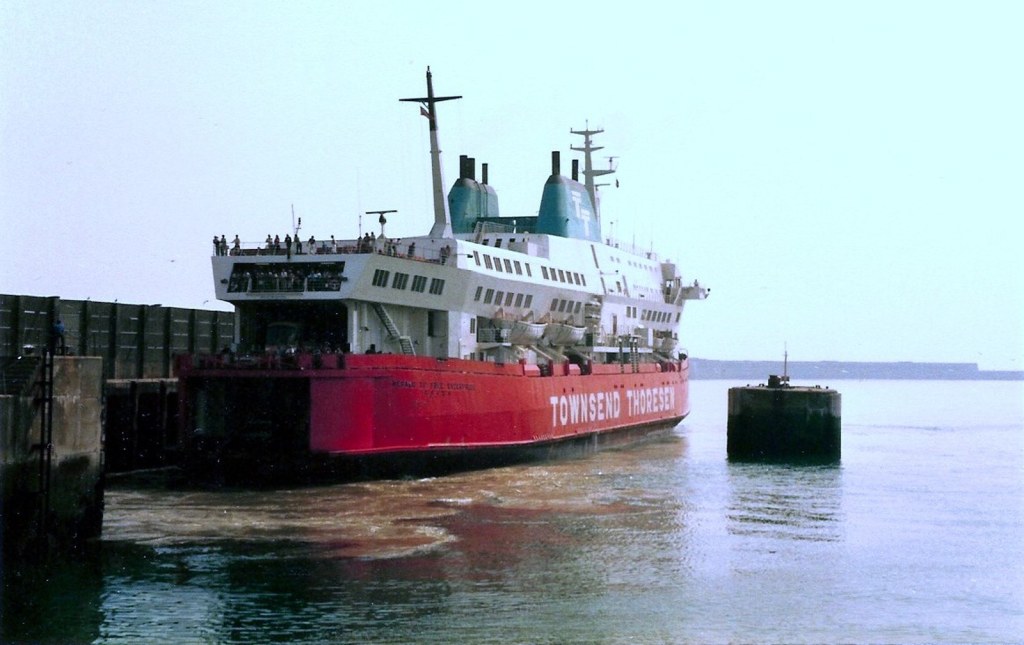
Herald of Free Enterprise was a triple-screw roll-on roll-off ferry built in 1980 by Schichau Unterweser at Bremerhaven, one of three sister ships of the Spirit class built for the Dover to Calais route. She was registered at Dover and owned by Townsend Car Ferries Limited, which traded as Townsend Thoresen. Each of her three Sulzer engines developed 9,000 brake horsepower and drove a controllable-pitch propeller.
Vehicles drove on and off through doors at the bow and stern, onto decks that ran most of the length of the ship. The investigation noted that her construction met the statutory requirements and that she held a valid passenger ship safety certificate. She carried more life-saving equipment than the minimum required.
Departure from Zeebrugge
Under Captain David Lewry, the Herald left No. 12 berth in the inner harbour at Zeebrugge at 1805 GMT, an hour behind Belgian local time. She had a crew of 80 and about 459 passengers, with 81 cars, 47 freight vehicles and three other vehicles. There was a light easterly breeze and very little sea or swell.
The loading ramp at that berth could not reach the upper vehicle deck at high water, so the ships were trimmed by the head with ballast to allow loading. The investigation found that she was still down by the head when she sailed. That reduced the height of the bow opening above the water, but the court treated it as a contributory circumstance and not the cause.
The Herald passed the outer mole at about 1824 and the master set the engine controls to a higher setting. The court concluded that water probably began coming over the bow sill within about a minute. She turned rapidly to starboard and capsized about four minutes after passing the mole. She was kept from sinking completely only because her port side took the ground in shallow water.
Why the doors were open
The assistant bosun, Mark Stanley, was responsible for closing the bow doors. He had opened them on arrival and then supervised maintenance and cleaning until the bosun released him. He went to his cabin and fell asleep, and did not wake when harbour stations were called over the public address. He was still asleep when the ship began to capsize. The court noted that he frankly accepted his failure.
Under a company instruction of July 1984, the officer loading the main vehicle deck was to ensure that the bow doors were secure when leaving port. The chief officer, Leslie Sabel, took over as loading officer shortly before harbour stations were called. He read his duty as making sure the assistant bosun was at the controls, and he went to the bridge without the doors being closed.
On the bridge, Captain Lewry did not ask whether the ship was secure, and no report was made. The court found that he followed a system used by all the masters of the Herald, in which the absence of any report was taken to mean the doors were closed. The company’s standing orders did not mention the bow and stern doors at all.
Warnings that had gone unheeded
This was not the first time. In October 1983 the assistant bosun of Pride of Free Enterprise, one of the Herald’s two sister ships, had fallen asleep and the ship sailed from Dover with both bow and stern doors open. The court recorded no fewer than five occasions before the disaster on which one of the company’s ships had gone to sea with bow or stern doors open.
Masters had asked for indicator lights on the bridge to show whether the doors were closed. In June 1985 Captain Blowers of the Pride proposed them in a memorandum. Managers’ replies, quoted in the report, included “Nice!” and a question about whether an indicator was needed to tell them whether the storekeeper was awake and sober. The request was repeated by two masters in May and October 1986.
The court found that the company was at fault at all levels, from the board of directors through the marine department down to the junior superintendents. Its report said that from top to bottom the company was infected with the disease of sloppiness. It also recorded that officers felt under pressure to sail as soon as loading was complete, and quoted a 1986 memorandum urging ships to leave 15 minutes early when fully loaded.
The findings
The court’s decision is dated 24 July 1987 and the report was published that September. It found that the capsize was caused or contributed to by the assistant bosun, the chief officer, the master and Townsend Car Ferries Limited. It suspended Captain Lewry’s certificate for one year and Mr Sabel’s for two years. Townsend Car Ferries was ordered to pay £350,000 towards the cost of the investigation.
When the transport secretary, Paul Channon, presented the findings to the Commons on 24 July 1987, he said the ship had put to sea with her bow doors fully open and that, as speed built up, water entered the vehicle deck in large quantities and destroyed her stability. He also said that the court took the view that no statutory offence had been committed.
Rescue and the human cost
The court praised the rescue effort. Belgian Air Force helicopters and Belgian Navy divers were quickly on the scene, leading an international operation that included Royal Navy, Dutch and German naval personnel. The government told Parliament that 350 people were rescued. Inside the capsized ship, survivors had to escape in darkness through spaces that now lay on their side.
The 1987 report gave at least 188 dead. The MAIB, publishing the report online in 2015, gives 193 lives lost and notes that the report detailed 188 confirmed deaths. Both figures appear in official records. This article uses 193 as the total, as the MAIB does.

Changes after the disaster
In July 1987 the government announced that it would make three measures mandatory: indicator lights on the bridge showing the position of the doors, television monitoring of the car deck doors, and self-contained emergency lighting. Speaking in the Lords that November, the government noted that emergency lighting had only been required to work at angles of list up to 22.5 degrees. The new lighting was to work up to 90 degrees.
At the request of the United Kingdom, the IMO adopted a first package of amendments to the SOLAS convention in April 1988. These required bridge indicators for doors whose opening could lead to major flooding of vehicle spaces, and monitoring to detect water leakage. Guidelines on ship management followed in 1989, leading to the International Safety Management Code, adopted in 1993 and made mandatory from 1 July 1998.
The IMO places the Herald among several serious accidents of the late 1980s caused by human error, with management faults as contributing factors. The investigation itself pointed to the same lesson: a critical task depended on one person, nobody checked that it had been done, and repeated warnings had not led to change. The Health and Safety Executive cites the disaster as an example of fatigue as a root cause.
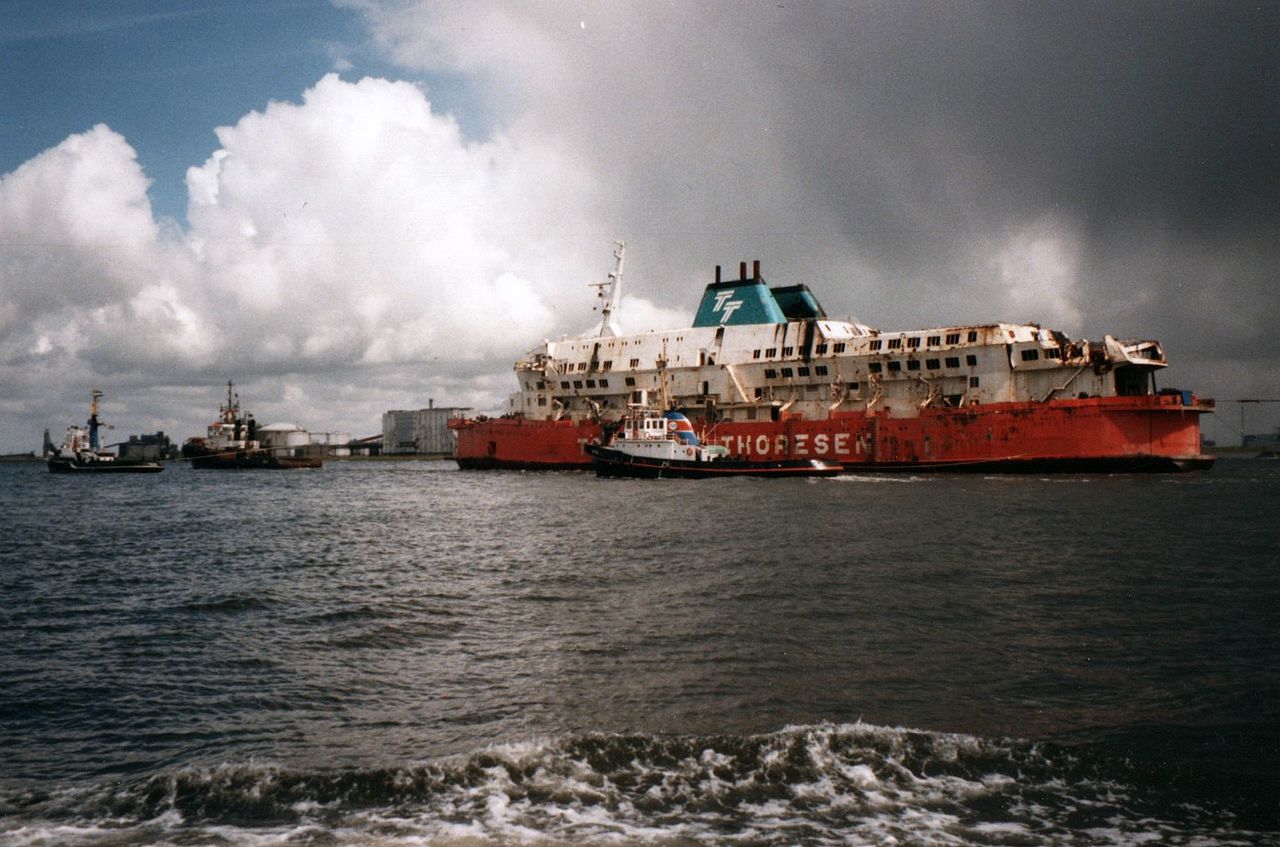
The Herald was later refloated and towed to Vlissingen in the Netherlands. Among the memorials to those who died, at St Margaret’s at Cliffe, near Dover, a stained glass window commemorates three men of the village who were among them.
Timeline
| Date | Event |
|---|---|
| 1980 | Completed at Bremerhaven |
| 29 October 1983 | Pride of Free Enterprise sails from Dover with bow and stern doors open |
| 28 June 1985 | Captain Blowers proposes bridge door indicators |
| 6 March 1987 | Herald sails from Zeebrugge at 1805 GMT and capsizes about 1828 |
| 24 July 1987 | Court’s decision; findings presented to Parliament |
| September 1987 | Formal investigation report published |
| April 1988 | IMO adopts the first SOLAS amendments on ro-ro ferries |
| 1993 | IMO adopts the International Safety Management Code |
Sources and further reading
- Department of Transport, mv Herald of Free Enterprise: Report of Court No. 8074, Formal Investigation, 1987.
- Marine Accident Investigation Branch, Flooding and capsize of ro-ro passenger ferry Herald of Free Enterprise with loss of 193 lives. Note on the 188 and 193 figures.
- Hansard, House of Commons, Herald of Free Enterprise, 24 July 1987. Statement by the Secretary of State for Transport.
- Hansard, House of Lords, Merchant Shipping (Passenger Ship Construction) Regulations, 30 November 1987. Door indicators and emergency lighting.
- International Maritime Organization, Ro-ro ferries. SOLAS amendments of 1988.
- International Maritime Organization, Safety management and safety culture. Origins of the ISM Code.
- Health and Safety Executive, Fatigue.
- Royal Museums Greenwich, Maritime Memorials M5029. The memorial window at St Margaret’s at Cliffe.
Image credits. Featured image: Herald of Free Enterprise at the Eastern Docks, Dover, in 1984. Photo: Franz Golhen, Wikimedia Commons, Public domain. Other photographs are credited in their captions.
Have a correction or a photograph that helps identify this ship? Contact contact@shipsarchive.com.