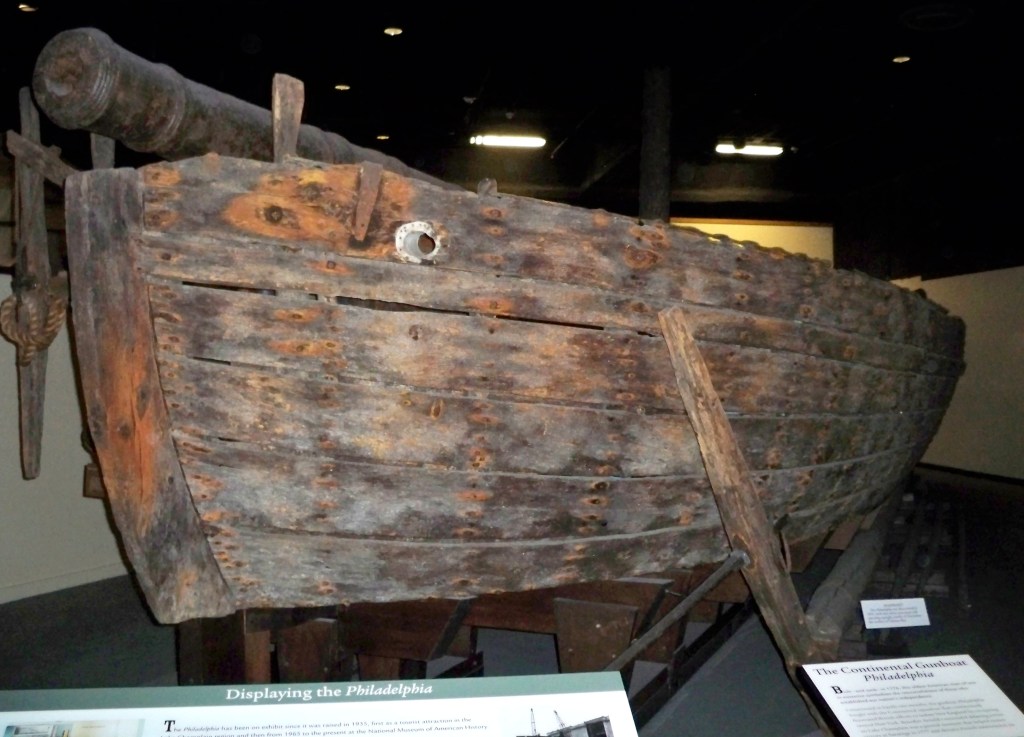
The original 1776 gunboat Philadelphia on display at the Smithsonian National Museum of American History, photographed on October 3, 2009. Matthew G. Bisanz / Wikimedia Commons, CC BY-SA 3.0. No changes.
The gunboat Philadelphia has spent far longer as a wreck and museum object than she ever spent afloat in military service. On 11 October 2026, the 250th anniversary of her sinking at Valcour Island, the surviving hull is still yielding information about how she was built and what happened to her after recovery.
The Smithsonian’s 8 October conservation announcement reports continuing work, not a completed anniversary restoration. Cleaning of the interior ceiling planks had finished by the end of September, with attention moving to decking and raised midship gun platforms. The distinction matters: the anniversary is fixed, but treatment must follow the condition of the object.
| Fact | Detail |
|---|---|
| Vessel | Philadelphia, 1776 gunboat |
| Waterway | Lake Champlain |
| Sinking | 11 October 1776 |
| Recovery | 1935 |
| Present custodian | Smithsonian NMAH |
| Conservation display | Opened August 2025 |
| Current work | Decking and midship platforms |
Contents: An emergency fleet · Marks in the structure · Recovery and treatment · Cleaning as investigation · Wood and iron · A working conservation space · Sources
An emergency fleet, not an improvised object
This is the open wooden gunboat built for the Lake Champlain campaign of 1776, not the later frigate Philadelphia associated with Tripoli. The Smithsonian’s 2019 research account places construction within the fleet authorised by the Continental Congress in July 1776. Under Benedict Arnold, eight 54-foot gunboats and four 72-foot rowing galleys were built in about two months at what is now Whitehall, New York.
The compressed timetable explains the value of the surviving hull. Written accounts establish the urgency; the structure can reveal how people met it. An emergency programme still required timber preparation, transport, ironwork and skilled assembly. Describing the fleet as hastily built should not imply that its builders lacked organised methods or that every structural decision was made without experience.
At Valcour Island, the Americans suffered a tactical defeat and lost vessels, including Philadelphia. The Smithsonian distinguishes that result from the campaign’s delaying effect on the British advance. Those are compatible statements, but neither requires turning the gunboat’s loss into a victory at the level of the individual action.
The October release places approximately 11,000 people within the wider mobilisation for fortifications and the fleet. That number is not Philadelphia’s complement or the workforce of a single boat. Its significance is the scale of the supporting effort, including supplying and caring for people as well as producing vessels. It broadens the history beyond the commanders whose names dominate accounts of the battle.
Marks that record professional shipbuilding
The museum’s description of the vessel and conservation exhibition identifies carved marks on frame components as evidence of professional shipwright construction. Such marks connect individual pieces with an assembly process. They are particularly useful where a hull survives but the detailed paperwork of its building does not.
A frame is not simply an anonymous rib once those working marks are recognised. Its constituent pieces can carry evidence of how they were identified and fitted. The interpretation should nevertheless remain at the level the museum supports. The marks do not, by themselves, identify a named craftsperson or prove that every gunboat in the fleet followed an identical production system.
This illustrates why conservation and historical research are inseparable. Cleaning a surface may expose a feature that changes how the object is understood. Equally, removing material too aggressively could destroy the feature before its significance is recognised. The aim is therefore not an evenly coloured hull, but a surface that can be studied without sacrificing vulnerable evidence.
The museum also reports microscopic freshwater-sponge colonies attached to the timbers from their period underwater. Their presence makes the lakebed part of the object’s history. They are evidence of the environment through which the gunboat survived, rather than a reason to describe the displayed vessel as an untreated wreck brought directly from the lake.
The hull now records several phases at once: construction, military use, submergence, recovery, storage and exhibition. A mark or deposit can belong to any one of them. Determining which phase it represents is a research problem, and its answer affects what a conservator should preserve, sample or remove.
Recovery created a second preservation problem
Lorenzo Hagglund’s team found and raised Philadelphia in 1935. The gunboat was later installed while the Smithsonian’s new museum building was still under construction, before its opening on 23 January 1964. The October announcement sets that sequence alongside the current project, linking the 1776 vessel to decades of decisions made on land.
Recovery made the hull accessible, but also changed its environment and introduced new treatment choices. The survival of wood underwater does not demonstrate that it will remain stable indefinitely on display. Nor does a treatment once regarded as protective become harmless simply because it has become part of the object’s recent history.
The Smithsonian’s 2019 account describes analysis of liquid nylon applied in the early 1960s. Researchers associated it with shrinkage at the wood’s surface and were investigating whether removal or neutralisation would be preferable. That was an earlier research finding, not an announcement that the nylon problem had been solved in 2026.
This is a difficult conservation distinction. An old coating may be contributing to deterioration, yet removing it may also disturb the material beneath. A decision requires more than identifying the coating as obsolete. It requires evidence of how it behaves on this particular substrate and what the proposed alternative would do.
Detached fragments can be valuable in that process. The 2019 work examined pieces whose locations on the hull were unknown, allowing research without immediately intervening on a major visible surface. Such material is not necessarily expendable, but its study can reduce uncertainty before treatment of the principal object. Preserving a ship includes preserving the evidence needed to make later decisions responsibly.
Cleaning as investigation, not cosmetic renewal
The October release records removal of 174 lb of sediment during the winter work. That is a measured quantity of recovered material, not an estimate of how much original hull has been lost. It should not be confused with earlier, less precise project updates that reported more than 150 lb removed while the work was progressing.
The project log explains the access problem behind those numbers. Hard sediment in the bottom required work from below through the planking as well as from above. Conservators used adapted tools to break it into manageable pieces. These details explain why the task cannot be compared with cleaning an unobstructed modern floor.
Access is only part of the difficulty. Sediment and debris can contain evidence from different periods, and fragments of the vessel may be mixed with unrelated material. The task involves recognising those differences while avoiding additional damage to the surrounding structure. Fast removal would not necessarily be successful removal.
The Smithsonian’s earlier examination of stored lakebed material recovered forged fastenings, caulking material, musket balls and gunflints. These findings were reported in 2019, following screening in 2018. They should not be presented as discoveries from the current winter campaign. Their relevance is methodological: material separated from a ship can still contain useful evidence long after the initial recovery.
The newest cleaning work addresses the interior planking known as the ceiling. In ship terminology, these are not overhead boards. They line the inside of the hull structure. Getting that term right helps readers understand the area treated and prevents a misleading picture of conservators working above their heads inside an enclosed cabin.
Wood and iron require different treatment decisions
Philadelphia is not a single-material object. Timber, iron fastenings and larger iron fittings have related but distinct conservation needs. A treatment chosen for one cannot be assumed suitable for the next simply because both belong to the same vessel. The public project record makes that separation unusually visible.
The spring 2026 update describes removing protective lacquer applied to the iron in the 1930s. Acetone-soaked pads softened the coating, with repeated applications where necessary and more detailed work in crevices. The team also used ultraviolet light to locate remaining lacquer. These are documented professional treatments, not general cleaning instructions for historic metal.
The point of removing the coating was to allow modern conservation measures to inhibit further deterioration. That does not mean stripping the iron back to an imagined new appearance. A cannon or anchor carries corrosion, manufacturing evidence and a history of treatment. Its conservation requires decisions about those layers, rather than a single test of whether the surface looks bright or uniform.
For the wood, the problem includes fragile, lifting surface material as well as accumulated deposits. The 2019 research asked whether disturbing that surface might expose further material to deterioration. The question illustrates why “cleaner” and “better preserved” are not synonyms. Each intervention has to be judged against the stability and evidential value of the object.
The general National Park Service preservation principles offer a useful frame: retain significant fabric, assess condition before intervention and document changes. They are cited here as principles, not as a claim that the Smithsonian has adopted a particular treatment under that programme. Their practical relevance is that future researchers need to distinguish an original surface from the results of successive conservation campaigns.
Making room for the work, and for visitors to understand it
Before the present treatment space could operate, the gunboat had to be protected from work around it. The museum’s May 2025 log describes a purpose-built enclosure, nearby demolition and measures to limit vibration. This was preservation work before direct treatment of the hull: controlling the risks created by changing its surroundings.
The public-facing conservation exhibition opened in August 2025. Viewing windows allow visitors to see work without entering the treatment area. That arrangement changes the interpretation of the ship. Instead of displaying preservation as an invisible activity that happens between exhibitions, it shows that maintaining an old hull involves continuing examination and decisions.
An anniversary can create pressure for a definitive “finished” object. Philadelphia’s October status offers a more useful account. One area has been cleaned, others are receiving attention, and research into earlier treatments continues to inform the approach. Completion of a particular task is real progress without implying that the whole vessel has reached a permanent end state.
At 250 years, the gunboat remains valuable because her surviving fabric can answer questions that a reconstruction cannot. The current project is preserving that capacity to be questioned. Its result should be assessed through the condition of the wood and iron, the evidence retained and the clarity of the treatment record, rather than whether every surface appears newly restored for the commemorative date.
Sources and further reading
- Smithsonian National Museum of American History, conservation and research announcement, 8 October 2026: https://americanhistory.si.edu/press/releases/gunboat-oct8
- Smithsonian, visual description of the gunboat and exhibition: https://www.americanhistory.si.edu/visual-descriptions/gunboat-philadelphia
- Paul F. Johnston, Smithsonian, “Old Mud, New Science”, 11 October 2019: https://americanhistory.si.edu/explore/stories/old-mud-new-science
- Smithsonian, project updates, including May 2025, winter 2025/26 and spring 2026: https://americanhistory.si.edu/explore/projects/gunboat-philadelphia/updates
- National Park Service, general preservation principles: https://home.nps.gov/articles/000/treatment-standards-preservation.htm
Related reading: Mary Rose: Raising and Conserving Henry VIII’s Warship · Vasa: Why the King’s Warship Sank and How She Survives


