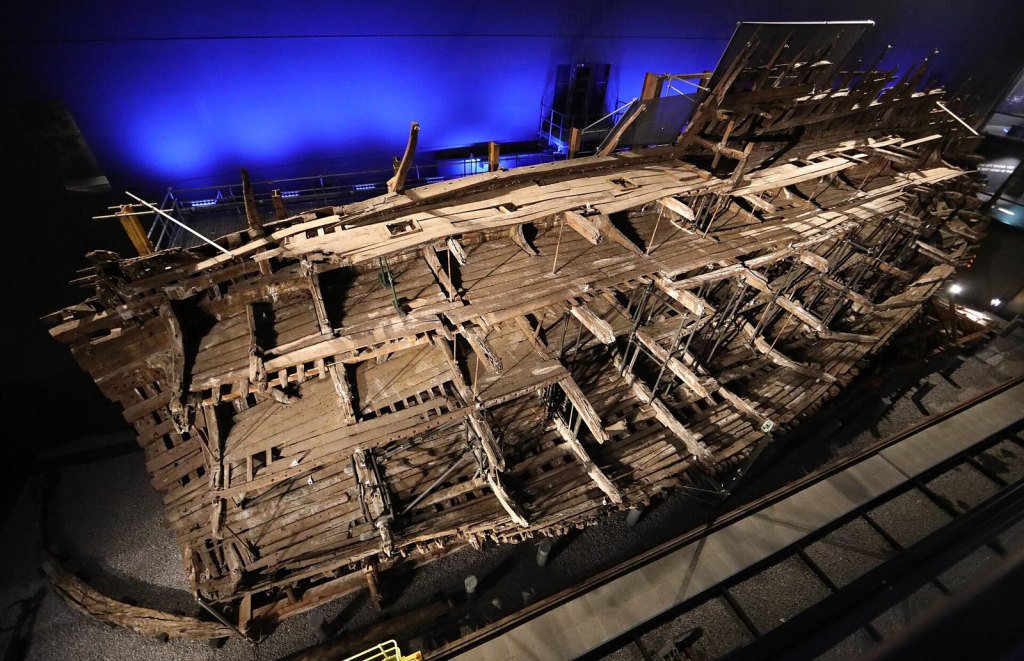
The Mary Rose that came out of the Solent on 11 October 1982 was not a ship in any working sense. It was roughly one third of a Tudor hull, mostly the starboard side, waterlogged and weakened by four centuries of burial, and it could not support its own weight out of the water. Raising it meant spreading the load through hundreds of fixings and moving the timber into a cradle before it ever broke the surface. Keeping it meant three decades of spraying, drying and chemical research, much of it carried out in full view of museum visitors. This article follows that work from the search on the seabed to the hull now on display in Portsmouth.
| Name | Mary Rose |
| Type | Carrack, warship of the Tudor navy |
| Built | Portsmouth; ordered 1510, launched July 1511, fitted out in London |
| Tonnage | About 500 tons as built; about 700 tons after rebuilding in the 1530s |
| Lost | 19 July 1545, during the Battle of the Solent |
| Crew at loss | About 400; perhaps 30 to 40 survived |
| Wreck located | 1 May 1971, by diver Percy Ackland |
| Protected wreck | Designated 5 February 1974 under the Protection of Wrecks Act 1973 |
| Hull raised | 11 October 1982 |
| Surviving structure | Most of the starboard side and parts of the decks; the hull is about 35 metres long |
| Artefacts recovered | About 19,000 |
| Active conservation | PEG spraying 1994 to 2013; controlled air drying 2013 to 2016 |
| Custodian | Mary Rose Trust, Portsmouth Historic Dockyard |
A Tudor warship and her loss
The Mary Rose and the Peter Pomegranate were ordered at Portsmouth in 1510, early in Henry VIII’s reign. The Mary Rose was launched in July 1511 and taken to London to be fitted out. On 17 April 1512 she sailed on her first voyage as a warship under the Lord Admiral, Sir Edward Howard, and she fought at the Battle of Saint-Mathieu off Brest that August. Records from the mid 1530s describe her as made new, and dating of her timbers confirms major work at about that time. Her tonnage rose from about 500 to about 700 tons.

On 19 July 1545 she went out with the English fleet to meet a French invasion force off Portsmouth. Early in the action she heeled sharply to starboard and water poured in through her open gunports. Of a crew of about 400, perhaps 30 to 40 survived. Vice Admiral Sir George Carew was among those lost. Why she heeled remains disputed: contemporary accounts mention a turn, a gust of wind, an overloaded ship and an undisciplined crew, and the physical evidence cannot settle the question on its own.
She settled in about 14 metres of water lying on her starboard side at an angle of about 60 degrees. That side sank into the soft clay and was sealed from oxygen, which kept out shipworm and gribble. The exposed port side was eaten away and collapsed, and a hard layer of compacted shelly clay later formed over the remains. Attempts to raise her began in August 1545 and failed. Between 1836 and 1840 the diving pioneers John and Charles Deane recovered guns and other objects, many of which were sold as souvenirs.
Finding the wreck
The modern search began in 1965, when the journalist and diver Alexander McKee started Project Solent Ships with the Southsea branch of the British Sub-Aqua Club. A sonar survey in 1967 found a W shaped anomaly under the seabed, and the 1967 Committee leased the area from the Crown Estate so that its volunteer divers had exclusive rights to work there. In 1970 they found a wrought iron gun of 16th century type. On 1 May 1971 Percy Ackland uncovered three or four frames of a ship, and by the end of that day a row of frames about 30 metres long had been exposed.
The Protection of Wrecks Act was passed in 1973, and the Mary Rose site was designated on 5 February 1974. It remains a protected wreck. Raising the main hull in 1982 did not empty the site: further timbers, including part of the stem, were recovered in 2003 to 2005, and significant remains still lie in the seabed.
Excavation on the seabed, 1979 to 1982
The Mary Rose Trust was formed in 1979, and the excavation became a full scale operation. The salvage vessel Sleipner was moored over the site in March 1979, allowing divers and finds staff to work in shifts. More than 500 volunteer divers took part, alongside professional archaeologists, conservators and Royal Engineers. Divers removed silt by hand, with trowels, brushes and airlifts.
A grid of bright yellow pipe was built over the wreck, dividing it into small areas matched to the ship’s decks and main beams. Every artefact, timber and sample was recorded with its position, and chests were raised intact where possible so that they could be excavated slowly on deck. About 19,000 objects came up, together with the remains of at least 179 people. Because the record ties each object to a place in the ship, the collection can be studied as the contents of working spaces rather than as loose finds.
How the hull was lifted
A committee considered several ways of raising the hull and chose a purpose built tubular steel lifting frame attached by wires to bolts passing through the structure at selected points, mostly in the major beams. Each bolt was tightened onto spreader plates inside and outside the hull so that it clamped the timbers together; the salvage divers fitted a further 103 bolts purely as clamps. The frame stood over the wreck on four legs set into holes dug in the seabed.
The first problem was suction. Twelve hydraulic jacks on the legs raised the frame slowly over several days, lifting the hull a few critical centimetres to break its grip on the clay. The frame was then attached to the crane barge Tog Mor. With the hull hanging free, the whole assembly was moved underwater into a steel cradle that had been built from section drawings made during the excavation and lined with air bags. Only then, on the morning of Monday 11 October 1982, was the cradle with its load winched to the surface, placed on a barge and towed into Portsmouth. An estimated 60 million people watched on television.

The hull still rests on that cradle today. It sits on the barge deck, which was cut away when it reached the dry dock, and rests on brick piers at a slight angle so that water and treatment solutions could drain.
Why waterlogged oak cannot simply be dried
Oxygen was shut out on the seabed, but some bacteria thrive without it. Over four centuries they consumed microscopic parts of the wood cell walls, leaving a weak skeleton whose shape was held by the water filling it. Let that water evaporate and the timber shrinks, cracks and distorts. The Trust’s own trials put the scale of the risk in numbers: untreated samples dried with about 85 per cent volumetric shrinkage.
Immediately after the raising the hull was covered in water saturated foam and sprayed with seawater. From December 1982 it stood in a temporary building, sprayed with recycled, chilled and filtered fresh water. The chilled spray limited microbial activity and slowly washed salts out of the wood. Between 1989 and 1993 loose timbers were refitted, although some could not be replaced because the weakened structure could not carry their weight. Steel bolts from the salvage were replaced with titanium, and titanium is also used for the modern beams that support the decks.
The treatment chosen was polyethylene glycol, or PEG, a water soluble wax already used on the Swedish warship Vasa. Two studies preceded it. A beaker scale study over three years compared one stage and two stage treatments: one stage samples shrank by about 20 per cent, two stage samples by as little as 13 per cent. A pilot study from 1987 to 1993 then compared brushing with spraying and showed that spraying carried the PEG deeper into the wood.
Thirty four years of treatment
Spraying began on 30 September 1994. Low molecular weight PEG, which stays liquid and penetrates deeply, was applied first to bulk out the less degraded inner wood. A higher molecular weight PEG followed to consolidate the softer outer layers and help seal in the first treatment. The circulating system used 522 metres of pipework and 315 nozzles, collecting the solution that ran off the hull and reusing it. Spraying ended in 2013.

The next stage was controlled air drying. Large fabric ducts delivered conditioned air to every part of the hull so that it dried evenly, without steep moisture gradients between thick and thin timbers. After three years the ducts were removed in 2016 and the hull could be seen without barriers for the first time. In the Trust’s own phrase, it took 34 years of treatment to conserve the ship.
The hall is still climate controlled, because temperatures or humidity outside a narrow range would put the dried timber at risk again. Since 2016 the Trust has monitored the hull for movement, so that a slow change at a joint can be recognised before it becomes damage.
The sulphur problem
Water was not the only threat. In 2005 a team led by Magnus Sandström at Stockholm University published a synchrotron study in the Proceedings of the National Academy of Sciences showing that the Mary Rose timbers contained reduced sulphur at about 1 per cent by mass throughout, mostly as organic thiols and disulphides in the lignin rich parts of the wood, with iron sulphides and elemental sulphur in separate particles. Iron content fluctuated up to several per cent by mass.
Similar sulphur had already been found in Vasa, where it oxidises slowly to form sulphuric acid that attacks the cellulose. Iron accelerates the reactions, and PEG itself can corrode iron and carry it deeper into the wood. Fortunately the Mary Rose was fastened largely with wooden treenails rather than iron bolts, though iron from nearby objects and seawater still reached the timbers. The research changed conservation thinking: supporting weak wood with PEG and controlling acid forming chemistry are separate tasks, and success in the first does not solve the second.
Conserving the contents
The artefacts needed treatments matched to their materials. Small wooden objects were soaked in PEG solutions of slowly rising concentration and then freeze dried, so that frozen water is removed by sublimation rather than evaporation. Leather shoes, jerkins and pouches were treated with lower concentrations of PEG or glycerol and freeze dried with care, because over drying destroys their flexibility.
Almost two thirds of the metal finds are iron, which is the hardest to stabilise after burial in the sea because of chloride. Some guns and shot were treated in the 1980s by hydrogen reduction, a method later criticised because its high temperatures altered the metal. Alkaline washing and electrolysis have since been preferred, although complete removal of chloride cannot be guaranteed. Each material, in short, became its own conservation programme, and the excavation record keeps all of them connected to the places where they were found in the ship.
Timeline
| Date | Event |
|---|---|
| 1510 | Mary Rose and Peter Pomegranate ordered at Portsmouth |
| July 1511 | Mary Rose launched and taken to London to be fitted out |
| 17 April 1512 | First voyage as a warship, under Sir Edward Howard |
| About 1536 | Major rebuilding; tonnage rises to about 700 tons |
| 19 July 1545 | Sinks during the Battle of the Solent |
| 1836 to 1840 | John and Charles Deane recover guns from the site |
| 1965 | Alexander McKee starts Project Solent Ships |
| 1 May 1971 | Percy Ackland uncovers the first frames |
| 5 February 1974 | Wreck designated under the Protection of Wrecks Act |
| 1979 | Mary Rose Trust formed; full excavation begins |
| 11 October 1982 | Hull raised by the crane barge Tog Mor |
| 30 September 1994 | PEG spraying begins |
| 2013 | Spraying ends; controlled air drying begins |
| 2016 | Drying ducts removed; hull fully revealed |
Sources and further reading
- Mary Rose Trust, Raising the Mary Rose. Search, excavation and lifting.
- Mary Rose Trust, Timeline of the Mary Rose.
- Mary Rose Trust, Conservation of the ship. Spraying, PEG phases and drying.
- Mary Rose Trust, Choosing a conservation treatment for a unique artefact. The beaker and pilot studies.
- Mary Rose Trust, Time and its effect on the Mary Rose. Burial conditions and monitoring.
- Mary Rose Trust, Conservation of artefacts.
- Mary Rose Trust, Caring for our collection.
- Ingenia, Raising and conserving the Mary Rose. Engineering account of the lift and conservation.
- Magnus Sandström and others, Sulfur accumulation in the timbers of King Henry VIII’s warship Mary Rose, Proceedings of the National Academy of Sciences 102 (2005), 14165 to 14170.
- Historic England, Mary Rose, protected wreck, list entry 1000075.
Image credits. Featured image: The surviving starboard side of the Mary Rose in the Mary Rose Museum, Portsmouth, after the end of active conservation. Photographed July 2019. Photo: Geni, Wikimedia Commons, CC BY-SA 4.0. Other photographs are credited in their captions.
Have a correction or a photograph that helps identify this ship? Contact contact@shipsarchive.com.