Vasa is famous for one of the shortest maiden voyages on record. She sank in Stockholm harbour on 10 August 1628, after sailing about 1,300 metres. She is better understood as a case study in early modern shipbuilding, and in the problems of conserving a large wooden ship once it has been brought out of the water.
More than 98 per cent of the original structure survives. That makes her unique, and it also makes her fragile. The museum is now replacing the cradle that has supported her since the 1960s.
| Owner | King Gustav II Adolf, as head of the Swedish navy |
| Shipwrights | Henrik Hybertsson, then Hein Jakobsson |
| Built | Skeppsgården, Stockholm, 1626 to 1628 |
| Length | 69 m |
| Height to top of mainmast | More than 50 m, from the keel |
| Armament | 64 guns |
| Sails | 10 |
| Weight when outfitted | More than 1,200 tonnes |
| Sank | 10 August 1628, in 32 m of water |
| Raised | 24 April 1961 |
| Museum opened | 15 June 1990 |
A contract for the king
In January 1625 King Gustav II Adolf signed a contract with the Dutch master shipwright Henrik Hybertsson and his business partner Arendt de Groote for four new ships. Vasa was to be the most powerful of them.
Her keel was laid in late winter 1626 at Skeppsgården, the navy yard in Stockholm. Hybertsson was already ill. By the summer he could no longer supervise the work and handed over to his assistant, Hein Jakobsson. Hybertsson died about a year later.
Vasa was launched in spring 1627, and hundreds of craftsmen worked through that summer on the hull and rigging. Outfitted with ten sails, 64 guns, 120 tonnes of ballast and hundreds of sculptures, she weighed more than 1,200 tonnes.
A warning that was ignored
In summer 1628, Captain Söfring Hansson, who was supervising the ship, became worried about her stability. He asked Vice Admiral Klas Fleming to watch a test at the quay below the royal palace. Thirty men ran back and forth across the deck, and the ship rolled so much that Fleming stopped the test for fear she would sink.
The king was pressing for the ship to go to sea, and Fleming let her sail anyway.
Twenty minutes
On Sunday 10 August 1628 Vasa cast off from the palace between four and five in the afternoon. The wind was from the south, so she was first warped along the waterfront to the place now called Slussen. Crew members’ families were aboard as guests, to be landed at Vaxholm. The 300 soldiers she was to carry had not yet embarked.
Four of the ten sails were set and a salute was fired. A small gust heeled her to port, and she recovered slowly. Off Tegelviken a stronger gust pushed her over until water poured in through the open gunports on the lower gun deck. Within minutes she was on the bottom at 32 metres, still in sight of the yard where she was built.

The masts stuck out of the water and many people clung to them. Others were picked up by small boats, and some swam to Beckholmen. The museum’s account is that all but 30 of the crew and guests survived. Most of the dead were trapped inside the ship.
Why she capsized
The Vasa Museum describes her as top-heavy, a little too tall and a little too narrow. The upperworks were too tall and heavily built for the small amount of hull below the waterline. That put the centre of gravity too high.
Shipwrights in the 1620s had no mathematical way to predict stability. New warships were often tender at first and were corrected after trials by changing the armament, adding planking at the waterline or removing a deck. Vasa did not survive long enough for any of that.
The open gunports turned a stability problem into a disaster. The inquiry that autumn found that the ship had too little hull to carry her heavy upperworks. The blame fell on Hybertsson, who was dead and could not answer.
Finding and raising her
In the 1660s salvors using a diving bell recovered almost all of her guns. The hull stayed in the mud. In 1920 two brothers asked permission to blow up wrecks in the area to sell the black oak for furniture. The authorities refused.
On 25 August 1956 Anders Franzén’s coring device brought up a plug of black, waterlogged oak from the bottom off Beckholmen. On 4 September navy divers Per Edvin Fälting and Sven Persson confirmed that it came from a large ship with two tiers of gunports.
Between 1957 and 1959 navy divers dug six tunnels under the hull and passed steel cables through them to two pontoons, Oden and Frigg. On 20 August 1959 the first lift freed the ship from the mud. She was moved in 18 stages into shallower water by Kastellholmen, where she lay at 17 metres.
For more than 18 months divers plugged bolt holes, covered the gunports and rebuilt the bow and stern to make the hull watertight. On Monday 24 April 1961 she broke the surface in front of thousands of spectators and live television.

Preparing her for the final lift, divers cleared mud from the upper gun deck and found more than a thousand objects, including coins, tools, gun carriages and the bones of five people who had been aboard when she sank.
Conservation with PEG
The interior was excavated from May to September 1961, and more than 40,000 objects were recovered. In November the ship was moved into a temporary building at the Wasa shipyard. It opened to the public on 16 February 1962, with conservation work going on in full view.
Waterlogged wood shrinks and cracks if it dries without treatment. The conservators chose polyethylene glycol, a water soluble synthetic wax, to replace the water in the wood. Spraying began by hand in April 1962. From 1965 an automatic system with 500 nozzles did the work, and PEG grades 4000, 1500 and 600 were used over the years.
Spraying ended in January 1979 after 17 years and was followed by nine years of slow air drying. The present museum opened on 15 June 1990.
Interest was immediate. In 1962 alone, 439,300 people bought tickets to see the ship at the temporary yard. In the 2011 anniversary year the museum had more than 1.2 million visitors.
Problems that appeared later
Conservation was thought to be finished when the museum opened. Over the next decade, white and yellow spots appeared on the hull and on objects. They were acidic sulphur and iron compounds, a sign that the wood was still degrading.
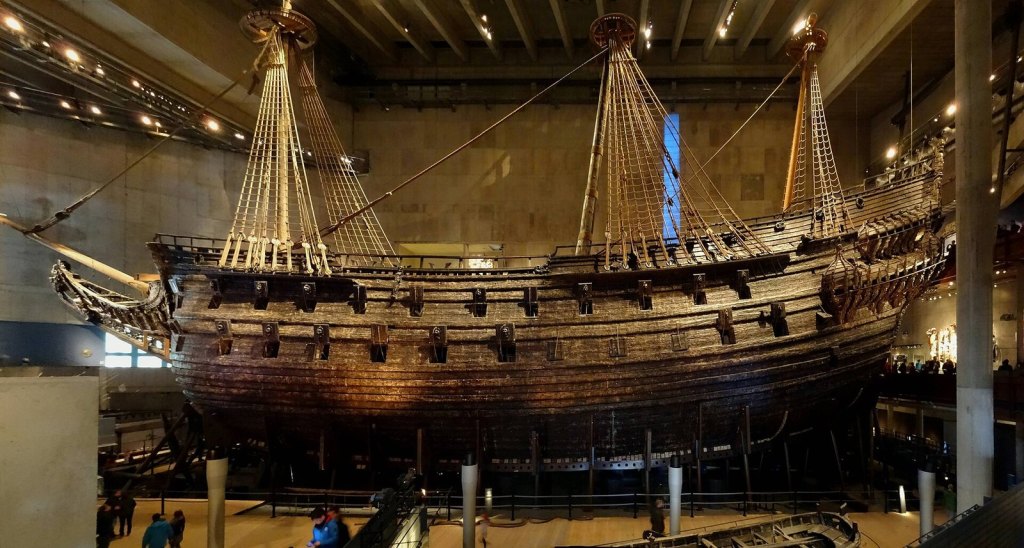
A new climate plant came into use in 2004. It keeps relative humidity around the ship between 51 and 59 per cent and the temperature at about 18 to 20 °C. Light levels are kept below 100 lux, which is why the hall is dark.
Shape is monitored as well. Twice a year since 2000, staff have measured 400 points on the hull, 350 outside and 50 inside, to an accuracy of less than a millimetre. More than twenty years of readings show the ship settling downwards by about 1 mm a year.
Around 4,000 rusty iron bolts were replaced with corrosion resistant steel bolts over seven years, work that the museum says was finished in 2018.
A new support for 2028
The weakened wood is struggling to carry the ship’s own weight, and the old cradle is itself causing deformation. Building of a new support began on 8 April 2024. The 17 pairs of external cradle elements are being replaced by 27 purpose designed steel cradles joined under the keel. An internal steel frame will follow.
The museum also intends to reduce her slight lean to port. The project is due to be completed in 2028, the 400th anniversary of the sinking.
The colours she sailed with
Today the hull is dark brown. In 1628 her upperworks were painted a deep red, and nearly 1,200 sculptures were painted in strong colours.
In the early 1990s researchers took more than a thousand paint samples. They found gold leaf on hair, costumes and weapons, with yellow ochre as a cheaper substitute on some figures. Other parts were white, green, red, brown, violet and blue, using pigments that included cinnabar and indigo.

Even basic dimensions are harder to fix than they seem. The upper gun deck is between 1.7 and 1.9 metres high, and the lower gun deck 1.6 to 1.7 metres. The mast heights of 47.0, 52.4 and 39.4 metres are estimates, because the upper parts of the masts did not survive.
Timeline
| Date | Event |
|---|---|
| January 1625 | Contract signed with Henrik Hybertsson. |
| Late winter 1626 | Keel laid at Skeppsgården. |
| Spring 1627 | Launched. |
| 10 August 1628 | Sinks on her maiden voyage. |
| 1663 to 1665 | Most of her guns are salvaged. |
| 25 August 1956 | Anders Franzén cores oak from the wreck. |
| 20 August 1959 | First lift from the seabed. |
| 24 April 1961 | Raised to the surface. |
| 16 February 1962 | Shown to the public at the Wasa shipyard. |
| April 1962 | PEG spraying begins. |
| January 1979 | Spraying ends. |
| 15 June 1990 | Vasa Museum opens. |
| 2004 | New climate plant in use. |
| 8 April 2024 | Work on the new support begins. |
Sources and further reading
- Vasa Museum, Timeline. Contract, building, stability test, sinking, salvage and conservation dates.
- Vasa Museum, The Disaster. The maiden voyage, casualties and the design faults.
- Vasa Museum, Facts about Vasa.
- Vasa Museum, The Salvage.
- Vasa Museum, Conservation. PEG treatment from 1962 to 1979.
- Vasa Museum, How we preserve Vasa.
- Vasa Museum, Climate control.
- Vasa Museum, Deformation monitoring.
- Vasa Museum, Construction start for Vasa’s new support structure.
- Vasa Museum, Vasa Shows Its Colours. Audio guide text.
- Vasa Museum FAQ, What are the precise dimensions of the Vasa?
Image credits. Featured image: Vasa’s port side in the Vasa Museum, Stockholm, in May 2015. A support pillar in front of the hull has been retouched out of this image. Photo: Je-str, Wikimedia Commons, CC BY-SA 3.0. Other photographs are credited in their captions.
Have a correction or a photograph that helps identify this ship? Contact contact@shipsarchive.com.