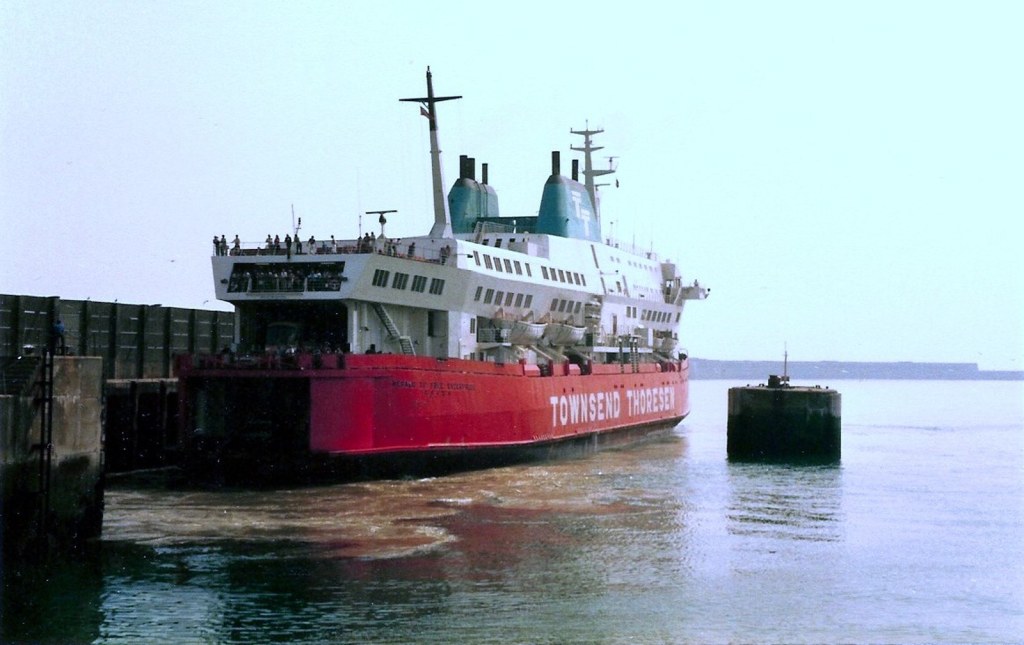
The liner France was built at Saint-Nazaire for the Compagnie Générale Transatlantique, the French Line, and entered service between Le Havre and New York in 1962. She was withdrawn in 1974, sold in 1979 and converted into the cruise ship Norway. On 25 May 2003 a boiler burst aboard her at Miami, killing eight crew members. She never sailed with passengers again.
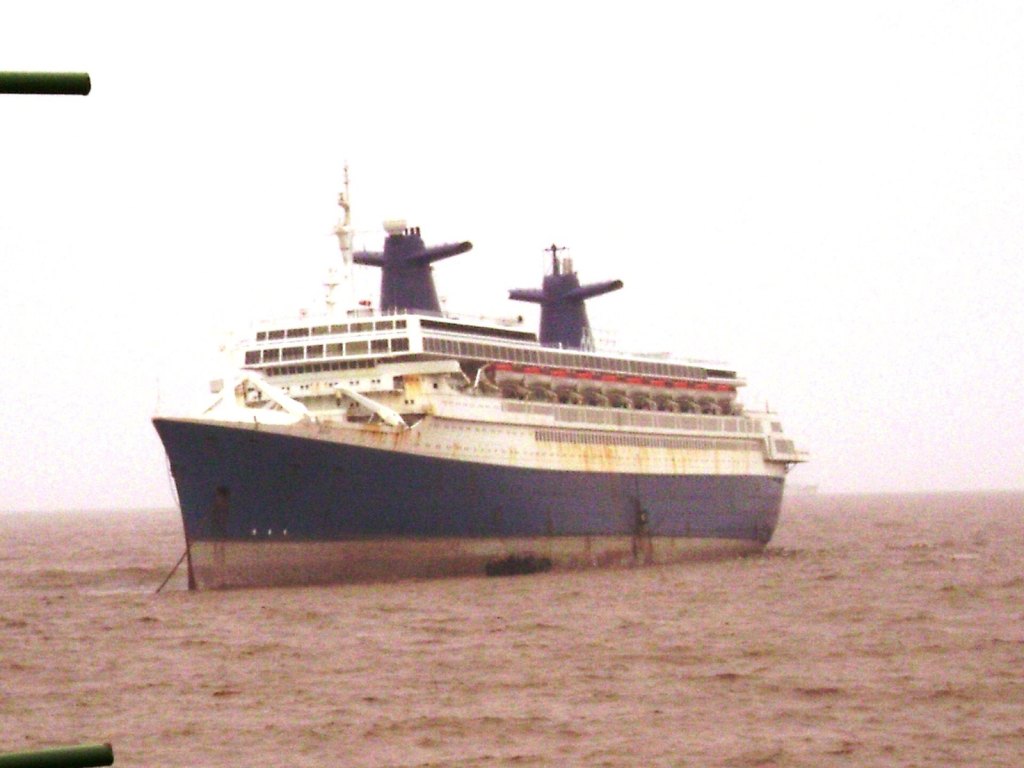
Renamed Blue Lady, she was beached at Alang in India in August 2006. After a case in the Supreme Court of India over asbestos and other hazardous materials, permission to dismantle her was given in September 2007, and cutting was under way by January 2008. This article follows the ship through her three names, with most attention on the end of her career.
| Names | France; Norway from 1979; Blue Lady when sold for scrap |
| IMO number | 5119143 |
| Builder | Chantiers de l’Atlantique (Penhoët), Saint-Nazaire |
| Keel laid | 7 October 1957 |
| Launched | 11 May 1960 |
| Length overall | 315.6 m (1,035 ft) |
| Beam | 33.7 m |
| Gross tonnage | 66,348 as built; 76,049 by 1994 |
| Passengers as France | 2,044 (407 first class, 1,637 tourist) |
| Service as France | February 1962 to October 1974 |
| Service as Norway | May 1980 to May 2003 |
| Boiler rupture | 25 May 2003, Miami; eight crew killed |
| Beached at Alang | 15 or 16 August 2006, as Blue Lady |
| Dismantling permitted | 11 September 2007, Supreme Court of India |
The French liner
France was the last great liner of the French Line. Her keel was laid in October 1957 on the slipway at Saint-Nazaire once used for Normandie, and partly assembled from prefabricated blocks. She was launched on 11 May 1960 in the presence of General de Gaulle, whose wife was her godmother. She left Saint-Nazaire in November 1961 and entered regular service between Le Havre and New York in February 1962.
At 315.6 m she was some four feet longer than Queen Elizabeth, but J. Kent Layton points out that the Cunard liner remained the largest passenger ship in service by gross tonnage until she retired in 1968. France carried 2,044 passengers in two classes, mostly tourist, and averaged 31 knots on the crossing. Saint-Nazaire records an estimated cost of 404 million francs in 1962.
Between 1962 and 1974 she made 377 transatlantic crossings and 93 cruises, including world cruises in 1972 and 1974. The Saint-Nazaire figures give 588,000 passengers on the crossings and 114,000 on cruises. Her cruises averaged 91 per cent occupancy and her crossings 77 per cent.
Withdrawal in 1974
The price of fuel quadrupled in 1973. The Saint-Nazaire account records that the cost of running the ship became too much for the French Line once the state ended its support. France was taken out of service in October 1974 and laid up at Le Havre, where she remained for almost five years.

Conversion into Norway
In 1979 she was sold to Klosters Rederi of Norway, whose subsidiary Norwegian Caribbean Lines ran cruises from Miami. Layton dates the purchase to 25 June 1979. She was renamed Norway and taken to Bremerhaven in Germany for conversion. The NTSB records that the four boilers in the forward boiler room and two of her four propellers were removed, since cruising did not need her transatlantic speed.
Her two classes were merged into one, public rooms were rebuilt, new pools were fitted and a sun deck was added aft. Layton notes a dark blue hull and new funnel colours. Norway made her first voyage to New York in May 1980 and then began cruising in the Caribbean from Miami. She was reflagged to the Bahamas in 1987.

Her gross tonnage rose with later additions, from 70,202 in 1980 to 76,049 by 1994. At the time of the 2003 accident the NTSB described her as the world’s longest cruise ship afloat. She could carry up to 2,560 passengers and 930 crew, and cruised at 17 to 18 knots with a steaming speed of 25 knots. She was the only steamship in Norwegian Cruise Line’s fleet.
By 2003 she sailed from Miami all year round on seven-day cruises, calling at St Martin, St John, St Thomas and Great Stirrup Cay in the Bahamas. Her steam plant was by then more than 40 years old. According to her chief engineer, interviewed by the NTSB, the working pressure of the boilers had earlier been lowered from 64 to 60 bar, reducing their output by about 20 per cent.
The boiler rupture at Miami
At 0637 on 25 May 2003, about an hour after Norway had moored at Miami at the end of a seven-day Caribbean cruise, boiler No. 23 in the aft boiler room ruptured. There were 2,135 passengers and 911 crew on board. Water at about 60 bar flashed into steam, which swept through the engineering spaces with smoke, soot and debris.
Four crew members on watch or on duty in or near the boiler room were fatally injured, as were four more in crew cabins on the deck next to it. Four died on the day, three within four days and the eighth 26 days later. Ten crew members were seriously injured and seven had minor injuries. No passengers were hurt.
What the NTSB found
The NTSB adopted its brief on 29 October 2007. It found that the probable cause was deficient boiler operation, maintenance and inspection practices by Norwegian Cruise Line, which allowed material deterioration and fatigue cracking to weaken the boiler. Inadequate boiler surveys by the classification society Bureau Veritas contributed. One board member voted against the brief.
The boiler records showed cracks in the welds of all four boilers as early as December 1970. The welds on the waterwall header of boiler No. 23 had last been repaired in 1990. Investigators found copper fragments on the fatigue fracture, which they concluded had been introduced in error during maintenance and had made cracks harder to detect. In 2008 NCL was ordered to pay nearly 15 million dollars to the victims.
The NTSB brief also records that the ship’s boilers had been repaired in Bremerhaven in 1987 and 1990, and that surveys and repairs had been documented by the classification society and the company over many years. The Board’s finding was not that age alone made the failure inevitable, but that deterioration and cracking had not been adequately dealt with through operation, maintenance and inspection.
From Bremerhaven to Alang
The damaged ship was towed to Bremerhaven, arriving on 23 September 2003. In March 2004 Norwegian Cruise Line announced that she would not return to service and transferred her to its parent company, Star Cruises, for eventual scrapping. She left Germany in May 2005 for Malaysia and lay off the Malaysian coast for a long period before going to India.
By the time of her sale for scrap she had been renamed Blue Lady, a nickname from her Caribbean years. Supporters of the ship campaigned to save her. The Supreme Court of India recorded that she was beached off Alang in Gujarat on 15 or 16 August 2006, and that beaching was an irreversible process. She was then registered as a barge under the Bahamas flag.
The Supreme Court decision
The ship was caught up in a long-running case in the Supreme Court of India on hazardous waste and shipbreaking at Alang. A technical committee reported on 10 May 2007 on the plan of the recycler, Priya Blue Industries, for dealing with asbestos, polychlorinated biphenyls and other hazardous materials. The court accepted the report on 6 September 2007.
On 11 September 2007 the court gave Priya Blue permission to dismantle the ship under the committee’s recommendations, with regular monitoring of worker safety and the environment. It noted that about 85 per cent of the asbestos was in panels and insulation, and that the work would provide 41,000 tonnes of steel and employment for 700 workers. The judgment did not find the ship free of hazardous material.
Taking the ship apart
Mer et Marine reported on 20 January 2008 that cutting had begun. The lifeboats had been taken off, the tip of the bow and one of the upper aluminium decks were gone, and so was the radar mast. Doors had been opened to strip the interior. Furniture, fittings and souvenirs from the ship were already being sold.

The tip of the bow was sold at auction in February 2009 and was displayed in Paris that summer. Many fittings from the interior passed into private hands. Layton puts her working career at over 41 years, as France and then Norway. Apart from such fragments, nothing of the hull survives.
Timeline
| Date | Event |
|---|---|
| 7 October 1957 | Keel laid at Saint-Nazaire |
| 11 May 1960 | Launched as France |
| February 1962 | Enters service between Le Havre and New York |
| 25 October 1974 | Withdrawn from service and laid up at Le Havre |
| 25 June 1979 | Bought by Klosters; renamed Norway |
| May 1980 | Enters cruise service after conversion at Bremerhaven |
| 25 May 2003 | Boiler rupture at Miami; eight crew killed |
| 23 September 2003 | Arrives at Bremerhaven under tow |
| March 2004 | NCL announces she will not return to service |
| May 2005 | Leaves Germany for Malaysia |
| 15 or 16 August 2006 | Beached at Alang as Blue Lady |
| 11 September 2007 | Supreme Court of India permits dismantling |
| January 2008 | Cutting reported under way |
| February 2009 | Bow tip sold at auction |
Sources and further reading
- Saint-Nazaire Agglomération Tourisme, Dossier de presse: 60 ans de la mise en service du paquebot France, 2022. In French.
- J. Kent Layton, Atlantic Liners, SS France / SS Norway.
- National Transportation Safety Board, Marine Accident Brief NTSB/MAB-07/03: Boiler rupture on Bahamian cruise ship S/S Norway, 2007.
- National Transportation Safety Board, Boiler rupture on Bahamian cruise ship S/S Norway. Investigation summary.
- National Transportation Safety Board, S/S Norway engineering factual report, 2007.
- National Board of Boiler and Pressure Vessel Inspectors, S/S Norway: the NTSB final report, Bulletin, Fall 2008.
- Vincent Groizeleau, Mer et Marine, Ex-paquebot France: NCL condamné après l’explosion d’une chaudière, 22 May 2008. In French.
- Supreme Court of India, Research Foundation for Science Technology and Natural Resource Policy v. Union of India and others, 11 September 2007.
- The Law Observer, Ship dismantling at Alang: Supreme Court approves Blue Lady recycling plan. Summary of the judgment.
- Vincent Groizeleau, Mer et Marine, La découpe de l’ex-paquebot France a débuté, 20 January 2008. In French.
- Myrabella, Wikimedia Commons, France Norway nez du paquebot. Bow tip in Paris, July 2009.
Image credits. Featured image: Blue Lady, formerly France and Norway, at Alang awaiting the shipbreakers in August 2007. Photo: aks1189, Wikimedia Commons, CC BY-SA 3.0. Other photographs are credited in their captions.
Have a correction or a photograph that helps identify this ship? Contact contact@shipsarchive.com.