On 18 March 1967 the Liberian-registered tanker Torrey Canyon ran onto Pollard Rock, part of the Seven Stones reef between Land’s End and the Isles of Scilly. She was carrying about 119,000 tonnes of Kuwait crude oil to Milford Haven. Over the next 12 days her whole cargo was lost, and oil came ashore in Cornwall, the Channel Islands and Brittany.
The International Maritime Organization describes it as the largest oil spill up to that time. It was not the first spill from a ship, but the scale of the pollution, the bombing of the wreck and the damage done by the cleaning chemicals made it a turning point. This article covers the ship, the grounding, the response and the legal changes that followed.
| Type | Crude oil tanker, steam turbine, single screw |
| Built | 1959, Newport News Shipbuilding, Virginia |
| Enlarged | 1965, in Japan |
| Registered owner | Barracuda Tanker Corporation |
| Time charterer | Union Oil Company of California |
| Flag | Liberia |
| Length | 297.03 m |
| Breadth | 38.25 m |
| Cargo | 119,328 tons of Kuwait crude (Liberian report) |
| Voyage | Mina al Ahmadi to Milford Haven, via the Cape of Good Hope |
| Grounded | 18 March 1967, Pollard Rock, Seven Stones |
| Bombed | 28 to 30 March 1967 |
The ship
Torrey Canyon was built in the United States in 1959 by Newport News Shipbuilding and was substantially enlarged in 1965. Her registered owner was Barracuda Tanker Corporation, a Liberian company, and she had been on a 20-year time charter to the Union Oil Company of California since January 1959. The charter was renegotiated in April 1965 after the enlargement.
Her cargo on the last voyage had been shipped by British Petroleum Trading under a voyage charter with Union Oil. Cedre gives her length as 297.03 m and her breadth as 38.25 m. Hawkins and his colleagues describe her as one of the first generation of supertankers, with 18 cargo tanks.
The grounding
Torrey Canyon sailed from Mina al Ahmadi in the Persian Gulf on 18 February 1967, bound for Milford Haven in Wales by way of the Cape of Good Hope. The Liberian report gives her cargo as 119,328 tons of crude oil. She had a Sperry automatic steering system.
On 18 March she struck Pollard Rock on the Seven Stones, about 15 miles from Land’s End. According to Hawkins and his colleagues she was making 17 knots. The impact tore open six of her 18 tanks and damaged the others less severely. Salvage attempts failed, and the hull broke up over the following weeks under the action of storms and bombing.

The Liberian Bureau of Maritime Affairs reported in May 1967. It heard conflicting evidence from the master and the chief officer and concluded that there was no mechanical failure or defect of any kind aboard. It found that the casualty was caused by human error alone and recommended that the master’s licence be revoked.
The board also recommended that sea routes be set by international agreement for ships approaching or passing near coastal areas with natural hazards. That pointed beyond one master’s decisions to the way traffic was organised near dangerous waters.
How much oil
Sources give different figures for the cargo. ITOPF gives about 119,000 tonnes, Cedre 121,000 tonnes and Hawkins and his colleagues 117,000 tons. The Liberian report gives 119,328 tons, the figure also used by the US appeal court in 1969. The differences partly reflect the use of tons and tonnes without the unit always being stated, so this article does not combine them.
The spill drew heavy media coverage and direct political involvement. Hawkins and his colleagues note that the Prime Minister, Harold Wilson, took a personal interest; he had a holiday home on the Isles of Scilly, about seven miles from the wreck. ITOPF describes Torrey Canyon as the first major tanker disaster to be brought to the attention of the general public in this way.
The armed forces were mobilised to deal with oil coming ashore. According to Hawkins and his colleagues, the priority was to protect the amenity value of the beaches before the holiday season. That priority shaped the choice of methods, and with it much of the later damage to the shore.
Bombing the wreck
With oil pouring from the wreck, the authorities considered towing her out to sea or pumping out the remaining cargo. Cedre records that they then decided to bomb the ship and burn the oil still on board. The attacks by aircraft of the Fleet Air Arm and the Royal Air Force took place on 28, 29 and 30 March 1967.

ITOPF describes the operation as partially successful. It did not stop oil already at sea from reaching the coast. Towards the end of April the wreck was officially declared to contain no more oil, according to Hawkins and his colleagues. By then around 150 km of the Cornish coast had been affected, with severe pollution on a similar scale in the Channel Islands, particularly Guernsey, and in Brittany.
Dispersants and the shore
A response centre was set up in Plymouth. Around 10,000 tonnes of dispersants were sprayed on the oil. Hawkins and his colleagues estimate that about 14,000 tons of oil came ashore in Cornwall and that 10,000 tons of dispersant were used on it. The most common product was BP1002. Most contained a high proportion of aromatic solvents.
ITOPF notes that the dispersants of the time were much more toxic than those used today and were often poured undiluted on slicks and beaches. On remote beaches, drums of neat dispersant were rolled over cliff edges to burst on the rocks below. Cedre records that some products were more toxic than the oil itself. On the north coast of Brittany, oil was gathered by hand and with straw.
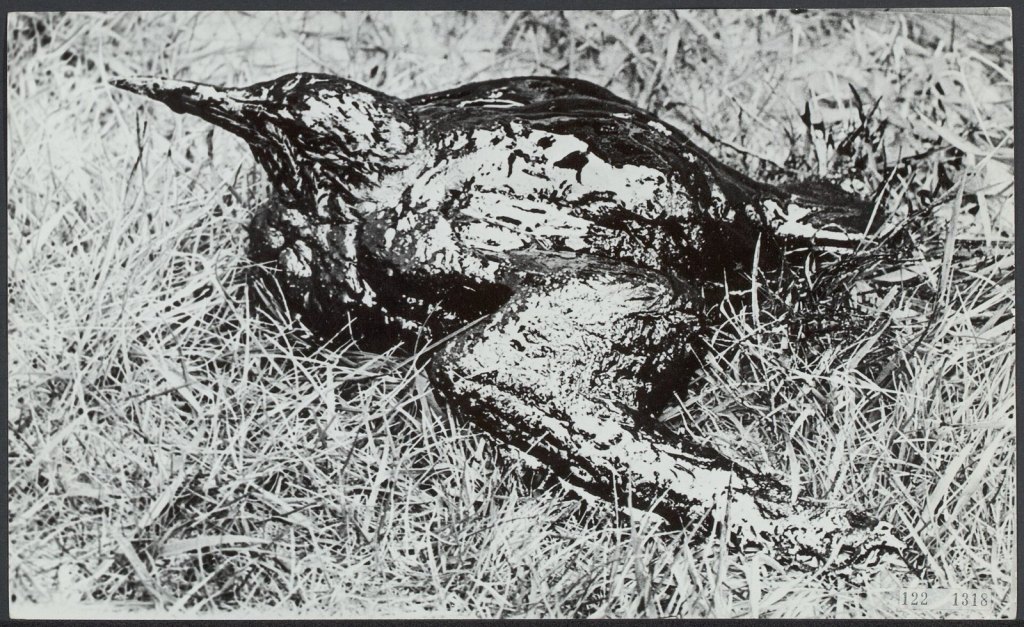
The spill came during the seabird migration. Cedre estimates that about 25,000 birds died, from swallowing oil, pneumonia, exposure and the cleaning agents, and that rehabilitation saved only about 1 per cent of the oiled birds. ITOPF notes the threat to the livelihoods of people who depended on the summer tourist season.
The long view from the shore
Scientists of the Marine Biological Association in Plymouth had studied Cornish rocky shores since the early 1950s, giving a baseline for judging recovery. Their later work found that dispersants killed the limpets that grazed the rocks, which led to a heavy growth of seaweed. Fresh limpets then settled under the weed, grazed it down and died off, starting a further cycle.
At Porthleven, one of the most heavily treated shores, recovery took up to 15 years. At Godrevy, where the National Trust did not allow dispersants because of concern for seals, recovery took two to three years. Where oil was stranded but not treated, there was little mortality. The authors caution that modern dispersants are very different from those of 1967.
The same work showed that where oil was left for a few days before treatment, or stranded without being treated, damage to shore plants and animals was slight, particularly on steep rock faces. The difference between those shores and the treated ones became one of the main lessons of the spill for later responses.
Liability and compensation
The IMO identifies three questions raised by the spill: who was responsible for oil pollution damage, on what basis liability should be decided, and how much compensation should be available. Unlike a collision between two ships, a major spill harmed coastal states and people who had no part in the voyage. The British and French governments and the States of Guernsey pursued claims through the American courts.
In 1969 an IMO conference adopted the Civil Liability Convention, placing liability for pollution damage on the shipowner, and the Intervention Convention, which recognised the right of coastal states to act against casualties threatening serious oil pollution. A second conference in 1971 adopted the Fund Convention, financed by oil receivers, to pay compensation above the shipowner’s limit. It came into force on 16 October 1978.
In the meantime, oil companies set up voluntary schemes. The TOVALOP agreement of 1968 had tanker owners accept strict liability up to a limit, and the CRISTAL scheme added voluntary contributions from cargo owners. ITOPF itself was founded in 1968 after the spill. The 1971 Fund was replaced by the 1992 Fund, which is still in operation.
Torrey Canyon did not create the modern system on its own; the conventions took years to negotiate and bring into force. But the IMO regards the spill as the catalyst for its work on pollution prevention, liability and compensation. Coastal states gained clearer powers to act, and those harmed by a spill gained a route to compensation that did not depend on suing a foreign shipowner.
Timeline
| Date | Event |
|---|---|
| 1959 | Completed by Newport News Shipbuilding |
| 1965 | Enlarged; time charter renegotiated in April |
| 18 February 1967 | Sails from Mina al Ahmadi for Milford Haven |
| 18 March 1967 | Grounds on Pollard Rock, Seven Stones |
| 28 to 30 March 1967 | Wreck bombed to burn the remaining oil |
| May 1967 | Liberian investigation reports |
| 1968 | ITOPF founded; TOVALOP agreement |
| 1969 | Civil Liability and Intervention conventions adopted |
| 18 December 1971 | Fund Convention adopted |
| 16 October 1978 | Fund Convention enters into force |
Sources and further reading
- Bureau of Maritime Affairs, Liberia, Report of the Board of Investigation in the matter of the stranding of the SS Torrey Canyon, 1967. TRID abstract.
- US Court of Appeals, Second Circuit, In re Barracuda Tanker Corporation, 409 F.2d 1013, 1969. Ownership, charters and cargo.
- ITOPF, Torrey Canyon, United Kingdom, 1967.
- Cedre, Torrey Canyon incident information sheet.
- S. J. Hawkins and others, From the Torrey Canyon to today: a 50 year retrospective of recovery from the oil spill, International Oil Spill Conference, 2017.
- International Maritime Organization, 50 years working together against oil pollution from ships.
- International Maritime Organization, Liability and compensation.
- International Maritime Organization, Fund Convention. Adoption and entry into force.
- International Maritime Organization, Address to the conference on the revision of the HNS Convention, 2010. The Intervention Convention.
- ITOPF, Liability and compensation for ship-source oil pollution: an overview. TOVALOP, CRISTAL and the Fund conventions.
- Newark Air Museum, via Navy Net, Buccaneer XN964 and the Torrey Canyon missions.
Image credits. Featured image: An oiled seabird, in an undated Dutch government press photograph catalogued with the Torrey Canyon spill. Photo: Anefo, photographer unknown, Nationaal Archief, Wikimedia Commons, CC0. Other photographs are credited in their captions.
Have a correction or a photograph that helps identify this ship? Contact contact@shipsarchive.com.


.jpg)
