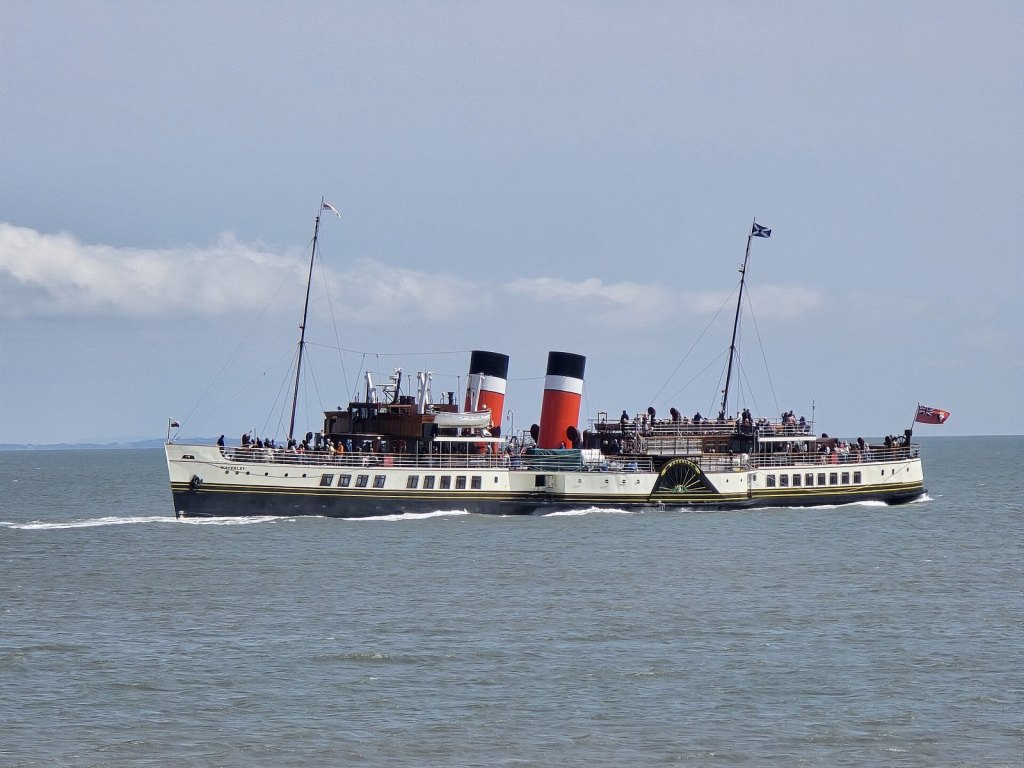
Waverley is the last seagoing passenger paddle steamer in the world. Her engine can be watched from the passenger walkways, but the moving rods show only part of the process. Steam comes from the boilers, works through three cylinders, and is then condensed and pumped back as feed water.
This article follows that cycle from boiler to paddle wheel. It also looks at what the 2020 accident at Brodick showed about handling an engine like hers.
| Builder | A. & J. Inglis, Pointhouse, Glasgow, yard number 1330P |
| Built for | London and North Eastern Railway |
| Keel laid | 27 December 1945 |
| Launched | 2 October 1946 |
| First passenger sailing | 16 June 1947 |
| Length overall | 239 ft 11 in (73.1 m) |
| Breadth over paddle boxes | 17.5 m (PSPS); 17.68 m (National Historic Ships UK) |
| Gross tonnage | 693 |
| Engine | Rankin & Blackmore diagonal triple expansion |
| Rated power | 2,100 ihp |
| Boilers | Two Cochran boilers, fitted 2020 |
| Owner | Waverley Steam Navigation Co, since 1974 |
A railway steamer
Waverley was ordered by the London and North Eastern Railway (LNER) to replace an earlier Waverley. That ship, also built by Inglis, was sunk by aircraft on 29 May 1940 during the evacuation from Dunkirk. The Paddle Steamer Preservation Society (PSPS) says the Admiralty paid £15,125 in compensation towards the new ship, which cost £107,725.
Her keel was laid at Pointhouse on 27 December 1945, and she was launched on 2 October 1946 by Lady Matthews, wife of the LNER chairman. Her operator says post-war shortages slowed the work. She was towed to Greenock on 20 January 1947 to have her boiler and engine fitted.
On trials in June 1947 she reached 18.37 knots. Her first passenger sailing was on 16 June 1947, on the LNER service from Craigendoran up Loch Long to Arrochar.
Her proportions suit excursion work. Much of her width is in the paddle boxes, not the hull. The PSPS gives a beam of 17.5 m, while the National Historic Ships UK register gives 17.68 m. Either way, a breadth figure for a paddle steamer needs to say where it was measured.
The boilers
Waverley now has two Cochran boilers fitted in 2020, burning marine gas oil. Her operator gives a working pressure of 180 psi. They are the latest of several boiler installations.
She was built with a coal-fired, double-ended Scotch boiler, which is now preserved at the Scottish Maritime Museum in Irvine. She changed to oil firing in time for the 1957 season, according to the PSPS chronology; its technical page gives 1956. In 1981 she received a Babcock Steambloc boiler, and in 2000 a pair of Cochran Thermax boilers.
In May 2019 both boilers were found to be beyond repair, and that season was cancelled. A public appeal raised £2.3 million for replacements. The PSPS says she first moved under steam from the new boilers on 13 August 2020 and returned to service on 22 August.
Almost all her machinery runs on steam, not just the main engine. The PSPS counts 11 steam engines on board, including the windlass, capstan, pumps, reversing engine and steering engine.
The engine
The main engine was built by Rankin & Blackmore at the Eagle Foundry in Greenock. It is a three-crank diagonal triple-expansion engine, rated at 2,100 indicated horsepower. Indicated power is the work done in the cylinders, before friction losses, so it is not the power delivered to the paddles.
Steam passes through a high-pressure, a medium-pressure and a low-pressure cylinder in turn. As it loses pressure it takes up more space, so each cylinder is larger than the one before. Her operator gives the bores as 24, 39 and 62 inches, with a stroke of 66 inches. The PSPS technical page gives 66 inches for the low-pressure bore too, which may repeat the stroke figure.
The PSPS says the cylinders typically work at about 130, 35 and 0 psi. The Marine Accident Investigation Branch (MAIB) says the three cylinders were designed to produce equal power, and that the cranks are set at 120 degrees to each other.
The pistons are double-acting, so steam pushes on both sides in turn. Piston valves control the steam to the high and medium-pressure cylinders, and a slide valve serves the low-pressure one. The operator names the valve gear as Stephenson link motion.

The condenser
After the low-pressure cylinder, the steam goes to a condenser, where it is cooled and turned back into water. MAIB explains that this creates a vacuum, helped by a vacuum pump, which keeps steam flowing through the engine.
The water recovered is returned to the boilers as feed water. Re-using it means the ship does not have to keep making large quantities of fresh boiler water.
The paddle wheels
Each wheel has eight timber floats, about 11 ft by 3 ft. The floats feather, which means they change angle as the wheel turns, so they enter and leave the water more cleanly than fixed blades would.
The PSPS gives an example. At 42 rpm the floats move at about 30 ft per second while the ship moves through the water at about 24 ft per second. The difference is the slip that produces thrust.
The crankshaft drives both wheels directly. They cannot turn at different speeds or in different directions. So Waverley cannot put one wheel ahead and the other astern to turn, as some paddle tugs could.
This has a cost in manoeuvring. MAIB gives her turning circle as 548.7 m, large for a ship of her size, and notes that she has a single rudder and no thrusters. Stopping is a strength: MAIB says she can stop in her own length from 16 knots.
Running the engine
The engine is controlled by hand from a position in the engine room. MAIB explains that the engineer on watch sets the speed with the lever for the high-pressure regulating valve, which controls how much steam enters the first cylinder. A separate control lever sets the engine ahead or astern, and impulse steam can be applied to another piston when the engine needs help to start.
Orders come from the bridge by telegraph. MAIB notes that the telegraph rings at each step of a change, from full ahead down through stop to full astern. Voice pipes are used to warn the engine room before berthing, but engine room noise rules them out for engine orders.
The starting steam matters because of a rare problem. If the engine stops with the high-pressure piston exactly at the end of its stroke, steam cannot move the engine through that cylinder. The engineers must then use impulse steam on another cylinder to start it turning.

Brodick, 3 September 2020
On 3 September 2020, at the end of a two-hour excursion, Waverley struck the eastern pier at Brodick on the Isle of Arran while trying to berth. Twenty-one of her 186 passengers and three of her 27 crew were injured, and her bow was damaged above the waterline.
The bridge had ordered the engine stopped and then put astern. When the chief engineer tried to restart it astern, the high-pressure piston had stopped at dead centre. His first attempts with impulse steam failed, and the ship reached the end of the pier still moving faster than intended.
MAIB found that an incorrectly secured piston valve had advanced the engine timing, letting too much steam into the high-pressure cylinder before top dead centre. That made the steam lock harder to clear.
The report, published on 26 February 2025, found that dead centre events were a known but rare hazard. The chief engineer did not know the signs that warned of one. There was no documented training system, and the loss of experienced engineers had made it harder to train new ones.
MAIB also found that maintenance relied on historic records without an effective safety management system, and that the risk of a dead centre event at a closed-end pier had not been assessed. The operator has since introduced planned maintenance, berthing risk assessments and competency-based training, and MAIB made no recommendations. Waverley stayed out of service for the rest of 2020 and returned in June 2021.
Preservation through use
Caledonian MacBrayne withdrew Waverley after the 1973 season. In 1974 it sold her to the PSPS for £1. She returned to service on 22 May 1975 and left the Clyde for the first time in 1977. National Historic Ships UK says she made her first full season of round-Britain cruising in 1981.

Her paddle wheels were replaced in the winter of 1990 to 1991. A £7 million rebuild in 2000 and 2003, at George Prior Engineering in Great Yarmouth and funded mainly by the Heritage Lottery Fund, restored her 1947 appearance while meeting modern safety rules. The PSPS record of the first phase lists the funnels, paddle wheels, crankshaft and boiler all coming out at Great Yarmouth in January 2000.
So Waverley is not an untouched survivor. New boilers, rebuilt structure and an original engine work together. What keeps her running is careful maintenance, well-trained engineers, and good communication between the bridge and the engine room.
Timeline
| Date | Event |
|---|---|
| 27 December 1945 | Keel laid at Pointhouse |
| 2 October 1946 | Launched |
| 16 June 1947 | First passenger sailing |
| 1957 season | Converted from coal to oil |
| 1973 | Withdrawn by Caledonian MacBrayne |
| 1974 | Sold to the PSPS for £1 |
| 22 May 1975 | Returns to service |
| 1981 | New boiler fitted |
| 2000 and 2003 | Heritage rebuild at Great Yarmouth |
| May 2019 | Season cancelled, boilers beyond repair |
| 22 August 2020 | Returns to service with new boilers |
| 3 September 2020 | Contact with Brodick pier |
| June 2021 | Returns to service after repairs |
| 26 February 2025 | MAIB report published |
Sources and further reading
- Paddle Steamer Preservation Society, Paddle Steamer Waverley, history, engine and sale.
- National Historic Ships UK, Waverley, register entry, dimensions and service history.
- Waverley Excursions, Introducing Waverley, history, boiler and engine data.
- Paddle Steamer Preservation Society, Waverley: Chronology, fuel change, ownership and 2019 to 2020 boiler work.
- Paddle Steamer Preservation Society, Waverley: Technical Details, engine, boilers, paddle wheels and dimensions.
- Paddle Steamer Preservation Society, Heritage Rebuild: 2000, aims and photographs of the first phase.
- Marine Accident Investigation Branch, Report 3/2025: Waverley, engine, controls and accident sequence.
- Marine Accident Investigation Branch, Contact with pier by paddle steamer Waverley, summary, injuries and safety issues.
Image credits. Featured image: Waverley leaving Minehead harbour in June 2025. Photo: Scglossop1, Wikimedia Commons, CC BY 4.0. Other photographs are credited in their captions.
Have a correction or a photograph that helps identify this ship? Contact contact@shipsarchive.com.


.jpg)
