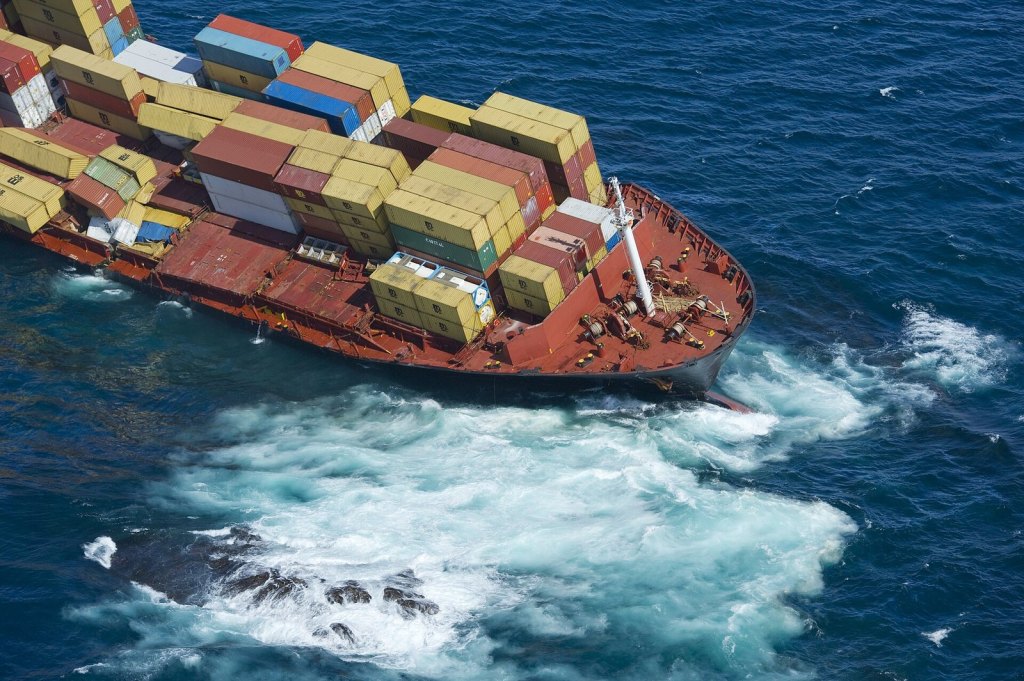
In the early hours of 5 October 2011 the container ship Rena ran aground on Astrolabe Reef, about 12 nautical miles off Tauranga in the Bay of Plenty. Nobody was hurt in the grounding. But the ship never came off the reef, and the oil and cargo lost from her made it one of New Zealand’s most serious maritime environmental disasters.
This article sets out what happened, what the Transport Accident Investigation Commission (TAIC) found, and how the response and salvage unfolded over the following years.
| Built | 1990, Howaldtswerke-Deutsche Werft, Germany |
| Type | Container ship |
| Length | 224.5 m (TAIC); 236 m (Maritime New Zealand) |
| Gross tonnage | 37,209 |
| Flag | Liberia |
| Owner and manager | Daina Shipping Co. and CIEL Shipmanagement S.A. |
| Grounded | 02:14 NZDT, 5 October 2011 |
| Location | Astrolabe Reef (Otaiti), Bay of Plenty |
| Crew | 25 |
| Containers on board | 1,368 |
| Heavy fuel oil on board | 1,733 tonnes (Maritime New Zealand) |
The ship
Rena was built in Germany in 1990 by Howaldtswerke-Deutsche Werft. TAIC gives her length as 224.5 m and her gross tonnage as 37,209. Maritime New Zealand describes her as 236 m long. She had a single fixed-pitch propeller driven by a Sulzer diesel, and TAIC lists her maximum service speed as 20 knots.
In 2011 she was owned by Daina Shipping Co., part of Costamare Inc., and managed by CIEL Shipmanagement S.A. She was registered in Liberia and on time charter to the Mediterranean Shipping Company, which directed her trading. She was working on the New Zealand coast, calling at several ports in turn.
The voyage from Napier
Rena left Napier at 10:20 on 4 October 2011 for Tauranga. The master gave the pilot station an arrival time of 03:00 the next morning. TAIC found that he worked this out by dividing the distance by the ship’s normal service speed, without allowing for the adverse current usually found along that coast.
After sailing, the master learned from notes on the chart about the adverse current. He had already shortened the planned route round Mahia Peninsula, and he now authorised the watchkeepers to leave the planned course lines to save distance and to look for weaker currents.
The second mate took over the watch shortly after midnight. Tauranga Harbour Control told him that the latest time Rena could take a pilot was 03:00, because entry to the harbour is limited by the depth of water and the strength of the tidal current in the channel. On the approach, he tried to make up time.
The passage plan allowed a clearance of 2 nautical miles from Astrolabe Reef. The second mate decided to reduce this to 1 mile. He made a series of small course changes towards the reef and, TAIC found, altered course 5 degrees past the required track. He made no allowance for compass error or for the ship being set sideways, so her track over the ground led straight for the reef.
The grounding
The master came to the bridge to prepare for arrival. TAIC says he took over the ship having received almost no information about where she was, where she was heading, or what dangers lay nearby. During this handover, nobody was monitoring the ship’s position.
At 02:14 Rena struck Astrolabe Reef. TAIC gives her speed as 17 knots. Maritime New Zealand’s own account says about 21 knots, which is above the maximum service speed in the TAIC report. This article follows TAIC.
The bow was wedged on the reef while the stern stayed afloat. Maritime New Zealand reported that two holds flooded and the hull was breached in several places. An oil leak was found that night.

Oil and cargo
Rena was carrying 1,368 containers and 1,733 tonnes of heavy fuel oil, according to Maritime New Zealand. The salvage company Svitzer was appointed by the owners and insurers on 6 October. Salvors began pumping oil from the tanks on 9 October, but bad weather, equipment breakdowns and the ship’s changing condition slowed the work.
A storm overnight on 10 to 11 October was the turning point. Maritime New Zealand estimates that about 350 tonnes of oil were lost, much of it reaching beaches along the Bay of Plenty. The crew were taken off the ship on 11 October, and the following night 86 containers went overboard.
Estimates of the total oil spilled vary. TAIC gives about 200 tonnes of heavy fuel oil lost to the sea. The Bay of Plenty Regional Council gives a range of 130 to 350 tonnes. The difference partly reflects how hard it was to measure loss from a broken ship on an exposed reef.
The salvors eventually recovered more than 1,300 tonnes of fuel oil, and all the accessible oil was out by 15 November 2011. Container removal began the next day, and 341 containers had been lifted off by 26 December.

The response ashore
Response staff, local volunteers and the armed forces cleaned oiled beaches and collected debris from lost containers. The Department of Conservation said up to 150 of its staff worked on the response each day at its height.
At the peak, 409 birds were being cared for at the Te Maunga wildlife facility. They included 345 little blue penguins, four pied shags and 60 New Zealand dotterels, which were caught before they could be oiled. Follow-up surveys found that about 90 per cent of the birds released settled back into the wild.

The ship breaks up
Rena stayed on the reef through the southern summer, weakening with each storm. On 8 January 2012 she broke in two. Maritime New Zealand estimates that 200 to 300 of the roughly 830 containers still aboard were lost.
By 10 January the stern section was about three-quarters underwater, and it sank completely in early April 2012. Its forward end came to rest in about 23 m of water and its after end in about 65 m.
The salvage was then managed by Resolve Fire and Salvage, with Braemar Howells handling container recovery. The Bay of Plenty Regional Council’s timeline records 944 containers recovered by mid-2012 and 1,007 later. By August 2013 work on the bow section had cut it down to at least one metre below the surface.
What the investigation found
TAIC published its final report on 18 December 2014. It found that the grounding followed from the master and crew not following the navigation and watchkeeping standards set out in Rena’s safety management system.
On 19 November 2014 TAIC recommended that CIEL check the effectiveness of its safety management system across its fleet. The recommendation noted that the standards had not been followed for at least the six coastal voyages before the grounding, and that other CIEL ships had a higher rate of port state control deficiencies than the regional average.
The report’s key lessons were that ship managers must make sure their safety management systems deliver safe operations on every ship, that crews must follow the required practice for passage planning and watchkeeping, and that national training systems must meet the international STCW standards.
Separately, an independent review of Maritime New Zealand’s own response, by Simon Murdoch, was published in March 2013.
The wreck that remains
The future of the wreck became a long dispute. The Crown’s October 2012 settlement with the owners included a deed obliging it to consider supporting an application by the owners to leave the remains on the reef.
The Waitangi Tribunal heard claims from Motiti Island and Bay of Plenty Māori groups in 2014. In its final report, published on 29 April 2015, it found the Crown had signed the deed without enough knowledge of Māori interests in Otaiti and without consulting those affected, breaching the Treaty principles of partnership and mutual benefit.
In June 2016 Maritime New Zealand reported that its director had withdrawn the statutory notices that declared the wreck a hazard to navigation and a hazardous ship. More than 22,000 tonnes of debris had been removed from the seabed. Some oil remained trapped in the wreck, to be monitored under the resource consent.
NZHistory puts the cost of the salvage at about $700 million and says the operation ended in April 2016. The reef itself, known to Māori as Otaiti, still holds what is left of the ship.
Timeline
| Date | Event |
|---|---|
| 4 October 2011, 10:20 | Rena leaves Napier for Tauranga |
| 5 October 2011, 02:14 | Grounds on Astrolabe Reef |
| 6 October 2011 | Svitzer appointed as salvor |
| 9 October 2011 | Oil pumping begins |
| 10 to 11 October 2011 | Storm; about 350 tonnes of oil lost; crew taken off |
| 15 November 2011 | All accessible oil removed |
| 16 November 2011 | First container lifted off |
| 8 January 2012 | Ship breaks in two |
| April 2012 | Stern section sinks |
| March 2013 | Murdoch review published |
| 18 December 2014 | TAIC final report published |
| 29 April 2015 | Waitangi Tribunal final report |
| June 2016 | Statutory notices withdrawn |
Sources and further reading
- Transport Accident Investigation Commission, Inquiry MO-2011-204: Container ship MV Rena grounding on Astrolabe Reef, inquiry page.
- Transport Accident Investigation Commission, Final report 11-204, ship details, voyage, findings and key lessons.
- Transport Accident Investigation Commission, Recommendation 010/14, recommendation to CIEL Shipmanagement.
- Maritime New Zealand, MV Rena, response case study.
- Maritime New Zealand, Independent Review of Maritime New Zealand’s Response to the MV Rena Incident, Simon Murdoch, March 2013.
- Maritime New Zealand, Safe Seas Clean Seas, issue 50, June 2016, statutory notices withdrawn.
- Ministry for Culture and Heritage, The Rena disaster, NZHistory, salvage cost and duration.
- Bay of Plenty Regional Council, Coastal State of the Environment Report, Rena timeline.
- Department of Conservation, Annual Report for the year ended 30 June 2012, wildlife response.
- Waitangi Tribunal, The Final Report on the MV Rena and Motiti Island Claims published, 29 April 2015.
Image credits. Featured image: Rena aground on Astrolabe Reef on 13 October 2011, eight days after the grounding. Photo: New Zealand Defence Force, Wikimedia Commons, CC BY 2.0. Other photographs are credited in their captions.
Have a correction or a photograph that helps identify this ship? Contact contact@shipsarchive.com.


.jpg)
.jpg)
