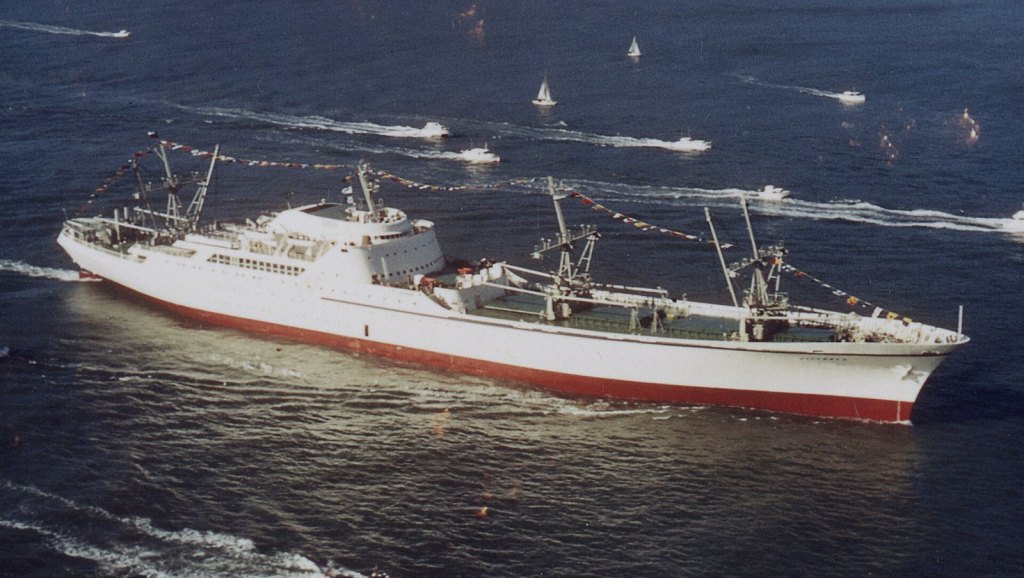
Savannah was built to show that a nuclear reactor could drive an ordinary merchant ship on commercial routes. She was a joint project of the Maritime Administration (MARAD) and the Atomic Energy Commission (AEC), announced by President Eisenhower on 25 April 1955 under his Atoms for Peace programme.
She carried cargo and passengers in regular service and is now a nuclear facility in the final stages of decommissioning at Baltimore. The ship proved that the technology worked at sea. Her own official histories are equally clear that she did not prove nuclear propulsion could pay its way in cargo service.
| Type | Nuclear-powered cargo and passenger ship |
| Owner | US Maritime Administration |
| Designer | George G. Sharp, naval architects, New York |
| Builder | New York Shipbuilding Corporation, Camden, New Jersey |
| Reactor | Babcock & Wilcox pressurised water reactor, 74 MW thermal |
| Keel laid | 22 May 1958 |
| Christened | 21 July 1959 |
| Delivered | 1 May 1962 |
| Length | 595 ft 6 in (181.5 m) |
| Beam | 78 ft (23.8 m) |
| Displacement | About 21,800 tons |
| Passengers | 60, in 30 staterooms |
| Status | Under decommissioning, NRC licence NS-1, Baltimore |
Why a merchant ship
In the mid-1950s the United States wanted a visible civilian use for atomic energy, and Congress authorised the ship on 30 July 1956. A merchant ship suited that aim well. She would call at foreign ports, carry real cargo and let the public see a reactor operating safely in a hull that berthed alongside ordinary shipping.
The design went to the New York firm of George G. Sharp. The 1982 National Register nomination prints the name as George W. Sharp, which appears to be a typing error. Babcock & Wilcox supplied the reactor plant, De Laval built the turbines and reduction gears, and New York Shipbuilding built the hull at Camden.
The Soviet icebreaker Lenin was operating at least a year before Savannah, so she was not the first nuclear surface ship. She was the first nuclear merchant ship built to carry cargo and passengers. Germany’s Otto Hahn followed in 1968 and Japan’s Mutsu in 1971.
Construction and trials
Patricia Nixon, wife of the Vice President, laid the keel on 22 May 1958. Mamie Eisenhower christened the ship on 21 July 1959. The reactor core was installed on 11 November 1961, and the reactor first reached criticality on 21 December 1961.
Captain Gaston DeGroote took command on 31 January 1962. Sea trials were run from Yorktown, Virginia, and in the first week of April the ship reached full power and more than 22 knots. She was delivered on 1 May 1962 to States Marine Lines, the first operating agent.

The reactor plant
The core held 32 fuel elements, each made up of 164 rods of uranium dioxide. Enrichment averaged 4.4 per cent, with 4.2 per cent in the inner elements and 4.6 per cent in the outer ones. Twenty-one cruciform control rods could shut the reactor down, or scram it, in 1.6 seconds.
The primary circuit ran at 1,750 psi and more than 500°F. It passed its heat through steam generators to a separate secondary loop, so the steam reaching the turbines was not the water that had passed through the core. That separation is the basic principle of a pressurised water plant, and it shaped much of the ship’s layout.
Power figures vary with the source. The ASME landmark record gives a design rating of 20,000 shaft horsepower at 107 rpm, and reports more than 22,300 shp and a top speed of 24 knots. The 1982 nomination quotes a maximum of 22,000 shp and a designed top speed of 20.25 knots. The figures describe different conditions and should not be merged into one.
What the reactor cost the ship
The reactor sat amidships inside a steel containment vessel 35 ft in diameter and 50 ft long, designed for 186 psig. The 1982 nomination puts the shielding at 2,150 tons in eight layers. Beside the reactor compartment ran a collision mat 24 in thick, built up from steel and redwood, to absorb the energy of a ship striking her side.
None of this weight or space earned freight. The ship also needed back-up power: two 750 kW diesel generators and a 750 hp take-home motor that could move her slowly if the reactor was shut down. A conventional cargo ship of the same size needed none of it.
The 1991 National Historic Landmark study is candid about the commercial compromises. It notes the luxurious passenger spaces, inefficient hatches and inadequate cargo gear. There were seven holds, one of them served only through side ports. Cargo capacity is given as 9,400 tons in the 1982 nomination and 10,000 tons in the 1991 study.

Passengers as part of the message
Savannah carried up to 60 passengers in 30 staterooms, with a dining room seating about 75 and a swimming pool. Her galley had an early Raytheon Radarange microwave oven. The white hull and streamlined superstructure, set aft of the reactor hatch, were meant to look modern, and the design brief valued public impression as much as cargo handling.
The demonstration voyages put that image to work. The first voyage began on 20 August 1962, bound for Savannah, Georgia. A faulty pressure indicator caused a scram on that first leg, a reminder that an operating reactor was still new to merchant crews. Later in 1962 she visited the Seattle World’s Fair.
Labour, operators and the Atlantic
In May 1963 a dispute over crew pay scales led her licensed engineers to shut the reactor down. The operating agency passed to American Export Isbrandtsen Lines, and about a year was lost. In 1964 the ship made her first transatlantic crossing, from New York to Bremerhaven in ten days.
By the end of the demonstration phase in 1965 she had steamed about 90,000 miles, received some 1.4 million visitors and carried 848 passengers and 4,800 tons of cargo. The passenger spaces were then sealed, and about 1,800 tons of ballast were removed.
Commercial service and fuel
First Atomic Ship Transport (FAST) leased the ship for $1 a year. The AEC issued operating licence NS-1 on 5 August 1965, and her first commercial voyage that September carried about 10,000 tons of cargo.
A 1966 fuel management report found that less than 30 per cent of the first core’s life had been used by the end of the European demonstration voyages in March 1965. Fuel burn-up rose once she was in regular service. When the ship was refuelled at Galveston in late 1968, only four of the 32 fuel elements were replaced.
Over her career she steamed more than 450,000 miles and consumed about 163 lb of uranium. Between 1965 and 1970 she earned nearly $12 million in revenue, against a public investment of about $90 million. Endurance was real, but the cost of the plant, a specialist crew and limited port access could not be recovered from freight.
Retirement and a long afterlife
Sources give different retirement dates because they describe different steps. The 1982 nomination says she was taken out of service in November 1970. The NRC says all fuel had been removed by October 1971. The National Historic Landmark study records deactivation in late 1971, and the ASME record says she was retired in the autumn of 1971.
In 1972 she was offered to the city of Savannah as an Eisenhower Peace Memorial, but the plan did not go ahead. From 22 October 1981 she was displayed at Patriots Point in South Carolina. That charter ended on 14 July 1994, and she joined the James River Reserve Fleet in Virginia.
She left the reserve fleet on 15 July 2006. Her home port moved to Baltimore on 3 June 2008. She was listed on the National Register of Historic Places on 14 November 1982, designated an ASME landmark in 1983 and a National Historic Landmark in 1991.

Decommissioning
The ship remains licensed by the Nuclear Regulatory Commission and is being decommissioned by the DECON method, in which radioactive components are removed so the licence can be ended. The reactor pressure vessel was lifted out on 8 November 2022 and sent for disposal at Clive, Utah.
MARAD submitted a licence termination plan on 23 October 2023. The NRC approved it on 30 January 2025 as Amendment 19. That approval is not the end of the licence: a separate termination request is still required. The NRC page records the licensee’s intention to make that request by December 2025 and an estimated closure by 2031.
The ship’s future after decommissioning is a separate question. A Programmatic Agreement executed on 17 March 2023 set up a peer review group and committed MARAD to a good-faith effort to find a preservation option. As of the NRC page last reviewed on 27 August 2026, no final disposition had been recorded.
Savannah’s record is therefore mixed but clear. She showed that a merchant ship could carry a reactor safely through years of ordinary port calls. She also showed how much hull, money and staff that reactor consumed, which is why no American nuclear merchant ship followed her.
Timeline
| Date | Event |
|---|---|
| 25 April 1955 | Eisenhower announces a nuclear-powered merchant ship |
| 30 July 1956 | Congress authorises the ship |
| 22 May 1958 | Keel laid at Camden by Patricia Nixon |
| 21 July 1959 | Christened by Mamie Eisenhower |
| 21 December 1961 | Reactor reaches criticality |
| 1 May 1962 | Delivered to States Marine Lines |
| 20 August 1962 | Demonstration voyages begin |
| May 1963 | Reactor shut down during labour dispute |
| 1964 | First transatlantic crossing, New York to Bremerhaven |
| 5 August 1965 | Operating licence NS-1 issued; commercial service follows |
| Late 1968 | Refuelled at Galveston |
| 1970 to 1971 | Withdrawn from service and defuelled |
| 22 October 1981 | Displayed at Patriots Point |
| 14 July 1994 | Patriots Point charter ends; to James River Reserve Fleet |
| 3 June 2008 | Home port moves to Baltimore |
| 8 November 2022 | Reactor pressure vessel removed |
| 30 January 2025 | NRC approves the licence termination plan |
Sources and further reading
- National Park Service, Savannah National Register nomination, 1982.
- National Park Service, N.S. Savannah National Historic Landmark nomination, 1991, via MARAD.
- American Society of Mechanical Engineers, N.S. Savannah, landmark 87.
- American Society of Mechanical Engineers, N.S. Savannah landmark brochure, 1983.
- Maritime Administration, Savannah vessel history.
- Maritime Administration, N.S. Savannah document library.
- Transportation Research Board, NS Savannah fuel management report, 1966 abstract.
- Nuclear Regulatory Commission, Nuclear Ship Savannah, decommissioning status.
- Maritime Administration, N.S. Savannah decommissioning and disposition.
Image credits. Featured image: Savannah under way in 1962, the year of her delivery and her visit to the Seattle World’s Fair. Photo: Elton Lord, US Atomic Energy Commission, Wikimedia Commons, Public domain. Other photographs are credited in their captions.
Have a correction or a photograph that helps identify this ship? Contact contact@shipsarchive.com.


_(cropped).jpg)