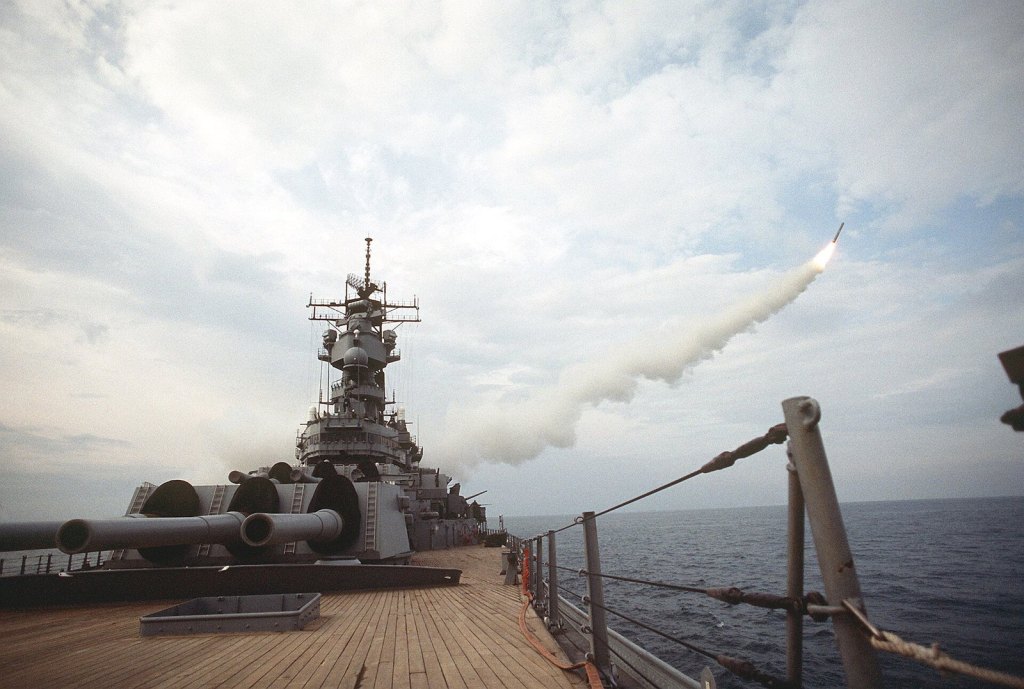
In January 1991 Missouri fired Tomahawk cruise missiles at Iraq from a ship whose main guns dated from 1944. The mix was deliberate. Her 1980s refit kept the heavy gun battery and added missiles that could reach far beyond it.
This article looks at what the refit kept, what it replaced, and why the battleship still needed other ships to protect her.
| Hull number | BB-63 |
| Class | Iowa |
| Builder | New York Navy Yard, Brooklyn |
| Laid down | 6 January 1941 |
| Launched | 29 January 1944 |
| Commissioned | 11 June 1944 |
| Length | 887 ft 3 in (270.4 m) |
| Machinery | 8 Babcock & Wilcox boilers, 4 General Electric geared turbines |
| Power | 212,000 shp on four shafts |
| Main battery | Nine 16-inch/50 guns in three turrets |
| Recommissioned | 10 May 1986 |
| Final decommissioning | 31 March 1992 |
| Today | Museum ship at Pearl Harbor, Hawaii |
The ship of 1944
Missouri was laid down at the New York Navy Yard on 6 January 1941 and launched on 29 January 1944. Margaret Truman, the daughter of Senator Harry S. Truman, was her sponsor. She was commissioned on 11 June 1944.
The official history in the Dictionary of American Naval Fighting Ships (DANFS) lists her original armament as nine 16-inch guns, twenty 5-inch guns, 80 40 mm guns and 49 20 mm guns. The Historic American Engineering Record notes that the number and arrangement of the light anti-aircraft guns varied from ship to ship and over time.
She went to the Pacific in late 1944 and took part in the Iwo Jima landings, the Okinawa campaign and raids on Japan. By then carrier aviation dominated the Pacific war, and fast battleships like Missouri operated with the carrier forces.
On 2 September 1945 the Japanese surrender was signed on her deck in Tokyo Bay. That ceremony is still the event most people associate with the ship.

The main guns
The nine 16-inch/50 guns were mounted in three turrets of three. The Battleship Missouri Memorial lists two main shell types: a 2,700-pound armour-piercing shell and a 1,900-pound high-capacity shell for targets ashore. A standard charge was six 110-pound bags of powder.
The memorial gives the guns a range of 23 miles. A later account in the Naval Institute’s Proceedings gives 26 miles, so the figure depends on the source and the ammunition. The rate of fire was two rounds per minute per gun.

Each turret needed a large crew and a magazine and hoist system below decks to move shells and powder to the guns. The three barrels seen above deck were only a small part of the installation.
Reserve and reactivation
After the war Missouri remained in commission. On 17 January 1950, then the only US battleship in commission, she ran aground near Thimble Shoals Light while leaving Hampton Roads on a training mission. DANFS says she was lifted some 7 ft above her waterline and was not refloated until 1 February, with the help of tugs, pontoons and a rising tide.
In September 1950 she became the first American battleship to reach Korean waters. On 15 September she bombarded Samchok as a diversion for the Inchon landings. In December she gave gunfire support around the Hungnam perimeter until the last UN troops were evacuated by sea on Christmas Eve.
She returned for a second Korean tour in 1952 and 1953, bombarding targets along the east coast, including Wonsan, Chongjin and Hungnam.
DANFS says she was decommissioned at Puget Sound Naval Shipyard on 26 February 1955 and joined the reserve fleet at Bremerton, where she stayed for about thirty years.
In the 1980s the Navy brought back all four Iowa-class battleships. Missouri was modernised and recommissioned at San Francisco on 10 May 1986, with Captain Albert L. Kaiss in command.
What the refit changed
The Historic American Engineering Record summarises the main changes. The 5-inch battery was cut from twenty guns to twelve. Sixteen Harpoon anti-ship missiles and thirty-two Tomahawk missiles were added.
The Tomahawks were carried in armoured box launchers, each holding four missiles. Norman Polmar and Thomas Allen note in Naval History that later warships carried Tomahawks in vertical launch cells instead.
The memorial lists four Phalanx close-in weapon systems. These were 20 mm Gatling guns, firing 3,000 rounds a minute, for defence against missiles and aircraft at short range.
Crew numbers fell sharply. The memorial gives a wartime complement of 134 officers and 2,400 enlisted men, and 65 officers and 1,450 enlisted for 1986 to 1992.
The refit did not remove the main battery or turn the ship into a missile cruiser. The new weapons were fitted around a hull and superstructure laid out in the early 1940s.
Tomahawk and Harpoon
The memorial describes the Tomahawks as anti-surface or land-attack missiles. Harpoon was a separate, shorter-range anti-ship missile. The two weapons gave the ship roles that her guns could not cover.
DANFS records the first Tomahawk launch from Missouri on 25 May 1988, during exercises off San Diego.
To the Gulf
Missouri was due to be laid up again in 1990 when Iraq invaded Kuwait. According to the Proceedings account, Captain Kaiss had returned to command her on 13 June 1990. She sailed for the Persian Gulf on 13 November 1990 with a newly embarked Pioneer remotely piloted aircraft.
Two battleships, Missouri and Wisconsin, served in the Gulf. The Proceedings account says that Wisconsin, which had been there longer, became the Tomahawk strike commander, and Missouri took the role of shore bombardment commander.
DANFS says Missouri fired her first Tomahawk at 01.40 on 17 January 1991, the opening day of Operation Desert Storm. She fired 27 more over the following days, a total of 28.
The guns in action again
On 3 February her 16-inch guns fired in combat for the first time since March 1953, off Korea. The Navy’s campaign history says she fired 112 rounds over three days before Wisconsin relieved her. She later fired 60 rounds off Khafji.

After minesweepers had cleared a lane, she fired 133 rounds in four missions on 23 February. This was part of a feint, meant to make the Iraqis expect a landing on the Kuwaiti coast.
The Pioneer aircraft helped her gunners. The official history of the frigate Jarrett says it was launched with a rocket booster and caught in a net on the fantail. It sent pictures back to the ship, so that observers could walk the shells onto their targets.
The Silkworm attack
At 04.52 on 25 February 1991 an Iraqi battery at al-Fintas fired two Silkworm anti-ship missiles at the ships. The Jarrett history says one fell into the sea soon after launch. The other was shot down by two Sea Dart missiles from the British destroyer HMS Gloucester.
Jarrett and a helicopter fired chaff and decoys. A Naval History and Heritage Command account notes that the Silkworm was shot down only after it had passed its closest point to Missouri, so it had already missed.
Missouri then launched her Pioneer, which found the Silkworm battery. The Jarrett history says she fired about 30 rounds and knocked it out.
The episode is sometimes presented as a test of her armour. It was not. The missile never hit her. Her protection that morning came from minesweepers, escorts, decoys and a British air defence ship, not from her armour belt.
By the end of the war, Proceedings records, Missouri had fired more than 800 16-inch rounds and 28 Tomahawks.
The last years
Missouri returned to Long Beach on 13 May 1991. On 7 December 1991 she hosted President George H. W. Bush at Pearl Harbor for the 50th anniversary of the Japanese attack.
She was decommissioned at Long Beach on 31 March 1992, with Captain Kaiss again in command. DANFS says she was struck from the Naval Vessel Register on 12 January 1995 and donated as a museum and memorial ship on 4 May 1998.
DANFS says she was then transferred to Pearl Harbor, where she lies near the USS Arizona Memorial. The memorial association says she opened to the public in 1999.
Reading the preserved ship
A visitor comparing the ship today with photographs from 1945 will see differences. The light anti-aircraft guns have gone, there are fewer 5-inch mounts, and missile launchers and Phalanx mounts have been added.
Her last commission shows how much of an old warship could be reused, and how much new equipment and support it needed to fight again.
Timeline
| Date | Event |
|---|---|
| 6 January 1941 | Laid down at New York Navy Yard |
| 29 January 1944 | Launched |
| 11 June 1944 | Commissioned |
| 2 September 1945 | Japanese surrender signed on board |
| 26 February 1955 | Decommissioned into reserve |
| 10 May 1986 | Recommissioned at San Francisco |
| 25 May 1988 | First Tomahawk launch from the ship |
| 17 January 1991 | First Tomahawk fired at Iraq |
| 25 February 1991 | Silkworm attack, missile destroyed by HMS Gloucester |
| 31 March 1992 | Final decommissioning |
| 12 January 1995 | Struck from the Naval Vessel Register |
| 4 May 1998 | Donated as a museum ship |
Sources and further reading
- Naval History and Heritage Command, Missouri III (BB-63), Dictionary of American Naval Fighting Ships.
- Historic American Engineering Record, USS Missouri, Library of Congress, armament changes.
- Battleship Missouri Memorial, Ship Characteristics, machinery, guns, ammunition and crew.
- Norman Polmar and Thomas B. Allen, Naval Weapon of Choice, Naval History, February 2016, armoured box launchers.
- Naval History and Heritage Command, H-Gram 059-1, mine clearance and the Silkworm attack.
- U.S. Navy, The War with Iraq, campaign history of Desert Storm at sea.
- Stuart Landersman, The Last Battleship Sailor, Proceedings, January 2019, based on an account by Captain Albert Lee Kaiss.
- Naval History and Heritage Command, Jarrett (FFG-33), Pioneer operations and the Silkworm attack.
- Naval History and Heritage Command, USS Missouri (BB-63), National Museum of the U.S. Navy photograph collection.
Image credits. Featured image: A Tomahawk land-attack missile leaves Missouri at the start of Operation Desert Storm, 17 January 1991. Photo: PH3 Brad Dillon, U.S. Navy, Wikimedia Commons, Public domain. Other photographs are credited in their captions.
Have a correction or a photograph that helps identify this ship? Contact contact@shipsarchive.com.


_flyover,_Tokyo_Bay,_2_September_1945_(520775).jpg)


_Tomahawk.jpg)