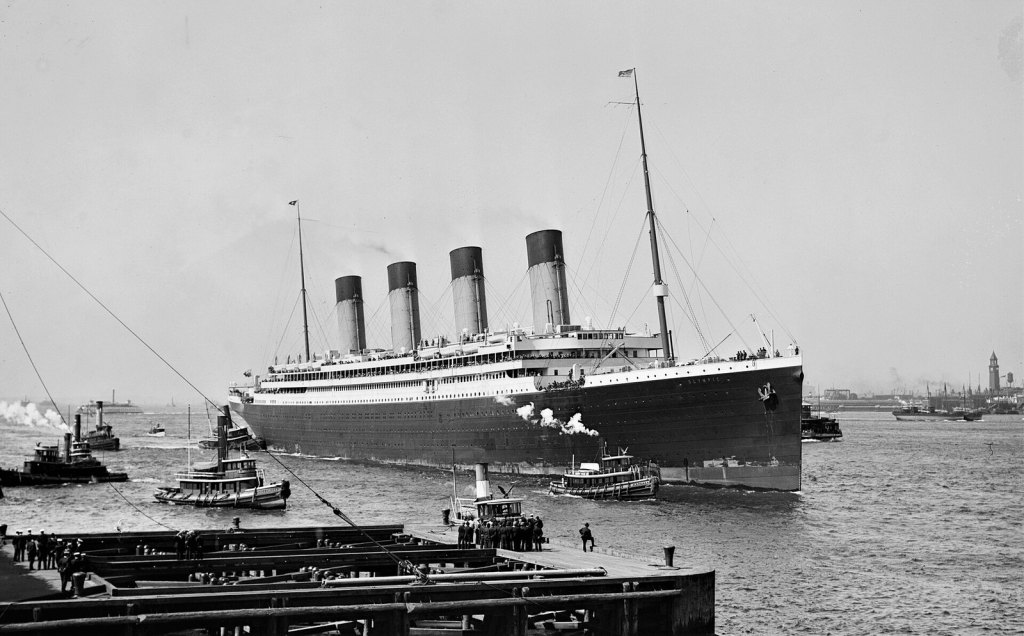
Olympic reached the Tyne on 13 October 1935 under her own steam, with a skeleton crew, the White Star house flag at her masthead and thousands of people on the piers. She was 24 years old, her engines were sound and she had made 257 round voyages between Southampton and New York. What followed was not a single act of scrapping but a sequence of separate transactions over four years: the sale of the ship, a ten day auction of her contents, the cutting down of her upper works at Jarrow and the final demolition of the hull at Inverkeithing. Each stage left its own record, and some of the fittings sold in 1935 are still in use today.
| Name | RMS Olympic |
| Type | Transatlantic passenger liner, triple screw |
| Builder | Harland & Wolff, Belfast; yard number 400 |
| Keel laid | 16 December 1908 |
| Launched | 20 October 1910 |
| Maiden voyage | 14 June 1911, Southampton to New York |
| Length overall | 882 ft 9 in (269 metres) |
| Beam | 92 ft 6 in (28.2 metres) |
| Gross tonnage | 45,324 as built; 46,439 after the 1920 refit |
| Operators | White Star Line; Cunard White Star from 1934 |
| Last commercial arrival | Southampton, 12 April 1935 |
| Sold | September 1935, to Sir John Jarvis for £97,500; resold to Thos. W. Ward Ltd |
| Breakers | Thos. W. Ward Ltd: Palmers yard, Jarrow, 1935 to 1937; Inverkeithing, 1937 onwards |
| Removed from register | 4 February 1939 |
Twenty four years on the North Atlantic
Olympic’s keel was laid at Harland & Wolff on 16 December 1908 as yard number 400, alongside her sister Titanic. She was launched on 20 October 1910 and sailed on her maiden voyage from Southampton on 14 June 1911 under Captain Edward Smith. In September 1911 she collided with the cruiser HMS Hawke in the Solent and returned to Belfast for repairs. After Titanic’s loss she was rebuilt with an inner skin along her boiler and engine rooms and with several bulkheads carried up to B deck.
As a troopship in the First World War she earned the name Old Reliable, and on 12 May 1918 she rammed and sank the German submarine U-103 in the English Channel. Her 1919 to 1920 refit at Belfast converted her boilers from coal to oil firing. Through the 1920s she was among the best liked ships on the Southampton route, but bookings fell after 1930, and in May 1934 a collision in fog sank the Nantucket lightship with the loss of seven of her crew.

Withdrawal and the floating hotel scheme
White Star merged with Cunard on 10 May 1934, and the combined fleet had more old express liners than it needed. Olympic arrived at Southampton from her last crossing on 12 April 1935 and was laid up. Correspondence studied by the historian Mark Chirnside shows that the company was in no hurry to scrap her. On 27 April the general managers wrote that no decision had yet been taken to dispose of her, although it was extremely unlikely that she would be recommissioned.
In May 1935 a promoter named Thiemann, who had earlier tried to buy Mauretania, asked about using Olympic as a floating hotel off the French Riviera. Cunard White Star told its broker that it would consider a figure around £150,000 and held back from stripping the ship while the scheme was explored. Thiemann wanted her delivered complete with furniture, plate and linen and the right to keep the name. The scheme stalled on French official approvals and finance, and by late July the company was preparing to put her on the breaking market. A French government enquiry, prompted by rumours that Italy wanted her as a troopship, also came to nothing.
Sir John Jarvis and the Jarrow scheme
Jarrow had lost its main employer when Palmers shipyard closed in the early 1930s, and unemployment in the town was among the worst in Britain. Sir John Jarvis led a relief scheme raised in Surrey to help the town, and breaking up a large liner at the old Palmers yard was one of its projects. In May 1935 he had told the company that Olympic was too large to bring alongside the wharf at Jarrow. Dredging solved the problem, and after an inspection in August his offer was accepted. He paid £97,500, and the ship passed to Thos. W. Ward Ltd of Sheffield, which would carry out the work under what The Times called the Surrey scheme.
The last voyage, 11 to 13 October 1935
Olympic left Southampton on the evening of 11 October 1935 under Captain P. R. Vaughan, formerly of the Homeric, with a pilot from South Shields and a skeleton crew that included several of her old hands. Ships in the harbour sounded their sirens as she passed. She flew the White Star house flag with the Blue Ensign at her stern.
She anchored off the Tyne early on 13 October and entered the river shortly before three in the afternoon, after the morning mist had cleared. She steamed up river under her own power, with two tugs ahead and two astern to work her into her berth alongside Palmers yard at the top of the tide. The Times reported that the work would employ some hundreds of Jarrow men for 18 months and pay about £100,000 in wages. A civic reception for 200 guests was held on board the next day, and special excursion trains ran from London for people who wanted a last look at the ship.
Ten days of sale
Before any cutting began, the contents were sold at Jarrow by the auctioneers Knight, Frank & Rutley on the instructions of Ward. The catalogue runs to more than 4,000 lots over ten sale days between Tuesday 5 and Monday 18 November 1935. It worked through the ship deck by deck. The first day began on the sun deck with the officers’ quarters, the bridge and the wheelhouse, and went on to the promenade deck staterooms and the first class lounge, drawing room, smoking room and verandah cafés.
Later days covered the first class restaurant and the Café Parisien, the dining saloon and kitchens on C deck, hundreds of cabins in each class, crew quarters, the swimming bath and the electric baths. The ninth day, 15 November, was given over to panelling, flooring, staircases, mantelpieces and passenger lifts. The tenth disposed of the ship’s instruments, machinery, lifeboats, davits, winches and fans. The catalogue is precise about what was being sold: a typical lot from the gymnasium is the white enamelled and oak panelling, with ceiling, 42 ft 6 in by 17 ft 6 in, with its two doors, seven windows and three Corinthian columns.
Cutting her down at Jarrow
Once the contents had gone, Ward’s men began removing the superstructure and the upper hull at Palmers. The work went on for nearly two years. The Ward company records, now held in the Marine Technology Special Collection at Newcastle University, include outturn ledgers recording the material recovered from ships the firm broke up, and they cover Olympic and the later stage of the work in Scotland.
By September 1937 the superstructure and upper hull had gone, and what remained could be towed north. On 19 September it left the Tyne under tow, and on 21 September it arrived at Ward’s yard at Inverkeithing on the Firth of Forth, where the company finished the work.
Inverkeithing and the end of the register entry
At Inverkeithing the remaining hull was broken up over the following months. The exact completion date is not recorded in the published sources, but the ship was removed from the register on 4 February 1939. Her chief engineer was quoted as saying that he could understand the decision if the old lady had lost her efficiency, but that her engines were as sound as they had ever been.
What survives ashore
The auction scattered Olympic’s interiors across Britain. The best known group is at the White Swan Hotel in Alnwick, Northumberland. Its owner, Algernon Smart, bought fittings from the first class lounge and part of the aft grand staircase, and built them into a new room at the hotel, now called the Olympic Suite. Historic England’s listing of the hotel describes the room and its fittings from the ship. The hotel itself refers to original panelling, mirrors and ornate ceilings from the liner.

Other fittings went elsewhere. The lounge electrolier, together with panelling from the library and a set of doors, is in Cutlers’ Hall in Sheffield. Panelling, light fittings, flooring, doors and windows were installed in a paint factory at Haltwhistle in Northumberland, where they stayed until they were sold at auction in 2004. Furniture from a single stateroom is at the Sparth House Hotel in Clayton le Moors, Lancashire, and some of the timber went into an extension of St John the Baptist’s Catholic Church at Padiham.

None of these rooms is a shipboard space preserved intact. Fittings were bought by the lot, cut to new dimensions and combined with other material, so the auction catalogue, the builder’s photographs and plans remain the best evidence of how the original rooms were arranged.
Timeline
| Date | Event |
|---|---|
| 16 December 1908 | Keel laid at Harland & Wolff, Belfast |
| 20 October 1910 | Launched |
| 14 June 1911 | Maiden voyage from Southampton to New York |
| 12 May 1918 | Rams and sinks U-103 in the English Channel |
| 10 May 1934 | White Star and Cunard merge as Cunard White Star |
| 12 April 1935 | Final arrival at Southampton; laid up |
| May to July 1935 | Floating hotel proposal for the French Riviera |
| September 1935 | Sold to Sir John Jarvis for £97,500; resold to Thos. W. Ward |
| 11 October 1935 | Leaves Southampton for Jarrow |
| 13 October 1935 | Berths alongside Palmers yard, Jarrow |
| 5 to 18 November 1935 | Ten day auction of fittings and equipment |
| 19 to 21 September 1937 | Hull towed from Jarrow to Inverkeithing |
| 4 February 1939 | Removed from the register |
Sources and further reading
- The Times, 12 October 1935, Last voyage of the Olympic, reproduced by Encyclopedia Titanica.
- The Times, 14 October 1935, Olympic berthed at Jarrow, reproduced by Encyclopedia Titanica.
- Mark Chirnside, Olympic: a floating French hotel, first published in the Titanic Commutator, 2007.
- Knight, Frank & Rutley, Catalogue of the first day’s sale of the RMS Olympic at Jarrow Docks, 5 November 1935, hosted by Encyclopedia Titanica.
- Encyclopedia Titanica, 1935 Olympic dispersal auction catalogue. The full order of sale.
- J. Kent Layton, RMS Olympic, Atlantic Liners. Particulars, commanders and service history.
- Newcastle University Special Collections, Thos. W. Ward Ltd records, Marine Technology Special Collection.
- Maritime Publications, Olympic scrapped in White Star purge.
- Historic England, White Swan Hotel, Alnwick, list entry 1041516.
- White Swan Hotel, History.
Image credits. Featured image: Olympic arriving in New York at the end of her maiden voyage, 21 June 1911. An earlier view, taken twenty four years before her last voyage to Jarrow. Photo: Paul Thompson, Bain News Service (Library of Congress), Wikimedia Commons, Public domain. Other photographs are credited in their captions.
Have a correction or a photograph that helps identify this ship? Contact contact@shipsarchive.com.


.jpg)


