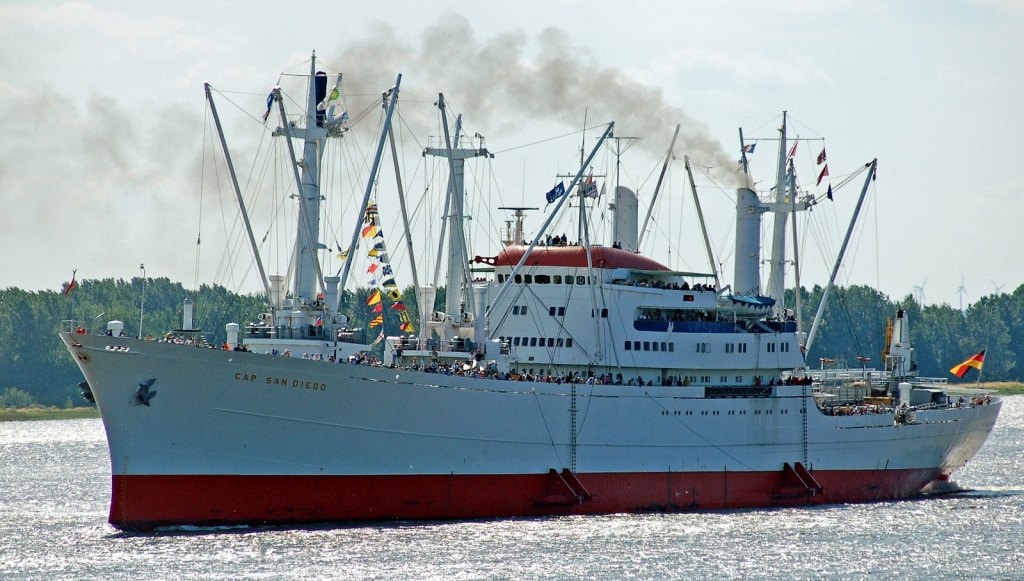
Cap San Diego was built for a trade that disappeared within twenty years of her launch. She carried machinery and manufactured goods from Europe to South America and came back with coffee, cocoa, meat, fruit and edible oil, loading and discharging with her own derricks at every port.
Containers ended that kind of shipping. Cap San Diego survived because Hamburg bought her in 1986, days from the breakers, and kept her working. Her operators describe her as the largest seaworthy museum cargo ship in the world, and almost everything that made her a general cargo liner can still be seen aboard.
| Name | Cap San Diego; later San Diego and Sangria |
| IMO number | 5060794 |
| Type | Fast general cargo liner with reefer holds, oil tanks and 12 passenger berths |
| Builder | Deutsche Werft, Hamburg-Finkenwerder; yard number 785 |
| Launched | 15 December 1961 |
| Delivered | 27 March 1962, to Hamburg Süd |
| Length overall | 159.4 m |
| Beam | 21.5 m |
| Deadweight | About 10,000 to 10,500 tonnes, depending on the source |
| Main engine | MAN nine cylinder two-stroke diesel, 11,650 hp at 118 rpm |
| Speed | 20.3 knots |
| Crew | 49 originally; 35 by the 1980s |
| Status | Museum ship in Hamburg since 1986; listed monument since 2003 |
Six sister ships for South America
Hamburg Süd, then part of the Dr. Oetker group, ordered six fast general cargo ships of the same design for its Europe to east coast of South America service. They were built in Hamburg and Kiel in 1961 and 1962. Cap San Diego was named after the cape at the western end of Tierra del Fuego.
She was launched at Deutsche Werft in Finkenwerder on 15 December 1961, on a site now occupied by Airbus. After trials in the German Bight she was handed over on 27 March 1962 and sailed on her first voyage on 30 March.
That first voyage gives a good picture of the trade. She called at Montreal, Baltimore and New York, then Recife, Rio de Janeiro and Buenos Aires before loading at Santos. The return ran by way of Antwerp, Rotterdam and Bremen to Hamburg.
A round voyage took about sixty days, and she made about 120 of them before leaving Hamburg Süd service at the end of 1981. She is the only one of the six still in existence.

Holds, tanks and refrigerated space
The ship has five holds, each with up to three tween decks. Tween decks let cargo for different ports and different owners be stowed at separate levels, so that the first goods to come out were not buried under the last.
Two of the holds were refrigerated from the start, for fruit and meat. The trade paid well enough that the ship was altered as early as March 1963. Hatch 2 was divided, with two insulated reefer pockets added on the port and starboard sides, each with its own hatch cover. The centre of the hatch was kept for heavy lifts and general cargo.
The refrigerated spaces could carry about 3,000 tonnes at temperatures between +12 and −20 °C. Six heated tanks carried edible oil. Two of them could be cleaned and used for general cargo, and the crew called them hatch 6.
The museum makes a point of one cargo the ship never carried: bananas. Northbound she brought green coffee, cocoa, beef, fruit and edible oil. Southbound she carried machinery, technical equipment and chemical products.
Working cargo with her own gear
Cap San Diego was built to load and discharge at ports where shore cranes could not be relied on. She had sixteen derricks rated at 3 to 15 tonnes, a 50 tonne heavy lift derrick on the foremast and two 3 tonne luffing cranes serving hatches 1 and 5.
Coffee shows how the gear was used. Fifteen 60 kg sacks were slung together into a single 900 kg hoist and lifted from the quay into the hatch, where dockers stowed the sacks by hand. Loading a full cargo of around 10,000 tonnes this way took about a week.
The derricks are still rigged, but as museum gear. The light derricks are now certified for loads of just under one tonne, and the heavy lift derrick is probably no longer used.

Machinery
The main engine is a nine cylinder MAN two-stroke crosshead diesel of type K9Z78/140D, producing 11,650 hp at 118 rpm. It drives a single propeller weighing 16.6 tonnes and gave a service speed of 20.3 knots on around 40 tonnes of fuel a day. Auxiliary diesel generators of 500 hp each supplied electricity.
There is no gearbox. To go astern the engine must be stopped, its camshaft shifted, and the engine restarted in the opposite direction. The manoeuvring station is in the engine room, and orders from the bridge arrive by engine telegraph.
For that reason the machinery spaces are among the most instructive parts of the ship. The location guide of MOIN, the Hamburg and Schleswig-Holstein film fund, describes the engine as a good example of marine engineering before electronic control, with the technical equipment almost entirely preserved and in working order.
Passengers and crew
The Hamburg architect Cäsar Pinnau shaped the ship’s appearance and interiors. There is no conventional funnel: exhaust is led up two slim posts at the after end of the deckhouse, and the company colours are carried on the superstructure.
Twelve passengers travelled in a separate deck with cabins, a saloon, a dining room, a bar and a small open air pool. The crew numbered 49 when she was new and 35 by the 1980s. With passengers aboard, the catering department alone included two cooks, a baker, a chief steward and five stewards.

The same quantity that took a week to load by hand can be moved in containers in a few hours. That difference explains why ships like Cap San Diego disappeared so quickly from the liner trades in the 1970s and early 1980s, even though they were only twenty years old.
Visitors can still see the working spaces of that era: the bridge with its telegraphs, the open hatches with their tween decks, the cargo winches on deck and the passenger rooms, which the museum notes were comfortable by the standards of the day.
San Diego, Sangria and a rescue
In 1981 Hamburg Süd sold the ship to the Spanish company Ybarra. She went under the Panamanian flag, sailed for another year on charter in the South American trade and was renamed San Diego in 1982.
In spring 1986 she was sold again, to Multitrade Shipping of Monrovia, renamed Sangria and registered in St Vincent and the Grenadines. She was expected to go to breakers in Hong Kong.
The city of Hamburg bought her in August 1986, shortly before she was due to be scrapped. Volunteers made her presentable at Cuxhaven in October, and she arrived in Hamburg on 31 October 1986. The Stiftung Hamburger Admiralität, a charitable foundation set up by the city, became her owner and leased her to an operating company.
Becoming a museum that still sails
She was overhauled in Dock 15 of HDW in 1987. From 1989 former shipyard workers made the large changes needed for visitors, including openings and stairs cut through the holds and oil tanks. The route a visitor follows below deck is therefore partly modern, and not every doorway was there when she carried cargo.
Machinery work began in 1992, and in June 1995 she sailed to the centenary of the Kiel Canal. Since 1990 she has lain at the Überseebrücke in Hamburg. She was listed as a protected monument on 1 December 2003.
Keeping a museum ship seaworthy means renewing her class every five years in dry dock: at Blohm+Voss in 2006 and 2011, and with German Dry Docks in Bremerhaven in 2016 and 2021. About twenty paid staff and around a hundred volunteers keep her running.
By the time the main engine was fifty years old, cylinder 7 needed a new liner, and no spare existed anywhere. Even the casting patterns had gone. MAN made a new pattern from its original production drawings, the liners were cast in Japan, and MAN donated three of them, worth about 90,000 euros. A floating crane lifted them aboard on 19 February 2013, and MAN apprentices helped the crew fit one over the following two weeks.
In June 2025 a new permanent exhibition of about 600 square metres opened aboard, prepared with former seafarers and young crew members. The best way to read Cap San Diego is to follow a sack of coffee from the quay, through the hatch and down into the hold.
Timeline
| Date | Event |
|---|---|
| 15 December 1961 | Launched at Deutsche Werft, Finkenwerder. |
| 27 March 1962 | Delivered to Hamburg Süd. |
| 30 March 1962 | First voyage begins. |
| March 1963 | Hatch 2 rebuilt with extra reefer space. |
| December 1981 | Leaves Hamburg Süd service after about 120 voyages. |
| 1982 | Renamed San Diego under Ybarra ownership. |
| Spring 1986 | Sold to Multitrade Shipping and renamed Sangria. |
| August 1986 | Bought by Hamburg shortly before scrapping. |
| 31 October 1986 | Arrives in Hamburg. |
| June 1995 | Sails to the Kiel Canal centenary. |
| 1 December 2003 | Listed as a protected monument. |
| 19 February 2013 | New cylinder liners delivered. |
| June 2025 | New permanent exhibition opens. |
Sources and further reading
- Cap San Diego, Gestatten: Cap San Diego. The operator’s description of the ship, cargo, gear and machinery. In German.
- Cap San Diego, Official website. Museum status and the surviving ship of the series. In German.
- Cap San Diego, Museum. Exhibitions, including the permanent exhibition opened in June 2025. In German.
- Karl-Heinz Hochhaus, Neue Laufbuchsen für die Cap San Diego. Career, conversion, dockings and the 2013 cylinder liners, by an engineer involved. In German.
- Seeleute Rostock, MS Cap San Diego. Particulars, ownership dates and cargo gear inventory. In German.
- Metropolregion Hamburg, Stückgutfrachter Cap San Diego. Builder and later names. In German.
- Hamburg.de, Cap San Diego. IMO number and museum ship profile. In German.
- MOIN Filmförderung, Cap San Diego location survey. Engine, interiors and the series of six ships.
Image credits. Featured image: Cap San Diego under way on the Elbe off Wedel on 25 July 2010, dressed overall for a museum cruise. Photo: Huhu Uet, Wikimedia Commons, CC BY 3.0. Other photographs are credited in their captions.
Have a correction or a photograph that helps identify this ship? Contact contact@shipsarchive.com.


.JPG)


