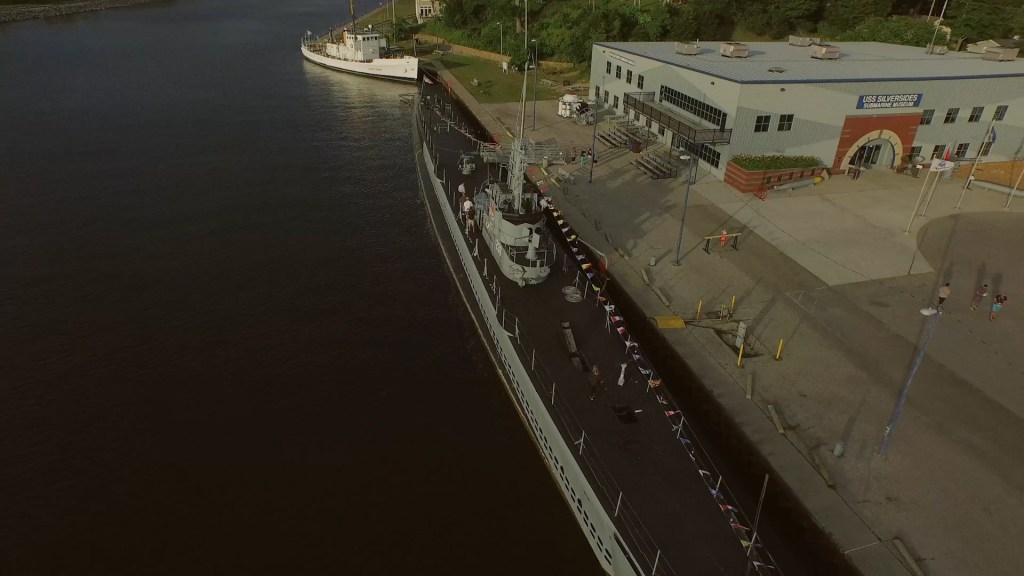
USS Silversides (SS-236) beside its museum in Muskegon, Michigan, in a photograph dated 2016. Wes O'Donnell / Wikimedia Commons, CC BY-SA 4.0. No changes.
A submarine can look complete from the quayside while concealing much of the structure that needs attention. USS Silversides’ 2026 docking has made that distinction unusually clear. Behind the familiar outline are tanks, enclosed recesses and fittings whose condition cannot be judged from a freshly painted upper deck.
The museum records entry into drydock at Fincantieri Bay Shipbuilding, Sturgeon Bay, on 22 July 2026, and identifies July 1954 as the previous docking. Its dated project log documents work on normally inaccessible steel and the recovery of a valve marked for sister submarine USS Trigger. As of 11 October, the sources checked still describe a return to Muskegon as anticipated, rather than accomplished.
| Fact | Detail |
|---|---|
| Vessel | USS Silversides, SS-236 |
| Class | Gato |
| Builder | Mare Island Navy Yard |
| Commissioned | 15 December 1941 |
| 2026 docking | 22 July, Sturgeon Bay |
| Return | Anticipated in October; unconfirmed |
Contents: The boat being preserved · Reading the hull · What the dock reveals · The Trigger valve · Preservation decisions · The return question · Sources
The boat being preserved
Silversides belongs to the wartime fleet submarine generation built to operate over Pacific distances. The Naval History and Heritage Command’s ship history records her laying down on 4 November 1940, launching on 26 August 1941 and commissioning on 15 December that year. It lists a length of 311 ft 10 in and beam of 27 ft 4 in. These identify a substantial seagoing vessel, despite the confined passageways encountered on a museum visit.
Her service also explains why preservation cannot sensibly be reduced to reproducing a launch-day appearance. The Navy’s history notes changes to the conning-tower silhouette, made to reduce visibility and accommodate anti-aircraft weapons. Wartime photographs therefore require dates and context before they can be used as restoration references. An alteration made during service is historical evidence, not automatically something to remove.
Silversides completed fourteen war patrols. Her final patrol included lifeguard duties supporting air attacks on Japan, with two aviators recovered in July 1945. The Navy credits twelve battle stars. Those facts are useful here because they place the physical boat within a working career that included attack, rescue, repair and modification. The preserved structure did not spend that career in a single, unchanging configuration.
After decommissioning on 17 April 1946, she returned to use as a reserve training vessel at Chicago in October 1947. The Navy struck her name from its list on 30 June 1969. Its modern historical overview records the move to Muskegon in 1987. Training and museum service are therefore substantial parts of the object’s history, with their own maintenance decisions and physical traces.
Reading the hull rather than its outline
The exterior shape of a fleet submarine is not simply the boundary of its occupied interior. The contemporary US Navy manual, The Fleet Type Submarine, Chapter 1, distinguishes the pressure hull from surrounding structure. Its arrangement chapter describes the fuel and water-ballast tanks around much of the hull. These are references for understanding the design, not surveys of Silversides’ present condition.
The distinction matters when photographs show steel removed near the ends of the boat. Free-flooding structure is intended to admit water during submerged operation. A pressure boundary, by contrast, separates the inhabited space from external water pressure. Damage in one category cannot be used to announce the failure of the other. Equally, describing a space as free-flooding does not make its steel unimportant: it may support fittings or preserve the vessel’s external form.
Ballast arrangements add another layer. In their original operating role, tanks and their associated valves controlled the exchange of water and air needed to change buoyancy. A museum submarine has a different operating purpose, but still depends on a defined floating condition and reliable boundaries. Preservation therefore requires an understanding of what each space originally did and how it is managed today.
That is why a photograph of an open tank is more informative when accompanied by its identity and location. Without those, readers can confuse ballast spaces with fuel tanks or occupied compartments. There is no sound basis for deriving remaining plate thickness, pressure resistance or a safe diving depth from an exterior photograph. None of those values is established by the published 2026 progress notices.
What the dock reveals
The museum’s September notices identify radar-mount preparation, steelwork near the stern torpedo shutters, sea-chest repairs, scupper restoration and safety-tank preservation. Earlier entries describe cleaning ballast tanks and replacing wasted steel in forward and aft free-flooding spaces. These are the documented work categories, rather than an inferred list of everything the yard must be doing.
Their variety illustrates the problem of maintaining a vessel assembled from interconnected spaces. Exterior access, drainage and concealed surfaces all matter. A narrow recess can require disproportionately awkward preparation; a small fitting may occupy a position that is difficult to revisit once surrounding work is closed up. Size alone is a poor guide to the effort involved.
Drydocking changes access as well as visibility. Water normally supports a floating hull over its immersed surface; in dock, a planned arrangement of blocks supports it while work proceeds. The museum’s July entry describes positioning the boat over the blocks before draining the dock. The operational achievement is controlled support that makes inspection possible, not simply getting a submarine out of the lake.
A repair photograph also captures only one stage. Cleaning can expose defects hidden by deposits. Examination establishes what needs attention. Replacement or repair then has to be followed by protection and documentation. A steel surface that looks unfinished in a progress image may be between those stages. Conversely, a painted surface alone does not reveal how much original metal remains beneath it.
The Trigger valve and the limits of provenance
The museum reports that an aft flood valve from main ballast tank 2D carried USS Trigger’s name and was retained for display. This is a specific, physically located discovery. The surviving marking is evidence of an association; the published account does not establish why the component ended up on Silversides.
That gap should remain visible in its interpretation. It would be tempting to supply a story of an urgent wartime exchange, a yard shortage or a later refit. Without a corresponding record, each would be conjecture. A compelling exhibit can instead distinguish three things: the marking, the place where the valve was found, and the unresolved route by which it arrived there.
Removal introduces another responsibility. A component displayed ashore loses some of the context that made it intelligible inside the boat. Photographs, orientation, tank designation and a description of its original function can preserve that relationship. The object then explains part of the submarine’s engineering as well as raising a question about its manufacture or allocation.
Repairing a vessel without erasing its evidence
The National Park Service’s general preservation standards favour retaining repairable historic material and documenting interventions. These are useful conservation principles, not evidence that a particular Silversides repair has received an independent certification. Applied to a museum submarine, they help explain why replacement and retention need to be considered together.
Leaving deteriorated metal untouched is not necessarily the more historically responsible option. If a local failure threatens adjacent fabric, a carefully defined repair may preserve more of the vessel overall. Yet replacing every irregular surface merely to produce a uniform finish can remove evidence of construction and service. The practical question is what must change to secure the object, and what can safely remain.
Documentation makes that judgement reviewable. A useful record connects an intervention to a location, records the condition found and distinguishes surviving material from new work. Future custodians should not have to infer the history of a repaired area from differences in paint alone. The same principle applies to detached fittings whose exhibition labels may outlast the memories of those who removed them.
The hull’s former military purpose also needs to be kept separate from its museum purpose. Preserving machinery and explaining its function do not amount to certifying it for its original duty. Restoring an external appearance does not establish operational readiness. For Silversides, the relevant outcome is a stable, maintainable historic vessel that can continue to be interpreted, not a return to submarine combat service.
What an October return would establish
The museum’s 5 June announcement names Valkor Energy Services as project and construction manager, Fincantieri Bay Shipbuilding as the yard and Basic Towing as tow contractor. It anticipates a mid-October return. The event page’s 16 October endpoint should not be converted into a confirmed arrival appointment.
A return would be a visible milestone, but its meaning would depend on the accompanying completion record. It would establish that the boat had made the journey home; it would not, by itself, describe every repaired surface, retained fitting or future maintenance requirement. Those are different kinds of information and deserve separate reporting.
The same caution applies to cost. The June announcement estimates $3.5 million and identifies a $750,000 Save America’s Treasures grant, while other museum project wording uses a lower approximate figure. These statements do not supply a reconciled final account. Until one is published, the documentary value of the docking lies in the work actually recorded and the hidden parts of the boat it has made available for examination.
Sources and further reading
- USS Silversides Submarine Museum, dated drydock updates, latest entry checked 9 September 2026: https://silversidesmuseum.org/dry-dock-updates-uss-silversides/
- Museum, drydock announcement, 5 June 2026: https://silversidesmuseum.org/event/dry-dock-notice-submarine-away-for-dry-dock/
- Naval History and Heritage Command, DANFS, Silversides I: https://www.history.navy.mil/research/histories/ship-histories/danfs/s/silversides-i.html
- Naval History and Heritage Command, Silversides overview: https://www.history.navy.mil/browse-by-topic/ships/submarines/silversides-ss-236.html
- US Navy, The Fleet Type Submarine, Chapters 1 and 3, historical manual reproduced by the maritime museum: https://maritime.org/doc/fleetsub/chap1.php and https://maritime.org/doc/fleetsub/chap3.php
- National Park Service, general preservation principles: https://home.nps.gov/articles/000/treatment-standards-preservation.htm
Related reading: Battleship Texas: The Work Beyond Drydock · HMS Belfast: A Cruiser’s Service From Scapa Flow to the Thames


