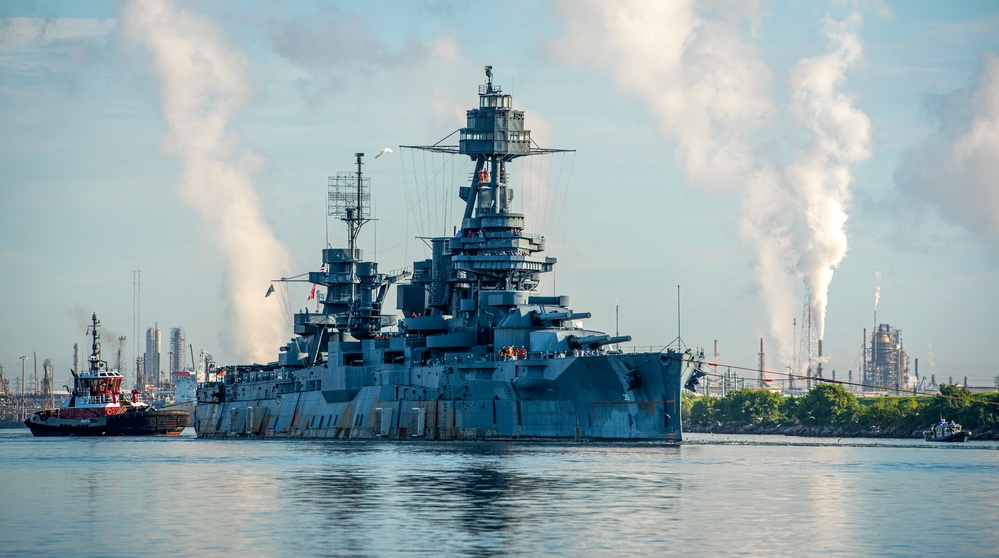
USS Texas (BB-35) under tow near Baytown on August 31, 2022, during its move toward Galveston for hull repairs. U.S. Coast Guard photo by Petty Officer 1st Class Corinne Zilnicki, via DVIDS. Public domain. No changes.
The appearance of U.S. Department of War (DoW) visual information does not imply or constitute DoW endorsement.
Leaving drydock did not make Battleship Texas ready for visitors. It completed a major stage of work below the waterline, while leaving the decks, internal spaces and future berth to be prepared. More than two years later, the distinction remains central to understanding the restoration.
The Battleship Texas Foundation’s official update of 9 October 2026 says the ship will remain at Gulf Copper Shipyard until Pier 15 is ready. Its published description lists wooden-deck replacement, electrical cabling, interior paint preparation, turret watersheds and smaller-gun restoration among current projects. The Foundation targets 2027 for reopening in Galveston. That is a target year, not an announced opening day.
| Fact | Detail |
|---|---|
| Vessel | USS Texas, BB-35 |
| Commissioned | 12 March 1914 |
| Main battery | Ten 14-inch guns |
| Drydock exit | 5 March 2024 |
| Current location | Gulf Copper, Galveston |
| Future berth | Pier 15 |
| Reopening | Targeted for 2027 |
Contents: What drydock achieved · Replacing the wooden deck · Services and interior spaces · Weapons and historical appearance · Preparing Pier 15 · Reading the reopening target · Sources
What drydock achieved, and what it could not finish
The Foundation’s FAQ, marked updated 23 February 2026, records approximately 700 tons of steel repaired or replaced below the waterline. It describes reconstruction of the submerged portions of the torpedo blisters and protective coating work. Texas left drydock on 5 March 2024 and moved to another Gulf Copper pier for the next phase.
That distinction separates two different forms of access. Drydock exposes the underwater hull for work that cannot be approached in the same way with the vessel afloat. Pierside work allows attention to the superstructure, deck and internal areas without continuing to occupy the dock. Moving between them is a change in the working environment, not a declaration that all preservation tasks are complete.
The torpedo blisters illustrate another distinction: conserving a museum ship does not always mean reproducing every concealed detail of a former combat arrangement. The Foundation says the reconstructed blisters differ slightly in design to reduce future maintenance requirements. That is an acknowledged adaptation, and should be described as such rather than presented as untouched original fabric.
For a historic vessel, the repair record is therefore as important as the exterior finish. Future custodians need to know which areas survive, which have been renewed and why a detail was changed. A uniform coating can make those differences difficult to see. Documentation preserves the information without requiring new and old material to be visually conspicuous to every visitor.
The drydock work addressed the part of the project most directly associated with keeping the hull secure in the water. A functioning museum demands more. People must be able to reach the ship, move through the intended spaces and use services installed for that purpose. Those requirements create a substantial programme even after the underwater structure has received attention.
A wooden deck is a system of joints and surfaces
The 18 September restoration report says the deck-laying team had reached the stern. It describes fitting 3.5-inch-square planks and fastening them to the steel beneath. In the midship area, cotton and oakum were being inserted into the seams before caulking. Sanding, oiling, priming and painting were planned to follow once the caulking had dried.
Reaching the stern is consequently a laying milestone. It does not mean that every seam, fastening and finish across the deck was complete that day. Work can be at different stages in different areas, with one team extending the newly laid surface while another completes the treatment of earlier work. The report’s sequence makes that distinction explicit.
The joints deserve as much attention as the broad surface. A deck consists of many individual pieces fitted around the ship’s geometry and equipment. Its performance cannot be judged solely by the quantity of timber visible in an overhead photograph. The seams and boundaries are part of the finished assembly, even when they occupy little of the image.
The cotton and oakum are also a reminder that a historic-looking result can require several operations beneath the final coating. They are not simply a decorative reference to traditional shipbuilding. In the Foundation’s reported method they occupy the joints before the sealing and finishing stages. A photograph of pale timber represents an intermediate state, rather than necessarily the intended final appearance.
The finish is to follow the historical Measure 21 camouflage. That means a visitor expecting a permanently exposed natural-wood deck would be judging the work against the wrong visual reference. The selected historical presentation, not the temporary colour of new material, determines what the completed surface is intended to show.
Internal services and the return of usable spaces
The October video description identifies electrical cabling and preparation of interior paint surfaces among continuing work. These tasks rarely produce the most recognisable restoration photographs, yet they are relevant to whether the ship can function as an occupied museum. Their presence in the work list helps explain the interval between major hull milestones and public reopening.
New services in an old vessel raise questions about routes and visibility. A cable installation must serve its intended equipment, but its placement can also affect how historic spaces are understood and how future maintenance is carried out. The published update does not provide circuit schedules or installation drawings. It establishes that cabling work is occurring, without supporting a claim that every system is complete or commissioned.
The September report gives a more specific view of future use. Volunteers were preparing second-deck spaces, including casemate 5, for educational, classroom and overnight functions. The preparation involved removing loose paint and readying surfaces for subsequent treatment. These are intended uses after reopening, rather than programmes already operating within finished rooms.
A casemate adapted for teaching remains a historic space with its own proportions and arrangement. Its value is not limited to the display cases or labels later placed inside it. The relationship between compartments, passages and equipment can explain how the ship was occupied. Adaptation is most informative when it allows that relationship to remain legible.
The National Park Service’s general preservation principles recognise compatible service upgrades while emphasising retention of distinctive materials and spatial relationships. They provide a useful framework for understanding this tension, not a claim about a specific Texas design approval. A museum has to work for its current occupants without allowing every practical requirement to erase the vessel it is interpreting.
Weapons, weather protection and a dated historical appearance
The October description lists restoration of the 20 mm, 40 mm and 3-inch guns, alongside replacement of turret watersheds. These should not be confused with the ten 14-inch guns of the main battery. Nor does restoration for museum display establish that a weapon is being returned to operational firing condition.
The variety of weapons is part of a much longer service history. The Foundation’s historical account records commissioning at Norfolk Navy Yard on 12 March 1914, service in both world wars and five Second World War battle stars. North Africa, Normandy, Southern France, Iwo Jima and Okinawa all form part of that later combat record. Texas was decommissioned on 21 April 1948 and became a museum and memorial.
A ship with that career cannot be represented by an undated collection of supposedly original features. Equipment changed, and photographs taken decades apart describe different configurations. The Foundation’s stated Measure 21 presentation provides a late-war visual reference. Readers should distinguish that chosen appearance from the commissioning configuration and from the condition in which the ship entered museum service.
Weather protection belongs in the same discussion because the restored object remains exposed to the elements. Preserving an exterior feature includes considering how water reaches adjoining spaces, not merely how the feature looks in profile. The public description confirms watershed work but does not specify its material, dimensions or completion percentage; those details should remain unclaimed.
The broader conservation issue is cumulative. Work on a deck, a turret boundary and an interior surface may involve separate trades, yet all concern the same vessel. A finished-looking exterior does not reveal the state of every protected space beneath it. Assessing progress therefore requires the Foundation’s task descriptions as well as photographs of the ship’s silhouette.
Pier 15 is a separate engineering project
The Foundation’s berth announcement confirms an agreement with the Galveston Wharves Board securing Pier 15. It identifies further steps involving final mooring engineering, permits, dredging, shoreside planning and construction of moorings and associated infrastructure. Securing the location is therefore different from having a completed berth available for occupation.
Each item answers a different practical question. Dredging concerns the space in which the vessel will float. Mooring engineering concerns how it will be restrained. Shoreside facilities concern the connection between a public destination and the ship itself. Progress in one category cannot be used as proof that the other categories are finished.
The Foundation’s FAQ also says the new berth requires a mooring arrangement re-engineered for the coastal location and stronger storm exposure. That statement should not be converted into a claim of unlimited storm resistance. The published material does not provide a full design basis, load cases or final approval record. It establishes that environmental exposure is part of the engineering work.
For the museum project, this produces a dependency outside the hull. Texas can become progressively more complete at Gulf Copper while still waiting for work at the destination. The 9 October statement that she will remain at the yard until Pier 15 is ready is therefore consistent with continuing progress aboard. It is not evidence that the ship has already moved across the channel.
What the 2027 target actually means
The Foundation currently targets reopening in 2027, and the October video description says no tours are being offered. A calendar year leaves room for a sequence of remaining shipboard and shoreside tasks. It should not be converted into an invented month, a booking date or an assumption that public access begins immediately after relocation.
Financial figures also need their source date. The February-marked FAQ describes a projected $75 million restoration, including $60 million supplied by the Texas Legislature. These are the Foundation’s published project figures, not a final audited outturn or a calculation of what remains to be spent in October. The work list does not provide a basis for making that calculation independently.
The most useful way to follow the project is to separate the completed underwater work from current pierside restoration and destination readiness. Each has its own evidence. New deck coverage, finished interior spaces, approved and installed berth infrastructure, relocation and reopening will answer different questions as they occur.
Texas has already passed a major structural milestone. The work now under way determines how that repaired vessel will survive as a museum and how people will use it. The next public opening will be meaningful because those strands have come together, not because the earlier drydock exit could retrospectively be treated as the end of the job.
Sources and further reading
- Battleship Texas Foundation, official video dated 9 October 2026; title, date and published description checked, not the complete spoken programme: https://www.youtube.com/watch?v=Zkhu2diD4-U
- Foundation, restoration update, 18 September 2026: https://battleshiptexas.org/battleship-texas-update-september-18th-2026/
- Foundation, Pier 15 announcement and remaining steps: https://battleshiptexas.org/coming-soon/
- Foundation, FAQ, marked updated 23 February 2026: https://battleshiptexas.org/about/faqs/
- Foundation, ship history: https://battleshiptexas.org/education/history/
- National Park Service, general preservation principles: https://home.nps.gov/articles/000/treatment-standards-preservation.htm
Related reading: USS Missouri: A Battleship Across Two Eras of Weapons · HMS Belfast: A Cruiser’s Service From Scapa Flow to the Thames · USS Silversides: What the 2026 Drydock Reveals

