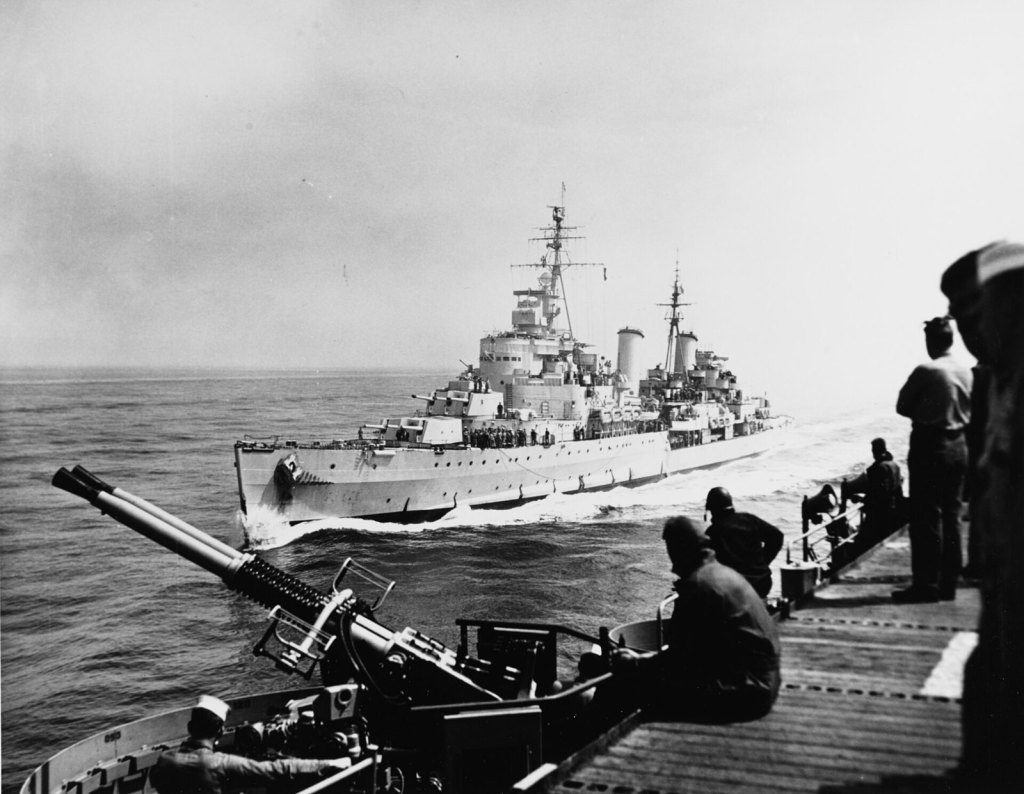
HMS Belfast is often described simply as a Second World War cruiser. That is only part of her story. She was badly damaged within three months of the war starting, rebuilt, fought in the Arctic and off Normandy, served in Korea, and was modernised in the late 1950s for a very different kind of war.
What visitors see on the Thames today is mainly the ship of 1959, not the ship of 1939. Knowing which features belong to which period makes a visit far more rewarding.
| Type | Town class light cruiser, improved Southampton type |
| Builder | Harland and Wolff, Belfast; Job Number 1000 |
| Laid down | 10 December 1936 |
| Launched | 17 March 1938, by Anne Chamberlain |
| Commissioned | 5 August 1939 |
| Displacement | About 10,000 tons as designed |
| Main armament | Twelve 6-inch guns in four triple turrets |
| Machinery | Four shafts, about 20,000 shp per engine |
| Speed | About 32.5 knots |
| Endurance | About 8,500 miles at economical speed |
| Ship’s company | 761 in 1939 |
| Museum ship | Opened in London on 21 October 1971; part of IWM since 1978 |
Building and an early mine
As completed in 1939 she carried twelve 6-inch guns, twelve 4-inch guns, four 3-pounder and four 2-pounder guns, as well as smaller weapons. The planned cost included £66,500 for aircraft, which she carried for scouting.
Belfast’s keel was laid at Harland and Wolff on 10 December 1936. The 1938 navy estimates put her planned cost at £2,141,514, including £75,000 for the guns. She was launched on St Patrick’s Day 1938 by Anne Chamberlain, wife of the Prime Minister, and commissioned on 5 August 1939 under Captain G. A. Scott.
She was designed for trade protection and offensive action, and as a support ship for amphibious operations. When war began she joined the 18th Cruiser Squadron at Scapa Flow. On 9 October 1939, on blockade duty, she captured the German liner Cap Norte, which was sailing disguised as a Swedish ship.
Six weeks later, on 21 November 1939, she set off a magnetic mine while leaving the Firth of Forth. The explosion broke her back and threw the engines off their seatings. She lay in Devonport Dockyard for 28 months and was largely rebuilt, recommissioning there on 3 November 1942.
The Arctic and the Battle of North Cape
Belfast went back to the Home Fleet as flagship of the 10th Cruiser Squadron and spent 1943 covering Arctic convoys to and from North Russia. The work meant long patrols in darkness, heavy seas and ice.

On 26 December 1943, flying the flag of Vice Admiral Robert Burnett, Belfast detected the German battlecruiser Scharnhorst by radar south-east of Bear Island. She, Norfolk and Sheffield engaged Scharnhorst, and the Home Fleet’s heavy ships under Admiral Fraser closed in later that day. Scharnhorst was sunk. Only 36 of her complement of 1,968 men were saved.
Burnett’s Force 1 was Belfast, Norfolk and Sheffield. Distant cover came from Force 2 under Admiral Sir Bruce Fraser, with the battleship Duke of York, the cruiser Jamaica and destroyers including the Norwegian Stord. Scharnhorst, flying the flag of Rear Admiral Erich Bey, had left Altafjord with five destroyers on Christmas Day.
In April 1944 Belfast was part of the escort for Operation Tungsten, the carrier strike on the battleship Tirpitz in Kaafjord.
D-Day and the end of the war
For the Normandy landings Belfast flew the flag of Rear Admiral F. H. G. Dalrymple-Hamilton in Bombardment Force E. At about 05:30 on 6 June 1944 she opened fire on the German battery at Ver-sur-Mer, behind Gold Beach. She went on bombarding targets ashore until 8 July.
A long refit on the Tyne followed. She left for the Far East in June 1945 but arrived after Japan had surrendered. On 19 September 1945 she was with the first Allied force to reach Shanghai.
She stayed in the Far East until October 1947, visiting China, Japan, Australia, New Zealand, Fiji and Malaya, then paid off into reserve at Portsmouth. She recommissioned on 22 September 1948. In October 1948 she visited Belfast to receive a silver bell from the city, a ceremony delayed for nine years by the war.
Korea
Belfast arrived in Korean waters on 29 July 1950. On 5 August she steamed up the difficult approach to Inchon to bombard oil storage, factories and gun positions. Shore bombardment, rather than fighting other ships, became her main task.
After recommissioning at Chatham in October 1950 she returned to Sasebo on 31 January 1951. She worked off both coasts, sometimes through pack ice, with an annual refit at Singapore from June to August 1951.
In February 1951, with Australian and US ships, she carried out an inshore bombardment at Wonsan after navigating some 37 km of channel through minefields. Her Mark 23 6-inch guns had a range of about 14 miles, and each triple turret had a crew of 27, supplied from shell rooms and cordite handling rooms deep in the ship.
On 29 July 1952 she was hit for the first time, by a 76 mm shell. One Chinese rating was killed and four were injured. She left the theatre in September 1952. By the Naval Historical Branch’s count she had steamed some 82,500 miles, fired well over 8,000 six-inch shells and spent 404 days at sea.
Inside the machinery spaces
Belfast’s two boiler rooms and her engine rooms lie below the waterline. Each of the four engines developed about 20,000 shaft horsepower through high and low pressure turbines and a single reduction gearbox. Full power gave about 32.5 knots, at a cost of around 26 tonnes of fuel an hour.
The outer engines each had a small cruising turbine of about 5,000 shaft horsepower for economical steaming. At economical speed the ship could cover about 8,500 miles.
The 1956 to 1959 modernisation
After Korea Belfast went into reserve at Devonport. Approval to modernise her was given in March 1955, and the work ran from 6 January 1956 to 12 May 1959. The Royal Mint’s history of the ship describes the aim as preparing her for nuclear, biological and chemical warfare.
The structure and armament were altered substantially. Plans in the National Maritime Museum, dated between April 1956 and October 1959, show the rebuilt superstructure, compass platform, bridge levels and hull sections. Much of the bridge and superstructure visitors walk through today dates from this refit.
She then served as flagship in the Far East. In December 1961 she attended the independence celebrations in Tanganyika, and she returned to Portsmouth on 19 June 1962 after nearly three years away.

Reserve and rescue
Her active career ended in 1963. From 1966 to 1971 she was a headquarters and accommodation ship for reservists at Portsmouth, under the name HMS Bellerophon. Officials from the Imperial War Museum visited in April 1967 to see whether she could become a museum.
Early in 1971 the government decided not to preserve her as a national museum. In February a private trust was formed, led by her former captain, Rear Admiral Sir Morgan Morgan-Giles, and in July the government agreed to hand her over.
Her last voyage was under tow from Portsmouth. The Royal Mint timeline and the National Historic Ships register give 21 October 1971, Trafalgar Day, as the date she opened to the public in London. The Naval Historical Branch summary dates her tow to her final mooring above Tower Bridge to 15 November 1971. The sources do not agree on this point.
A museum ship that still needs a dockyard
The Imperial War Museum took her over from the trust on 1 March 1978. She was dry docked at Tilbury in 1982 and at Portsmouth in 1999, when her hull was inspected and recoated.
For the 1982 docking she was towed down the Thames on 15 September for a six-week inspection and repainting of the hull, and returned to the Pool of London on 19 October.
In 2010 the Severnaya Verf shipyard in St Petersburg built replacement lattice masts in recognition of the Arctic convoys, and they were dedicated on 19 October that year. After a 15-month closure and refit on the Thames, she reopened on 8 July 2021.

On board, the 6-inch turrets, mess decks, sick bay and the galley and bakery, which produced more than 18,000 meals a week for nearly a thousand men, tell the human side of the story. The engine rooms show how much work it took to keep a 1930s cruiser at sea.
Timeline
| Date | Event |
|---|---|
| 10 December 1936 | Keel laid at Harland and Wolff. |
| 17 March 1938 | Launched by Anne Chamberlain. |
| 5 August 1939 | Commissioned. |
| 9 October 1939 | Captures the German liner Cap Norte. |
| 21 November 1939 | Mined in the Firth of Forth. |
| 3 November 1942 | Recommissioned at Devonport. |
| 26 December 1943 | Battle of North Cape. |
| 6 June 1944 | Bombards the Ver-sur-Mer battery on D-Day. |
| 29 July 1950 | Arrives for Korean War service. |
| 6 January 1956 | Modernisation begins at Devonport. |
| 12 May 1959 | Modernisation completed. |
| 21 October 1971 | Opens to the public in London. |
| 1 March 1978 | Taken over by the Imperial War Museum. |
| 8 July 2021 | Reopens after a 15-month refit. |
Sources and further reading
- Naval Historical Branch, HMS Belfast summary of service (PDF, within a compilation of ship histories).
- National Historic Ships UK, HMS Belfast. Register entry with building, wartime and museum history.
- The Royal Mint, Sailing through History. Timeline of the ship from 1936 to the present.
- Imperial War Museums, HMS Belfast in the Korean War (archived copy).
- Imperial War Museums, HMS Belfast’s Engine and Boiler Rooms (archived copy).
- IWM Film, The Second Launch of HMS Belfast. Film of the 1971 tow from Portsmouth.
- Royal Museums Greenwich, Belfast (1938), hull sections, October 1959.
- Royal Museums Greenwich, Belfast (1938), upper and lower decks, 1959.
- Royal Museums Greenwich, Belfast (1938), superstructure and bridge, 1956 to 1959.
- Imperial War Museums, The Main Deck. Visitor guide to the mess decks, sick bay and galley.
- Royal Navy, Belfast is back, 7 July 2021.
Image credits. Featured image: HMS Belfast under way off Korea on 27 May 1952, during her Korean War service. US Navy photograph. Photo: US Navy, National Archives 80-G-633883, Wikimedia Commons, Public domain. Other photographs are credited in their captions.
Have a correction or a photograph that helps identify this ship? Contact contact@shipsarchive.com.


.jpg)

_underway_off_Korea_on_27_May_1952_(80-G-633883).jpg)