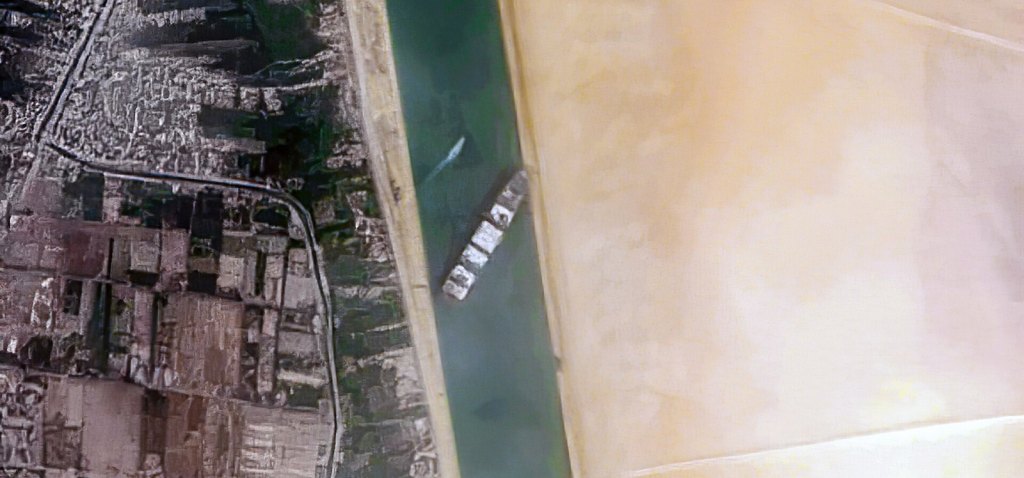
On the morning of 23 March 2021 the container ship Ever Given ran aground in the Suez Canal and ended up wedged across it, with her bow and stern stuck in the banks. For six days nothing could pass. Hundreds of ships queued at both ends, and some shipping lines sent vessels around the Cape of Good Hope instead.
The pictures made the incident look simple: a very large ship blown sideways by the wind. The investigation by the flag state, Panama, gives a more detailed picture of speed, steering, wind, pilotage and the shape of the canal itself.
| IMO number | 9811000 |
| Flag | Panama |
| Built | 2018, Imabari Shipbuilding, Japan |
| Owners | Higaki Sangyo Kaisha 90%, Luster Maritime 10% |
| Managers | Bernhard Schulte Shipmanagement (Hong Kong) |
| Length overall | 399.98 m |
| Beam | 58.80 m |
| Gross tonnage | 219,079 |
| Capacity | 20,124 TEU, including 1,273 reefer slots |
| Grounded | 07:41 local time, 23 March 2021, canal km 151 |
| Refloated | 15:05 local time, 29 March 2021 |
The ship and the canal
Ever Given is almost exactly 400 metres long. The Panamanian report lists her owners as Higaki Sangyo Kaisha, with 90 per cent, and Luster Maritime, with 10 per cent. She was managed by Bernhard Schulte Shipmanagement in Hong Kong and sailed in Evergreen’s service. Statements after the incident often named the owner as Shoei Kisen Kaisha.
The canal is about 313 metres wide at the surface. The sloping sides narrow the usable width to about 225 metres at an 11 metre draught, and the bottom is about 121 metres wide. A 400 metre ship is longer than the canal is wide.
The grounding happened in a single lane section in the southern part of the canal, where ships cannot pass each other in opposite directions. That is why one ship could stop all traffic.
Twenty-five minutes on the morning of 23 March
Ever Given was northbound in a convoy. According to the master’s statement, the canal pilots boarded at about 07:16 and handed over at about 07:20. Two pilots remained on the bridge, one giving orders and one observing.
At about the same time the wind rose and a sandstorm cut visibility for a few minutes. The report records southerly wind of 25 to 27 knots, gusting to 40 knots. The pilots had trouble keeping the ship in the middle of the channel and ordered more power, and speed rose to about 12 knots over the ground.
The pilot then gave a series of hard over helm orders, hard to port or hard to starboard, with nothing in between. At about 07:38 the ship, now close to the port (western) bank and at about 13 knots, began swinging quickly to starboard. The two pilots spoke to each other in Arabic, and the master and bridge team could not follow what they were discussing.
Hard to port did not stop the swing. At 07:41 Ever Given ran onto the eastern bank at about 12 knots, at kilometre 151. She ended up wedged across the waterway, with her bow and stern both stuck in the banks.
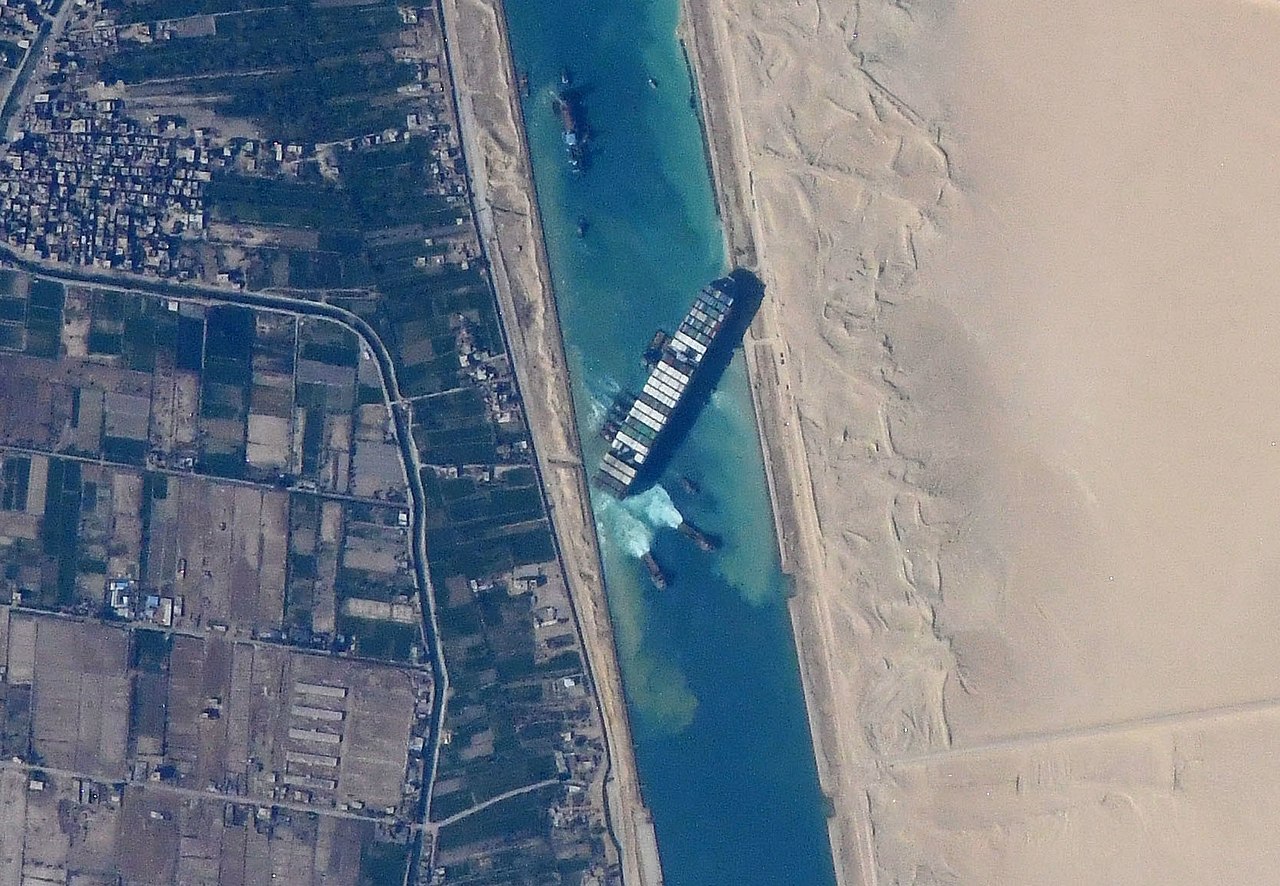
At 07:43 the pilot ordered full astern and at 07:44 crash astern. Neither had any effect. The master had the bow thruster started in a first attempt to work her free.
What the investigation found
The Panama Maritime Authority’s report, R-026-2021-DIAM, lists several contributing factors. The weather was not properly assessed as a risk for a ship with such a large area exposed to the wind. The transit could have been postponed, and no escort tugs were used.
Under the canal’s own rules, container ships of 170,000 Suez Canal net tons and more are to be escorted by two tugs. Ever Given was well above that figure. The report says the lack of tugs contributed to the grounding.
The permissible speed in the canal is 16 km/h, or 8.64 knots, for ordinary ships. The report finds that Ever Given was on average faster than that. It concludes that squat, bank effect, speed, changes in wind direction and the hard helm orders together directly affected her loss of manoeuvrability.
The report also stresses that under canal regulations the master keeps command at all times and the pilots only advise. It recommends that the pilot and master agree before the transit to use one language, preferably English.
The report is a flag state investigation based mainly on the ship’s records and crew statements. Researchers who modelled the incident afterwards found that bank effect alone can strongly push a large container ship off course in a canal with sloping sides like those at Suez.
A study in the Journal of Marine Science and Engineering gives a sense of the margins. At her static draught of 15.7 metres, the canal offered Ever Given roughly 180 metres of usable width, about 60 metres of free water on each side. Squat reduces that further, and the same margin also has to absorb drift from wind and steering.
The queue
The report cites Lloyd’s List figures of more than 230 ships waiting on 25 March and 429 by 29 March. NASA’s Earth Observatory gave a different count of 367 on 28 March, from the agency Leth: 154 near Port Said, 42 in the Great Bitter Lake and 171 to the south.

Maersk warned customers to expect a 20 to 30 per cent loss of capacity on affected routes for several weeks, followed by port congestion as delayed ships arrived out of turn. Some of its ships were routed around the Cape of Good Hope.
The salvage
SMIT Salvage, part of Boskalis, worked with the Suez Canal Authority. Its team prepared three plans at once. Plan A was to pull the ship free with two heavy seagoing tugs. Because the Authority’s own heavy equipment was to the north of the ship, the tugs were needed to pull from the south.
The ALP Guard and Carlo Magno were already in the Indian Ocean and had to turn back against a strong headwind. The fallback plans were to wash away the sandy clay under the bow with dredging equipment brought from Alexandria, and, if that failed, to unload containers using large barges and cranes.
Dredgers removed about 30,000 cubic metres of sand. The crew pumped about 5,000 tonnes of ballast water to the stern and moved extra ballast to port, so that the ship heeled slightly and the bow pressed less on the bottom. A spring tide gave extra water.
Early on 29 March the Authority announced that the ship was partly refloated. Her stern was then 102 metres from the bank, compared with 4 metres before. Eleven harbour tugs and the two seagoing tugs completed the job, and Ever Given was fully refloated at 15:05 local time. She was taken north to the Great Bitter Lake for inspection, and traffic began moving again that day.
Nature helped. NASA noted that tides in the canal rose about 46 centimetres above normal on 29 March. Inspection afterwards found only minor scratches and cuts on the propeller blades, and the owners proposed that she should sail under her own power for further assessment and temporary repairs.
The International Maritime Organization followed events closely. On 26 March its Secretary-General, Kitack Lim, offered encouragement to the Egyptian authorities, salvors, tug and dredger crews. After the refloating he also thanked the crews of the ships caught in the queue for their patience, at the end of a very hard year for seafarers.
Detention and the voyage on
The ship did not leave the canal for more than three months. The Suez Canal Authority impounded her in the Great Bitter Lake while it negotiated compensation with her owners.
A settlement was signed at Ismailia on Wednesday 7 July 2021. The International Chamber of Shipping welcomed it, noting that the mainly Indian crew could at last be relieved.
Ever Given reached the ECT Delta terminal in Rotterdam on 29 July 2021. Containers for Rotterdam and Hamburg were discharged there, and the Hamburg boxes went on in the Ever Utile. Ever Given then sailed to Felixstowe with the British cargo.

The lessons are not new to seamen. Speed in a narrow channel increases squat and bank effect. Strong wind on a very high, flat sided ship has to be planned for. And everyone on a bridge needs to understand what everyone else is saying.
Timeline
| Date | Event |
|---|---|
| About 07:16, 23 March 2021 | Canal pilots board. |
| 07:41, 23 March 2021 | Ever Given grounds at canal km 151. |
| 25 March 2021 | More than 230 ships reported waiting. |
| 27 March 2021 | Photographed from the International Space Station. |
| Early 29 March 2021 | Partly refloated; stern 102 m from the bank. |
| 15:05, 29 March 2021 | Fully refloated. |
| 7 July 2021 | Settlement signed at Ismailia. |
| 29 July 2021 | Arrives at ECT Delta, Rotterdam. |
Sources and further reading
- Panama Maritime Authority, Final investigation report R-026-2021-DIAM (PDF, hosted by gCaptain).
- Boskalis, Suez Canal unblocked: we pulled it off, 29 March 2021.
- Boskalis, Annual Report 2021 (PDF). Salvage plans, tugs and ballast.
- Suez Canal Authority, Successful Refloating of EVER GIVEN, 29 March 2021.
- NASA Earth Observatory, Traffic Jam on the Suez Canal.
- Mate Baric, Robert Mohovic, Djani Mohovic and Vinko Pavic, The Simulation of Sloped Bank Effect Influence on Container Ship Trajectory, Journal of Marine Science and Engineering (PDF).
- International Maritime Organization, Secretary-General statements on the MV Ever Given incident.
- International Chamber of Shipping, ICS welcomes release of Ever Given, July 2021.
- Hutchison Ports, Ever Given arrived at ECT Delta terminal, 29 July 2021.
- Maersk, Vessel blockage in the Suez Canal. Customer advisory with updates.
Image credits. Featured image: Ever Given wedged across the Suez Canal on 24 March 2021, seen by the Sentinel-2 satellite. Contains modified Copernicus Sentinel data [2021], processed by Pierre Markuse. Photo: Pierre Markuse, Wikimedia Commons, CC BY 2.0. Other photographs are credited in their captions.
Have a correction or a photograph that helps identify this ship? Contact contact@shipsarchive.com.


.jpg)
.jpg)