Batillus was delivered by Chantiers de l’Atlantique at Saint-Nazaire in June 1976 for Société Maritime Shell. She was 414 metres long, had a deadweight of about 553,000 tonnes, and she and her sister Bellamya were the largest ships then built anywhere. Her working life lasted seven years. She made 24 voyages between Europe and the Persian Gulf, was laid up in a Norwegian fjord in August 1983 and arrived in Taiwan for demolition at the end of 1985. Most of the detail below comes from Jacques Girard, the Shell engineer who worked on her design, construction and commissioning, and from the builder’s own film of the project.
| Name | Batillus |
| Type | Ultra large crude carrier (ULCC) |
| IMO number | 7360095 |
| Owner | Société Maritime Shell, France; home port Fos sur Mer |
| Builder | Chantiers de l’Atlantique, Saint-Nazaire; yard number V25 |
| Contract | April 1971 |
| Delivered | June 1976 |
| Length overall | 414.2 metres |
| Beam | 63 metres |
| Depth | 35.9 metres |
| Summer draught | 28.6 metres |
| Deadweight | About 553,000 tonnes |
| Gross tonnage | About 274,000 |
| Machinery | Two Stal-Laval geared steam turbine sets, each 32,500 hp at 86 rpm; two propellers |
| Speed | 16.7 knots loaded; 19 knots in ballast |
| Laid up | Vestnes, Norway, from August 1983 |
| Fate | Broken up at Kaohsiung, Taiwan, from December 1985 |
From contract to delivery
Shell France signed for the ship in April 1971, when the tanker market was strong and the closure of the Suez Canal since 1967 had made the long route round the Cape of Good Hope the normal one for Gulf crude bound for Europe. On that route the economies of size were clear. Girard records that design studies ran from 1971 to 1974. The construction film made for the yard, now held by the Cinémathèque de Bretagne, gives the final specification as completed in December 1974.
By then the oil crisis of 1973 had changed the outlook, but the ship was already committed. The first plate was cut in January 1975, prefabrication of blocks began in June, and the first block was placed on 20 August 1975. The hull was started on a platform and then moved into the building dock. The boilers went in during November 1975, the superstructure in December and the funnels in January 1976. On 29 March 1976 the hull was floated out and moved by tugs to the fitting out basin. Sea trials began on 28 May, and delivery followed in June.
Bellamya followed for Shell a few months later. Two near sisters were then built at Saint-Nazaire for Compagnie Nationale de Navigation, Pierre Guillaumat in 1977 and Prairial in 1979. Pierre Guillaumat was measured at 555,051 tonnes deadweight.
Dimensions that set the limits
The figures from Girard show what a ship of this size meant in practice. Length overall was 414.2 metres, beam 63 metres and depth, which he gives as the depth of the cargo tanks, 35.9 metres. Deadweight was 553,000 tonnes, against a lightship weight of about 80,000 tonnes, so the loaded displacement reached 633,000 tonnes. The ballast tanks held 58,000 cubic metres. Gross tonnage was about 274,000. From keel to masthead she measured 74.5 metres, and a single anchor weighed 24 tonnes.
The figure that governed her trading was the draught. Fully loaded to her summer marks she drew 28.6 metres, more than almost any other ship afloat. She could not pass the Suez Canal loaded, and only a small number of terminals had the depth to receive her with a full cargo. Size per voyage was bought at the cost of flexibility: the economics worked only on long hauls between deep water terminals, with a full cargo every time.
Kees Helder’s register details, reproduced by Auke Visser, give her 10 centre and 15 wing cargo tanks and a fuel consumption of 335.5 tonnes a day. Bunker prices rose steeply after 1973, so that consumption cost far more than it would have when the ship was ordered.
Two complete steam plants
Most large tankers of the period had a single screw. Batillus had two, each with its own complete machinery set: a boiler, a deaerator, a condenser and a geared turbine set from Stal-Laval rated at 32,500 hp at 86 rpm. The two plants were fully independent but could be cross connected, so that two boilers could feed one turbine set, or the port boiler could drive the starboard turbine. Girard notes that slow speed diesels able to deliver the necessary power at 80 to 90 rpm were not available at the time, which is why steam remained the choice for tankers of this size.
The Stal-Laval units were unusually flat and were mounted beneath the boilers. They used triple reduction epicyclic gearing on the high pressure line and double reduction on the low pressure line, which made them lighter and more compact than conventional geared turbines. The propellers were 8.5 metres across and weighed 52 tonnes each. The two rudders, each with an area of 125 square metres, weighed 220 tonnes apiece with their stocks, the heaviest removable items in the ship.
The ship was classed for unattended machinery spaces. There was no engineer on watch either in the engine room or in the machinery control room, which was placed on the bridge next to the cargo control position and separated from it only by a removable partition. At sea and in port, Girard writes, the officer of the watch acknowledged alarms and called the duty engineer when work was needed.
Antifer, the port built for her class
Batillus was christened at Antifer, north of Le Havre, on 25 June 1976, the same day the new oil port was officially opened by Robert Galley, the minister responsible for equipment. Marcel Cavaillé, secretary of state for transport, presided over the christening. It was not a launch, since the ship had been afloat since March, but it linked the ship and the terminal in public.

The Port of Le Havre had begun studies for very large tankers in 1966, when it already expected ships of 500,000 tonnes deadweight with deeper draughts than first assumed. It settled on a site off Cap d’Antifer, about 20 kilometres north of Le Havre, where a band of sand could be dredged to 32 metres close to the coast. The port authority’s report for the inauguration, published in Ports and Harbors in October 1976, estimated that a ship of 540,000 tonnes would save 7 to 8 francs per tonne of crude on the Gulf to Le Havre run compared with one of 250,000 tonnes, about 20 per cent of the transport cost. It also admitted that freight rates in the current crisis did not reflect that difference.
The same report expected the four French ships to make six round trips a year via the Cape and bring about 12 million tonnes of crude a year into Antifer. The port authority later recorded that Batillus called there 20 times before she was withdrawn in 1983. Pierre Guillaumat holds the record for the largest single discharge at Antifer, 548,248 tonnes on 4 July 1978.
A market without work for her
Batillus entered service when there were already more tankers than cargoes. The rise in oil prices after 1973 cut demand, the reopening of the Suez Canal in 1975 shortened some routes, and the large orders placed before the crisis kept delivering ships into a falling market. Laid up tankers became a common sight in sheltered anchorages around the world. UNCTAD’s Review of Maritime Transport for 1984 and 1985 describes the scale of the surplus and its weight on the tanker sector.
For a ship that could only operate on a few routes, the effect was severe. Her commercial career ended in August 1983, and on 22 August she was laid up at Vestnes in Norway, where Girard notes that many tankers were waiting for the market to improve. It did not improve soon enough.

Disposal
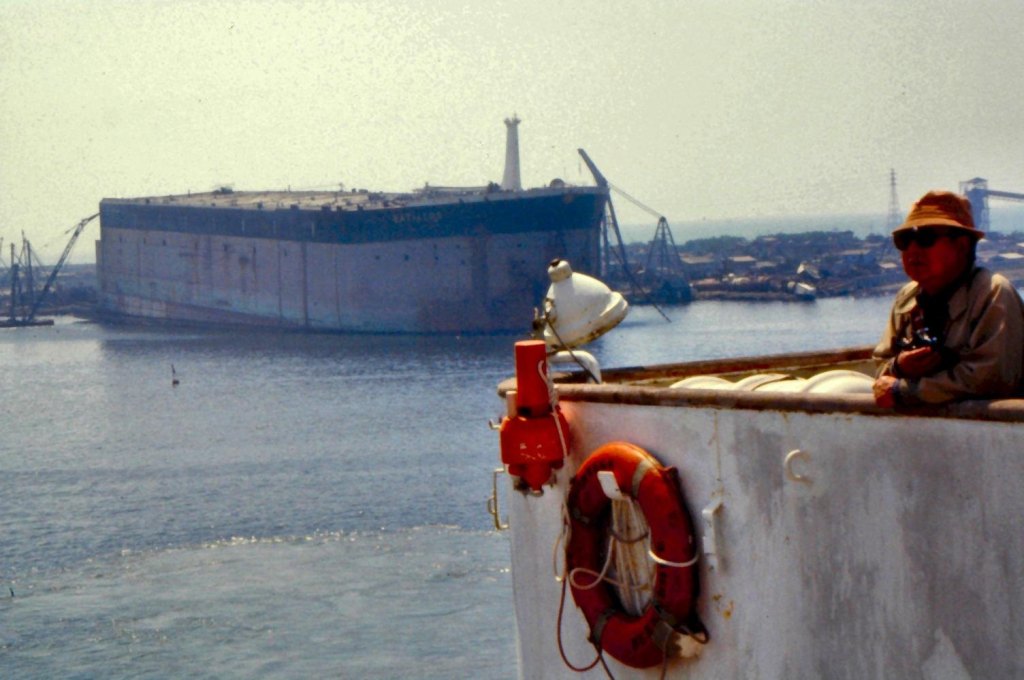
She left Vestnes on 8 November 1985 for Singapore, where she took bunkers, and then sailed for Kaohsiung in Taiwan, then one of the world’s main ship breaking centres. Arrival dates differ in the records: the Miramar Ship Index gives 22 December 1985 and Kees Helder 28 December. Photographs of her at the breakers’ yard are dated February 1986. Bellamya went the same way in 1986, and Pierre Guillaumat had already been scrapped at Ulsan in South Korea in 1983. Only Prairial, renamed several times, survived into the next century, and she was broken up in 2003.
Batillus was built for a long haul trade around Africa that the Suez reopening and a falling demand for oil had already started to shrink by the time she sailed. She was not a technical failure. The ship carried full cargoes, her machinery ran unattended, and the port built for her class worked as intended. The market simply did not need four ships of her size.
Timeline
| Date | Event |
|---|---|
| April 1971 | Contract signed with Chantiers de l’Atlantique |
| December 1974 | Final specification completed |
| January 1975 | First plate cut |
| 20 August 1975 | First block placed in the building dock |
| 29 March 1976 | Hull floated out to the fitting out basin |
| 28 May 1976 | Sea trials begin |
| June 1976 | Delivered to Société Maritime Shell |
| 25 June 1976 | Christened at Antifer on the day the port opens |
| August 1983 | Withdrawn from trading; laid up at Vestnes from 22 August |
| 8 November 1985 | Leaves Vestnes for Singapore and Taiwan |
| December 1985 | Arrives at Kaohsiung for demolition |
Sources and further reading
- Jacques Girard, Les pétroliers de 550.000 tonnes, Marine Marchande. Construction, machinery and career, by a Shell engineer on the project. In French.
- Jacques Girard, Batillus, Marine Marchande. Dimensions, machinery and photographs. In French.
- Jacques Girard, Batillus, le groupe turbo réducteur, Marine Marchande. The Stal-Laval geared turbines. In French.
- Cinémathèque de Bretagne, Batillus, pétrolier de 550 000 tonnes. Catalogue entry for Henri Husson’s 1976 construction film, with a dated chronology. In French.
- Port of Le Havre Authority, The Port of Le Havre-Antifer is officially opened, Ports and Harbors, October 1976, pages 30 to 33.
- Port Autonome du Havre, Antifer et les géants, 2006 anniversary statement reproduced by Marine Marchande. In French.
- Auke Visser, Batillus. Photographs with Miramar Ship Index and Kees Helder register details.
- UNCTAD, Review of Maritime Transport 1984.
- UNCTAD, Review of Maritime Transport 1985.
Image credits. Featured image: Batillus at Kaohsiung, Taiwan, in 1986, during demolition after less than ten years in service. Photo: André Cordier, Wikimedia Commons, CC BY-SA 4.0. Other photographs are credited in their captions.
Have a correction or a photograph that helps identify this ship? Contact contact@shipsarchive.com.