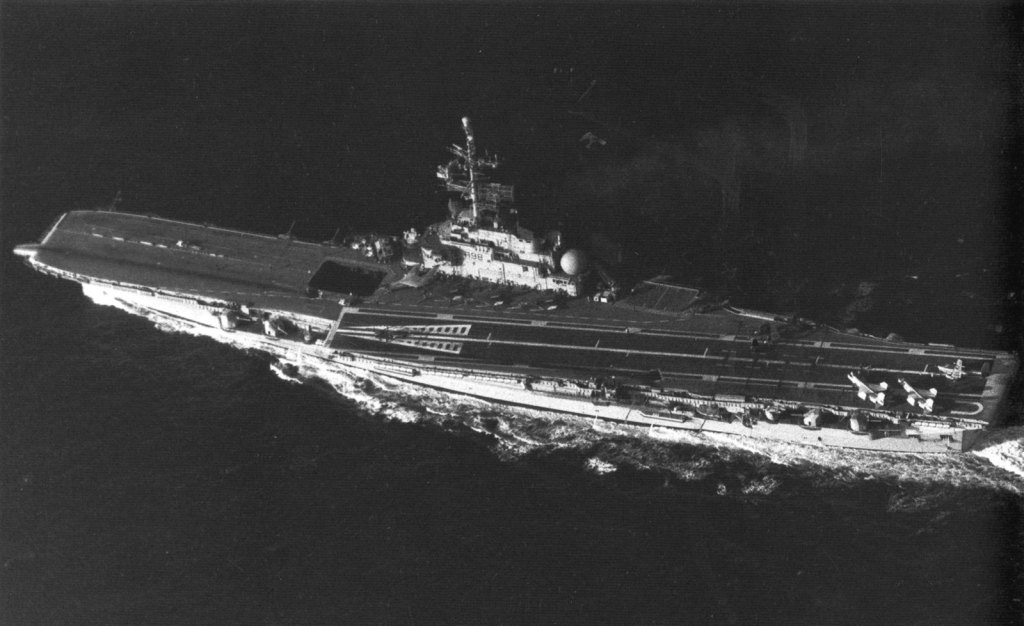
The aircraft carrier Clemenceau left active service with the French Navy in 1997. Disposing of her took more than a decade. Contracts in Spain and then Greece and India failed, a tow to India was turned back after a ruling by the Conseil d’État, and the hull was finally dismantled at Hartlepool in north-east England in 2009 and 2010.
The central issue throughout was asbestos in the ship’s structure and fittings, and how much of it remained. Figures published at the time varied widely. This article sets out the carrier’s service, the sequence of disposal attempts, the legal decisions in France and the United Kingdom, and the estimates of asbestos, each attributed to its source.
| Pennant number | R98 |
| Type | Conventionally powered aircraft carrier |
| Builder | Brest naval dockyard |
| Laid down | 15 September 1955 |
| Launched | 21 December 1957 |
| Admitted to active service | 22 November 1961 |
| Length and beam | About 238 m by 30 m |
| Full load displacement | About 32,000 tonnes |
| Machinery | Six boilers, 126,000 hp; 32 knots |
| Crew | About 2,200 including the air group |
| Withdrawn from service | 25 September 1997 |
| Condemned | 16 December 2002, as hull Q790 |
| Returned to Brest | 17 May 2006 |
| Dismantled | 2009 and 2010, Able UK, Hartlepool |
Service, 1961 to 1997
Clemenceau, the first of two carriers of her class, was laid down at Brest on 15 September 1955 and launched on 21 December 1957. She was admitted to active service on 22 November 1961. Her sister Foch followed. The French defence historical service gives her length as about 238 m, her full load displacement as about 32,000 tonnes, and her speed as 32 knots from six boilers.
She had an angled flight deck of 165.5 m set at 8 degrees, two steam catapults and four arrester wires, and carried about 40 aircraft. Her air groups included Alizé, Étendard IV, Super Étendard and Crusader aircraft. She was armed with 100 mm guns and, from 1986, Crotale missile systems.

Her operations included the Pacific nuclear test area in 1968, deployments off Djibouti from 1974 to 1977, the eastern Mediterranean during the Lebanese civil war from 1982 to 1984, protection of shipping during the Iran and Iraq war in 1987 and 1988, the Red Sea in 1990, and the Adriatic from 1993 to 1996. She steamed about a million nautical miles, spent 3,125 days at sea and made more than 70,000 catapult launches.
Reserve and condemnation
Clemenceau was withdrawn from active service on 25 September 1997 and decommissioned on 1 October. She was placed in special reserve on 2 March 1998 and remained at Toulon for nearly five years, serving as a source of spare parts for Foch until Foch was sold to Brazil in 2000. In July 2000 a condemnation commission concluded that dismantling was the only option.
The minister of defence condemned the ship on 16 December 2002. She lost her name and became the hull Q790, and was handed to the state property agency for sale by tender for dismantling. The French defence historical service records her sale for demolition on 14 April 2003; the minister later told the National Assembly that this was the date the agency launched a European tender.
First attempts: Spain, Turkey and Greece
A Spanish company, Gijonesa de Desguaces, was chosen from three bidders, and the National Assembly report dates its contract to 12 June 2003. It provided for asbestos removal and dismantling in Spain. The hull left Toulon under tow in October 2003. When it became clear that the tow was heading for Turkey instead, it was intercepted and brought back to Toulon on 18 October 2003.
On 20 October 2003 a new contract was signed with Ship Decommissioning Industries Corporation (SDI), the second-placed bidder. It provided for asbestos removal in Greece and dismantling in India. Greece refused to accept the work, as Turkey had. On 23 June 2004 the contract was amended to provide for partial asbestos removal at Toulon, followed by final removal and dismantling in India.
Asbestos removal at Toulon
Work at Toulon began in November 2004. The contract required removal of all friable and accessible asbestos without affecting the ship’s ability to make the voyage. Material built into the structure could not be reached without dismantling parts of the ship, so some asbestos was always intended to remain aboard for removal at the breaker’s yard.
According to the minister’s evidence to the National Assembly in February 2006, independent experts found that the first contractor had not completed the work, the contract was ended and another firm finished it. The ministry reported discrepancies in waste tracking records and filed a complaint in 2006. These are the ministry’s statements; this article does not assess them further.
The voyage towards India
A navy briefing dated 6 January 2006 described the plan. Indian engineers trained in France would supervise the work at the Alang yard of Shree Ram Vessel Scrap, and French engineers would provide expertise on site. The minister later added that the workers would be medically monitored and that France would take back the asbestos waste from the final removal.
Associations including Ban Asbestos France, Greenpeace France, the Comité anti-amiante Jussieu and ANDEVA, the national association of asbestos victims, challenged the export in the courts. An export authorisation for war material was issued on 29 November 2005. On 30 December 2005 the Paris administrative court rejected urgent applications to suspend it, and the hull left Toulon the next day.
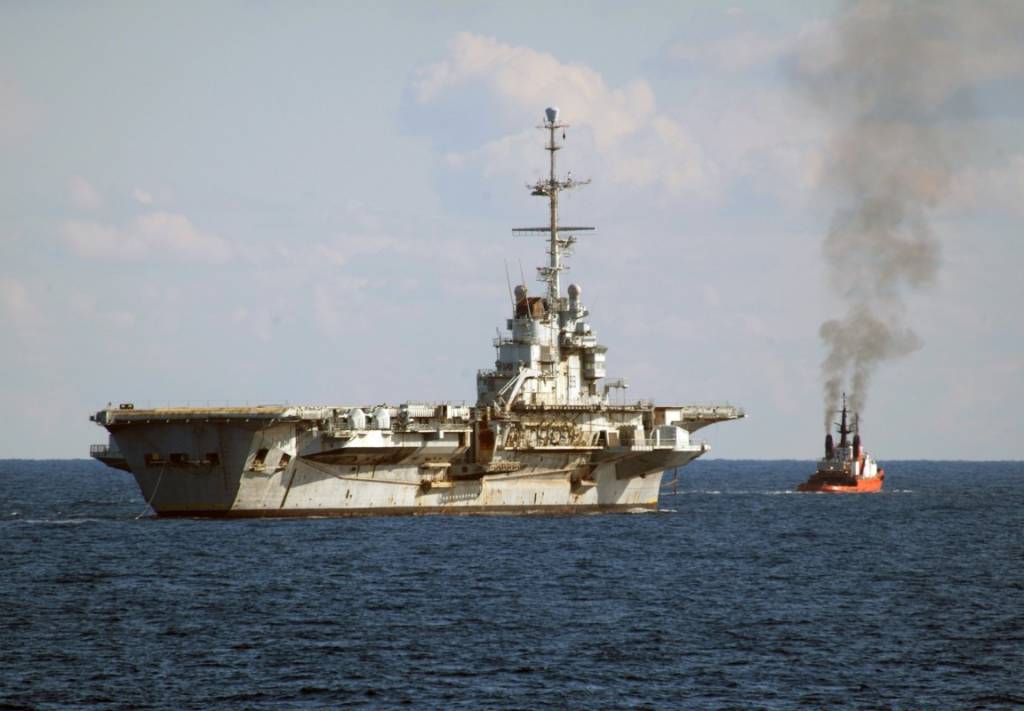
In India, a monitoring committee appointed by the Supreme Court was asked to examine the case on 6 January 2006. Its members divided seven to three in favour of accepting the ship under conditions. On 13 February the Supreme Court decided that it could not rely on these reports and asked the Indian defence ministry to appoint naval experts.
The Conseil d’État decision
On 15 February 2006 the Conseil d’État annulled the Paris court’s orders and suspended the export authorisation and the related decisions. It held that asbestos-containing material falls within the European definition of waste, that the state’s tender and contract showed an intention to dispose of the hull, and that EC Regulation 259/93 restricted waste exports to countries outside the OECD, which included India.
The court found the urgency condition met and declined the associations’ request for an order to bring the ship back. President Jacques Chirac ordered her return to Brest the same day. According to the National Assembly report, the hull contained no PCBs, another common hazard in old ships, because its transformers were of the dry type.
The hull arrived at Brest on 17 May 2006. The government commissioned an independent survey of all potentially hazardous materials aboard, to be followed by a public tender for dismantling. In a reply to the Senate it expected bids in April 2007 and a contract by the end of that year.
How much asbestos?
Estimates varied throughout. In February 2005 the ministry wrote that about 90 per cent of the asbestos would be removed at Toulon, leaving about 22 tonnes. In January 2006 a navy briefing stated that 115 tonnes of friable and accessible asbestos had been removed and about 45 tonnes of asbestos waste remained.
In February 2006 the minister told the National Assembly that the ship had held 160 tonnes before work began, and that the remaining quantity lay between 45 and 75 tonnes. A senator’s question in January 2006 cited more than 500 tonnes, attributed to the contractor that carried out the first removal, and the minister referred to association estimates of up to 1,000 tonnes.
In the English courts in 2009, the Court of Appeal recorded that the ship contained asbestos estimated at some 690 or 770 tonnes. The figures were produced at different times by different parties, and they may not measure the same thing: asbestos fibre, products containing it and contaminated waste are different quantities. Taken together, the figures show why a full survey was needed before the final contract.
Hartlepool and the English courts
The French ministry ran a European tender, and the contract went to Able UK, whose Teesside Environmental Reclamation and Recycling Centre at Hartlepool has a large dry dock. A letter from the French defence ministry, quoted by the Court of Appeal, stated that no facility in France could carry out the work.
Importing asbestos into the United Kingdom was prohibited under the Control of Asbestos Regulations 2006 unless the Health and Safety Executive granted an exemption. Able UK applied on 7 January 2008, and the exemption was granted on 17 June 2008. HSE inspectors concluded that the asbestos could not all be removed before import without dismantling the ship to the point where she could not be towed.

Jean Kennedy sought judicial review. She argued that the HSE’s policy required it to ask whether the work could be done elsewhere, for example in France. Permission was refused in the High Court in September 2008. The Court of Appeal heard the application in November 2008 and refused it, giving its reasons on 28 January 2009.
The court held that the policy test of reasonably practicable alternatives referred to the alternatives open to the applicant, Able UK, and not to the world at large.
Dismantling, 2009 and 2010
In June 2009 a member of the National Assembly told the chamber that the hull was being dismantled at Hartlepool, nearly two and a half years after her arrival at Brest. Able UK states that the work was done in the dry dock at its Seaton Port facility in 2009 and 2010, and reports a recycling rate of over 98 per cent with full traceability of waste streams.
The case had effects beyond one ship. The National Assembly’s 2007 report on end-of-life warships opened by describing the Clemenceau affair as the trigger for a general review of how France should dispose of its old ships. The questions it raised, about hazardous materials, the status of a ship sent for breaking and the responsibility of the owning state, have stayed at the centre of ship recycling policy.
Timeline
| Date | Event |
|---|---|
| 15 September 1955 | Laid down at Brest |
| 21 December 1957 | Launched |
| 22 November 1961 | Admitted to active service |
| 25 September 1997 | Withdrawn from active service |
| 2 March 1998 | Placed in special reserve at Toulon |
| 16 December 2002 | Condemned as hull Q790 |
| 14 April 2003 | Sale for demolition, or tender launched; sources differ |
| 18 October 2003 | Tow intercepted and returned to Toulon |
| 23 June 2004 | Contract amended for removal work at Toulon |
| November 2004 | Asbestos removal begins at Toulon |
| 31 December 2005 | Leaves Toulon for India |
| 15 February 2006 | Conseil d’État suspends the export; return ordered |
| 17 May 2006 | Arrives at Brest |
| 17 June 2008 | UK import exemption granted to Able UK |
| 28 January 2009 | Court of Appeal gives reasons for refusing judicial review |
| 2009 and 2010 | Dismantled at Hartlepool |
Sources and further reading
- Service historique de la Défense, Porte-avions Clemenceau (1954 to 1998). Service record; in French.
- Assemblée nationale, Rapport d’information 3609 sur le démantèlement des navires, 2007; in French.
- Assemblée nationale, Commission de la défense, compte rendu 25, 22 February 2006. Evidence of the minister of defence; in French.
- Centre d’enseignement supérieur de la Marine, Brèves Marine 39: Ex-Clemenceau, en route pour l’Inde, 6 January 2006; in French.
- Conseil d’État, Decision 288801, 15 February 2006; in French.
- Sénat, Question écrite 21310 and reply, 2006; in French.
- Sénat, Question écrite 23069 and reply, 2006; in French.
- Court of Appeal of England and Wales, R (Kennedy) v Health and Safety Executive [2009] EWCA Civ 25.
- Able UK, Marine decommissioning.
- Assemblée nationale, Compte rendu, 2 June 2009; in French.
Image credits. Featured image: An earlier view: Clemenceau under way in the Mediterranean in November 1981, photographed from a US Navy F-14A Tomcat, sixteen years before she left service. Photo: US Navy, Wikimedia Commons, Public domain. Other photographs are credited in their captions.
Have a correction or a photograph that helps identify this ship? Contact contact@shipsarchive.com.


_1988.JPEG)


_underway_1981.jpg)