The Italian liner Andrea Doria sank off Nantucket on the morning of 26 July 1956, about eleven hours after she collided with the Swedish liner Stockholm in fog. Forty-six people died as a result of the collision aboard Andrea Doria, and five crew members aboard Stockholm. More than 1,600 people were rescued from the sinking ship by a group of merchant, naval and passenger ships.
This article describes the ship, the approach of the two vessels, the collision and the rescue, and the wreck as divers and surveyors have found it since. The account of the approach draws on Samuel Halpern’s reconstruction, which assigns contributing causes to both ships. The deaths are stated plainly; no part of the rescue story should obscure them.
| Owner | Italia di Navigazione (Italian Line) |
| Builder | Ansaldo, Sestri Ponente, Genoa; hull 918 |
| Keel laid | 9 February 1950 |
| Launched | 16 June 1951 |
| Gross tonnage | 29,083 |
| Dimensions | 213.98 m by 27.4 m |
| Machinery | Parsons geared steam turbines, 50,000 hp |
| Speed | 23 knots service; 26.44 knots on trials |
| Accommodation | 218 first, 320 cabin and 703 tourist class |
| First Atlantic crossing | Genoa to New York, from 14 January 1953 |
| Collision | About 23:11, 25 July 1956, with Stockholm |
| Sank | 10:09, 26 July 1956 |
| Deaths | 46 from Andrea Doria; 5 Stockholm crew |
The ship
Andrea Doria was built by Ansaldo at Sestri Ponente, Genoa, as hull 918. Her keel was laid on 9 February 1950 and she was launched on 16 June 1951 for Italia di Navigazione, the Italian Line. Italian Liners gives her dimensions as 213.98 m by 27.4 m and her tonnage as 29,083 gross. PBS gives her length as 697 ft.
She had Parsons geared steam turbines developing 50,000 hp, for a service speed of 23 knots and a maximum of 25.4 knots. On trials on 9 December 1952 she reached 26.44 knots. She carried 218 first-class, 320 cabin-class and 703 tourist-class passengers, with a crew of 563.

Her interiors were a showcase of postwar Italian design. The Ansaldo archive lists work by Ponti, Zoncada, Pulitzer Finali, Longoni, Minoletti and the Cassi Ramelli group, among others. Furniture came from Cassina, and the commissions included a statue by Paganin, ceramics by Gambone and a panel by Zuffi.
Her first sailing was a cruise, the Crociera del Sole, from 23 December 1952. Her first Atlantic crossing began at Genoa on 14 January 1953, and she arrived at New York on 23 January. She then worked the route between Italy and New York for three and a half years.
The two ships on 25 July 1956
On the night of 25 July 1956 Andrea Doria was westbound, nearing the end of a crossing to New York, with 1,706 people aboard, of whom 1,134 were passengers. Captain Piero Calamai, aged 58, was in command. She was in fog. Halpern gives her speed as 21.8 knots, reduced from 23.3 knots.
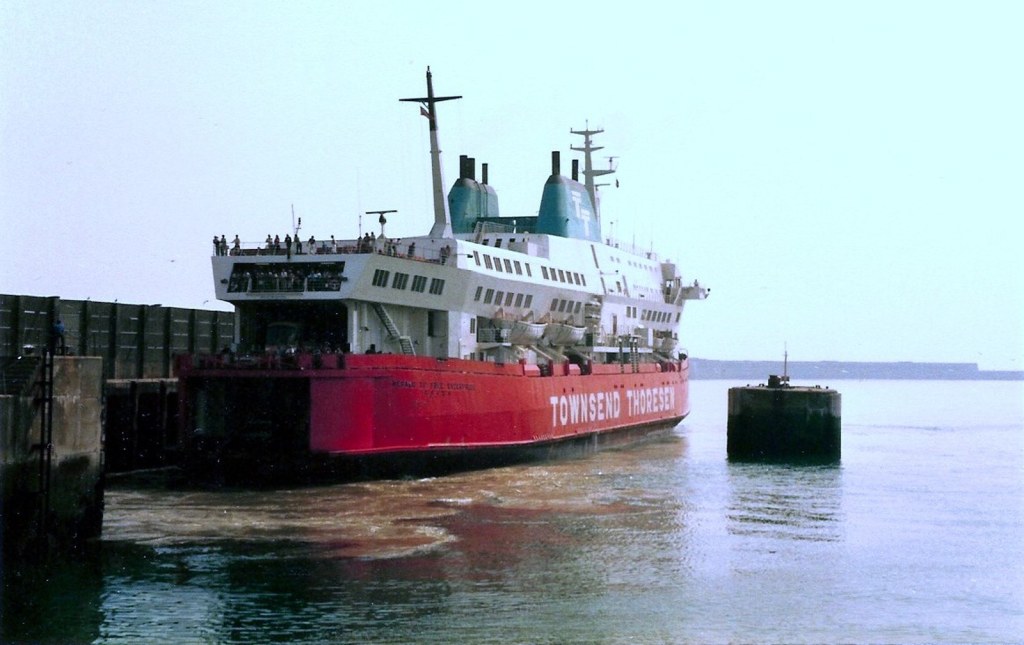
Stockholm, a Swedish liner of 528 ft and 12,165 tons, had sailed from New York and was eastbound. Her bridge watch was kept by Third Officer Johan-Ernst Carstens-Johannsen, aged 26. PBS records that Stockholm was in clear weather, while Andrea Doria was in fog. Halpern gives Stockholm’s speed as 18.5 knots.
Andrea Doria’s radar picked up Stockholm at about 10:45 pm at 17 nautical miles. Stockholm also had the Italian ship on radar. Each bridge drew a different conclusion. Andrea Doria’s officers expected the ships to pass starboard to starboard. Stockholm’s officer expected a port-to-port passing, as the rules required for ships meeting nearly head on.
The collision
At about 11:05 pm Calamai ordered a turn of four degrees to port to open the starboard-to-starboard passing distance. Halpern points out that so small a change would not be easily seen on the other ship’s radar. At 11:09 Carstens-Johannsen ordered a turn of more than 20 degrees to starboard. By then the ships were about 1.3 miles apart.
In the last minutes, as each ship saw the other’s lights, Andrea Doria turned to port while Stockholm turned to starboard. Stockholm’s bow struck Andrea Doria on her starboard side, just aft of the bridge. Halpern places the collision at 23:11 from the course recorder. The SOS position was 40°30′N, 69°53′W.

Contributing causes
Halpern lists contributing factors on both ships. On Stockholm, these included the inexperience of a third officer left alone on the bridge, reliance on an inattentive helmsman for heading reports, and the late timing of the starboard turn. He also argues that the ship’s chosen route exposed her to more head-on traffic than the recommended lane.
On Andrea Doria, he identifies the failure to plot the radar contact as it developed, officers without special radar training, a breakdown in bridge teamwork as attention moved to the lights outside, and the small four-degree turn based on an assumption about the other ship’s intentions. His conclusion quotes Captain Richard Cahill: “Both vessels were to blame.”
Halpern’s paper is a retrospective analysis based on testimony, recorder data and his own reconstruction. It is not an official finding. The reconstruction should be read as a reasoned account of how the two bridge teams reached conflicting pictures of the same encounter.
Flooding and the list
The bow opened Andrea Doria’s starboard side below the waterline. PBS reports that water ran through an access tunnel into the generator space, bypassing a watertight bulkhead. The liner had 11 watertight compartments and was designed to stay afloat with any two flooded, and never to list more than 15 degrees. Halpern records a list of about 18 degrees within minutes of the collision and about 25 degrees within ten minutes.
The list made the port lifeboats impossible to launch, because they could not swing clear of the high side. PBS records that the starboard boats could carry only 1,044 of the 1,706 people aboard. The first boats did not leave until more than an hour after the collision. MARAD notes that even the starboard boats could not be loaded until they had been lowered into the water.
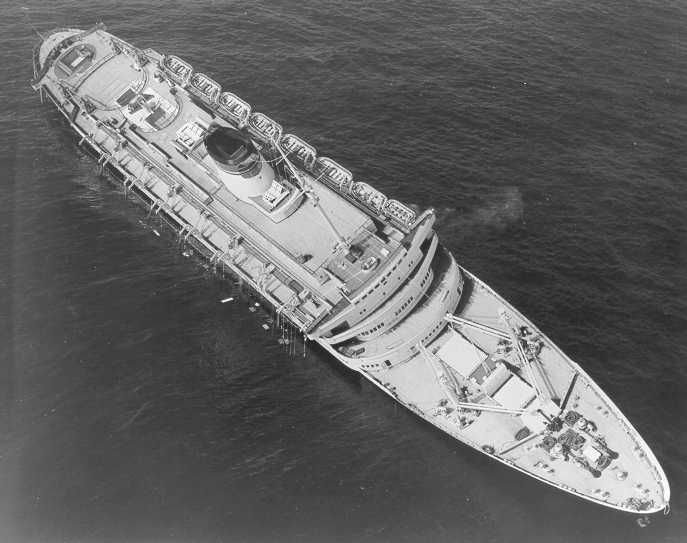
Sources differ on how the evacuation was ordered. MARAD’s rescue histories state that the master ordered all to abandon ship within half an hour of the collision. PBS states that Calamai never sounded the abandon-ship signal. Both agree that Andrea Doria needed boats from other ships to complete the evacuation.
The rescue
The cargo ship Cape Ann, on passage from Bremerhaven to New York and about 15 miles away, was the first relief vessel on the scene, according to MARAD. She launched her two lifeboats within a quarter of a mile of the liner. Soon after she arrived the fog began to lift, and a near-full moon gave light for the boat work. Her boats brought 129 survivors aboard.
The Military Sea Transportation Service transport Private William H. Thomas, carrying troops and dependants from Europe, arrived within two hours of the first SOS. She launched two motor lifeboats and took 159 survivors aboard. She also directed radio traffic for the rescue until the Coast Guard relieved her on the morning of 26 July.
The French Line’s Île de France, eastbound from New York and already past Nantucket, turned back under Captain Raoul de Beaudéan. She stopped about 400 yards from the sinking ship, launched 13 lifeboats and took 753 survivors aboard, more than any other ship. Stockholm, her bow crushed but her hull still seaworthy, carried 545 survivors to New York under her own power.
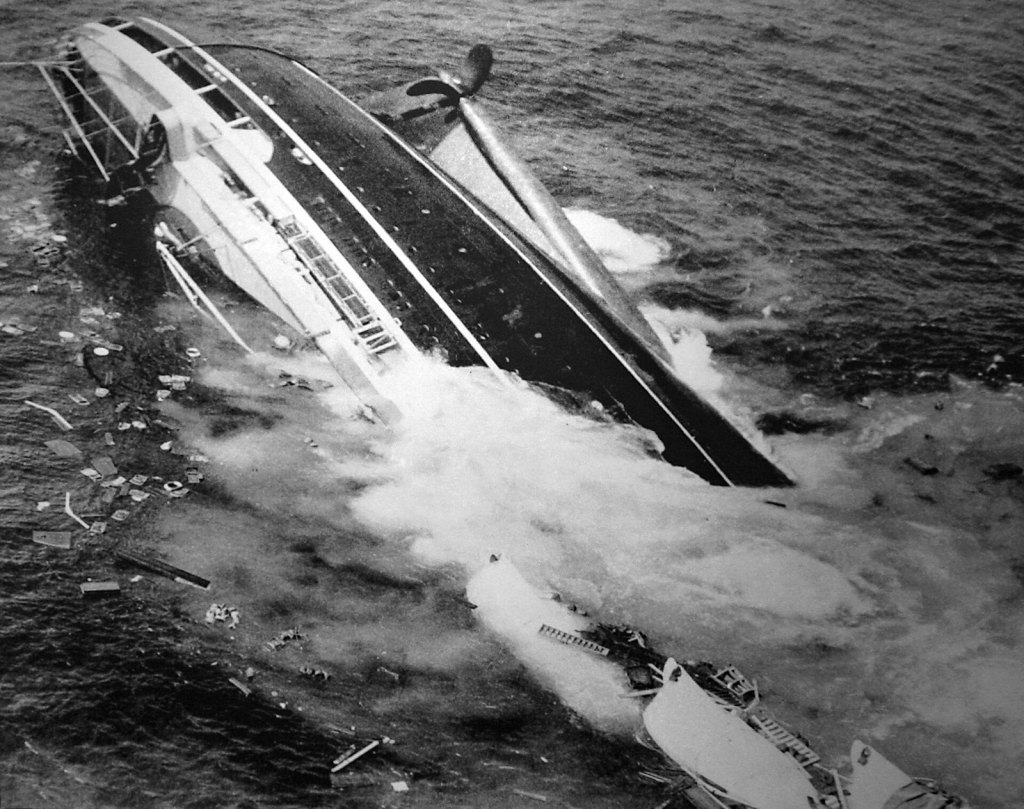
Halpern gives the number rescued as 1,660. MARAD records that rescue operations ended at about 3.30 am on 26 July. Calamai left the ship in a lifeboat just after 5.30 am. Andrea Doria capsized and sank at 10:09 am, about eleven hours after the collision, while press aircraft circled overhead.
The wreck
Andrea Doria lies on her starboard side about 45 miles south of Nantucket, according to Divers Alert Network. The University of Delaware gives a depth of 240 ft for the wreck, while PBS gives about 250 ft; the shallowest parts lie at about 160 ft. Peter Gimbel and Joseph Fox dived on her for Life magazine the day after she sank, the first divers to reach her.
Gimbel led five later expeditions and in 1981 recovered the purser’s safe, cutting an opening that divers still call Gimbel’s Hole. Recreational wreck divers followed from 1966. The depth, cold, poor visibility and the ship’s position on her side made diving there dangerous. Divers Alert Network counted 17 diver deaths on the wreck by 2016; the University of Delaware gave 16.
The wreck has been collapsing for decades. Divers Alert Network reported in 2016 that internal spaces once explored by divers had fallen in. In June 2016 an OceanGate submersible made three dives to the wreck, and the survey obtained 17 sonar scans of the bow, with the University of Delaware helping to map the site.
Recoveries continue. Atlantic Wreck Salvage reports that in July 2025 its divers recovered a gyrocompass repeater from the port bridge wing at a depth of about 230 ft, after four dives over three days to free it from debris, pipes, cables and fishing nets. Such finds now come from a wreck whose original layout is increasingly hard to read.
Timeline
| Date | Event |
|---|---|
| 9 February 1950 | Keel laid at Ansaldo, Sestri Ponente |
| 16 June 1951 | Launched |
| 9 December 1952 | Trials; reaches 26.44 knots |
| 23 December 1952 | First sailing, a cruise |
| 14 January 1953 | First Atlantic crossing begins at Genoa |
| 25 July 1956, about 23:11 | Collides with Stockholm off Nantucket |
| 26 July 1956, about 03:30 | Rescue operations end |
| 26 July 1956, 10:09 | Andrea Doria sinks |
| 27 July 1956 | Gimbel and Fox make the first dive |
| 1981 | Gimbel recovers the purser’s safe |
| June 2016 | OceanGate submersible survey |
| July 2025 | Gyrocompass repeater recovered |
Sources and further reading
- Fondazione Ansaldo, Andrea Doria archive. Builder’s records, launch and interiors.
- Italian Liners, Andrea Doria. Particulars and service history; in Italian.
- PBS, Lost Liners: Andrea Doria.
- Samuel Halpern, Stockholm and Andrea Doria: a collision analysis. Retrospective reconstruction.
- US Maritime Administration, SS Île de France. Gallant Ship citation.
- US Maritime Administration, SS Cape Ann. Gallant Ship citation.
- US Maritime Administration, USNS Pvt. William H. Thomas. Gallant Ship citation.
- Michael Menduno, Divers Alert Network, Remembering the Andrea Doria, 2016.
- University of Delaware, Mission: Andrea Doria, 28 June 2016.
- Atlantic Wreck Salvage, Fifteen Tenacious years, September 2025.
Image credits. Featured image: Andrea Doria rolling onto her starboard side as she sinks on the morning of 26 July 1956, photographed from the air by Harry A. Trask. Photo: Harry A. Trask, Wikimedia Commons, Public domain. Other photographs are credited in their captions.
Have a correction or a photograph that helps identify this ship? Contact contact@shipsarchive.com.