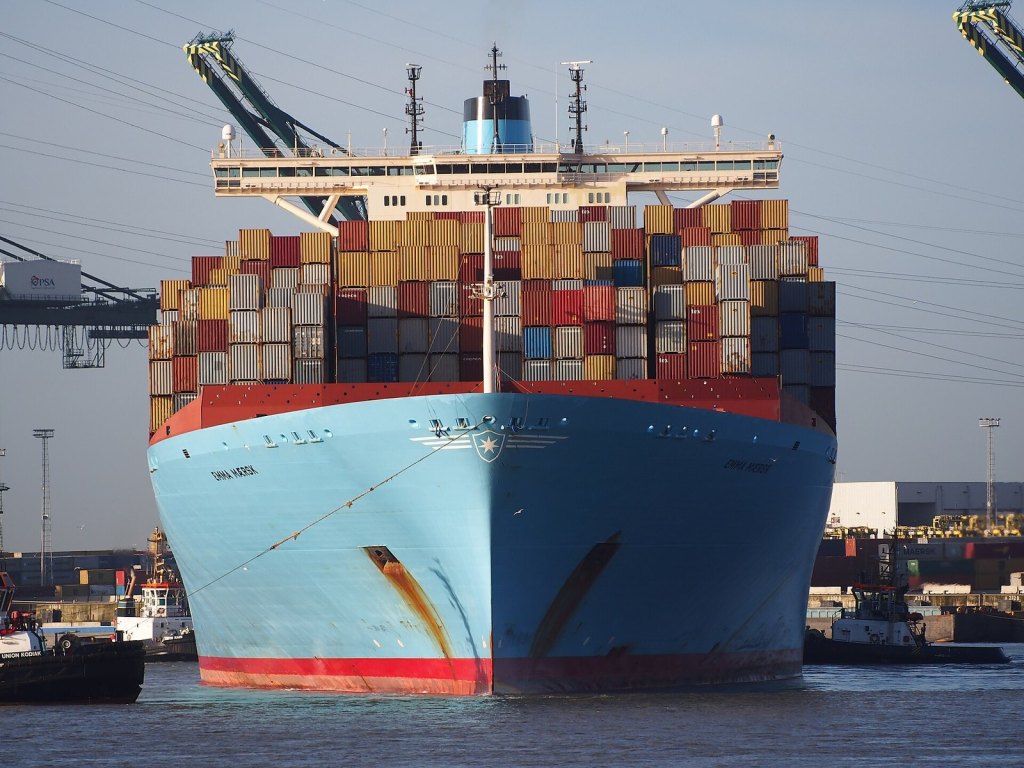
When Emma Maersk was named in August 2006, Maersk described her as an 11,000 TEU container ship. Other figures soon appeared, some much higher. They are not simply right or wrong. Each one measures something different.
This article explains those figures and what really limits the cargo a container ship can carry. It also covers her engine and the flooding that put her out of service in 2013.
| IMO number | 9321483 |
| Builder | Odense Steel Shipyard, Denmark, yard number 203 |
| Named | 12 August 2006 |
| Class | First of eight E-class ships |
| Length overall | 397.71 m (DMAIB, 2013) |
| Breadth | 56.40 m |
| Gross tonnage | 170,794 (DMAIB, 2013) |
| Deadweight | 156,907 t (DMAIB, 2013) |
| Main engine | Wärtsilä 14RT-flex96C |
| Engine rating | 80,080 kW at 102 rpm |
| Service speed | 24.5 knots (DMAIB) |
| Declared capacity | 11,000 TEU |
The first of the E class
Emma Maersk was built at the Maersk group’s Odense Steel Shipyard as newbuilding L 203. A Maersk press release says she was named on Saturday 12 August 2006 by Ane Mærsk Mc-Kinney Uggla. The ship took her name from Emma Mc-Kinney Møller, the late wife of Mærsk Mc-Kinney Møller, who had died the previous December.
Delivery was later than planned. The Danish newspaper Politiken reported on the day of the naming that a fire in early June had badly damaged the bridge and parts of the engine room, and that delivery had been due in July.
She was the first of eight E-class ships. The design firm Deltamarin lists the sisters as Emma, Ebba, Edith, Eleonora, Elly, Eugen, Estelle and Evelyn Maersk. Deltamarin did the basic design of the machinery, piping and engine room, and the detail design of the forward hull.

Which dimensions to use
Published dimensions vary slightly. The Danish Maritime Accident Investigation Board (DMAIB) gives a length overall of 397.71 m, a breadth of 56.40 m, a gross tonnage of 170,794 and a deadweight of 156,907 tonnes. Deltamarin’s reference page gives 398.90 m, 171,542 and 174,239 tonnes.
The two sets may describe the ship at different dates or on different bases, and neither source explains the difference. This article uses the DMAIB figures throughout, rather than mixing values from the two.
The sources also differ on the year. DMAIB records her as built in 2005, while Deltamarin gives 2006 as the delivery year. The naming in August 2006 and the engine entering service in September 2006 support 2006 as the year she entered service.
What a TEU is
TEU stands for twenty-foot equivalent unit. Maersk’s container guide describes the standard 20-foot container as 1 TEU. A 40-foot container counts as two TEU but is a single box.
So a TEU figure is not a count of containers. A load of 5,000 forty-foot boxes is 10,000 TEU, but the cranes lift only 5,000 boxes. The TEU count also says nothing about weight.
Height adds another variable. Maersk notes that a standard container is about 8 ft 6 in high and a high-cube container about 9 ft 6 in. Both count the same in TEU, but taller boxes can change how many fit in a stack.
Four figures for one ship
The marine insurer Gard uses Emma Maersk as its example of how capacity figures differ. It says she may have a nominal capacity of up to 15,000 TEU. That is roughly the number of slots available if weight is ignored.
Gard then gives 11,000 TEU as her capacity when every container weighs 14 tonnes. This figure allows for draught limits, stability and some ballast and consumables on board. Gard also mentions an official figure of 12,500 TEU, which includes a number of empty containers.
Deltamarin’s page adds a fourth number. Next to 11,000 TEU at 14 tonnes it lists a separate figure of 17,816 TEU, without saying how it was calculated. It should not be read as the number of loaded boxes she carried.
At the naming, the trade press noted that Maersk was known for understating capacity. FreightWaves reported estimates of 13,000 to 15,000 TEU. The variety of numbers is partly a matter of definitions and partly a result of that caution.

Weight is a separate limit
Deadweight is the total weight a ship can carry. It includes fuel, fresh water and stores as well as cargo. Dividing 156,907 tonnes by 14 tonnes gives about 11,200, which is close to Gard’s figure, but that sum leaves nothing for fuel and water.
A ship can therefore run out of weight allowance before it runs out of slots, or the other way round. Heavy cargo fills the deadweight first. Light cargo fills the slots first.
Draught limits at ports along the route add a further limit. A planner has to check the deepest point of the voyage, which may be an intermediate port rather than the first one.
Knowing the real weights
Stowage planning depends on accurate container weights. Since 1 July 2016, amended SOLAS rules have required the gross mass of a packed container to be verified before it is loaded. The shipper must state the verified weight and pass it to the master and the terminal in time for stowage planning. Without it, the container is not loaded.
The IMO allows two methods. The packed container can be weighed on approved equipment, or every item packed in it can be weighed and added to the weight of the empty container. These rules came into force nearly ten years after Emma Maersk entered service.
The engine
Emma Maersk was fitted with the world’s first 14-cylinder low-speed engine, the Wärtsilä RT-flex96C. A Wärtsilä release of 12 September 2006 says it entered service on 1 September 2006 in a large, fast container ship, rated at 80,080 kW (108,920 bhp) at 102 rpm. The release does not name the ship, but the rating matches the DMAIB particulars.
Earlier engines of this type had a maximum of 12 cylinders. Wärtsilä says it strengthened the crankshaft and thrust bearing for the extra power. The engine uses electronic common-rail fuel injection instead of a camshaft.
The first installation also had a waste heat recovery plant. Exhaust gas produced steam for a turbine generator, and a power turbine used part of the exhaust flow. Wärtsilä says this could supply electricity equal to about 12 per cent of main engine power, used partly to drive a shaft motor. Deltamarin also lists waste heat recovery and cogeneration among the ship’s features.
Maersk’s naming release mentioned another fuel saving. Silicone paint on the underwater hull was expected to reduce fuel use by 1,200 tonnes a year.
Flooding at Suez in 2013
On the evening of 1 February 2013, Emma Maersk was at the entrance to the Suez Canal at Port Said, about to join a southbound convoy. She had 25 crew and, according to DMAIB, about 14,000 containers on board.
The forward stern thruster broke down, and water flooded the shaft tunnel. The bulkhead between the shaft tunnel and the engine room did not hold, mainly because cable penetrations through it were not sealed well enough. The engine room flooded, and the ship lost propulsion, electric power and steering.
DMAIB notes that the timing made things harder. She had just started a convoy passage through the canal, so the crew could see that loss of propulsion, power and steering was coming while other ships were moving close by.
Four tugs towed her into the Suez Canal Container Terminal, where she was moored and unloaded. Nobody was hurt and there was no pollution. DMAIB says the ship was out of service for six months for repairs.

The DMAIB report, issued on 19 December 2013, found that the crew coped well in spite of the many alarms sounding at once. It made no safety recommendations of its own, but it records the measures taken by the owner, the classification society and others.
Reading a capacity figure
When a capacity figure is quoted, it helps to ask what it measures. Is it nominal slots, a count at a fixed weight per TEU, or a cargo actually carried? For Emma Maersk, the 11,000 TEU figure only makes sense with its 14-tonne basis.
The higher numbers are not errors. They answer different questions. Quoting the basis alongside the number gives a reader more useful information than choosing the largest figure.
Timeline
| Date | Event |
|---|---|
| Early June 2006 | Fire on board at the shipyard |
| 12 August 2006 | Named at Odense |
| 1 September 2006 | Main engine enters service, per Wärtsilä |
| 1 February 2013 | Flooding at Port Said |
| 19 December 2013 | DMAIB report issued |
| 1 July 2016 | SOLAS weight verification in force |
Sources and further reading
- Gard, Gard Guidance on Freight Containers, capacity definitions and the Emma Maersk example.
- A.P. Moller-Maersk, Namegiving of newbuilding L 203 from Odense Steel Shipyard, press release, 12 August 2006, archived copy.
- Politiken, Verdens største containskib hedder Emma, 12 August 2006, in Danish, fire and delayed delivery.
- FreightWaves, World’s largest container ship named Emma Maersk, 13 August 2006, capacity estimates.
- Deltamarin, Emma Maersk, design scope, sister ships and published figures.
- Danish Maritime Accident Investigation Board, Emma Mærsk: Flooding of engine room on 1 February 2013, December 2013, particulars and accident sequence.
- Danish Maritime Accident Investigation Board, Emma Mærsk: Flooding on 1 February 2013, report summary.
- Maersk, A guide to shipping container sizes and types, TEU and container heights.
- International Maritime Organization, Verification of the gross mass of a packed container, shipper and master responsibilities.
- International Maritime Organization, New ship safety rule to prevent loss of containers enters into force, 1 July 2016, weighing methods.
- Wärtsilä, The world’s most powerful engine enters service, 12 September 2006, engine and waste heat recovery.
Image credits. Featured image: Emma Maersk on the Scheldt at the Port of Antwerp in January 2016. Photo: Alf van Beem, Wikimedia Commons, CC0. Other photographs are credited in their captions.
Have a correction or a photograph that helps identify this ship? Contact contact@shipsarchive.com.


.jpg)

_IMO_9321483_Schelde_Port_of_Antwerp_pic1.JPG)