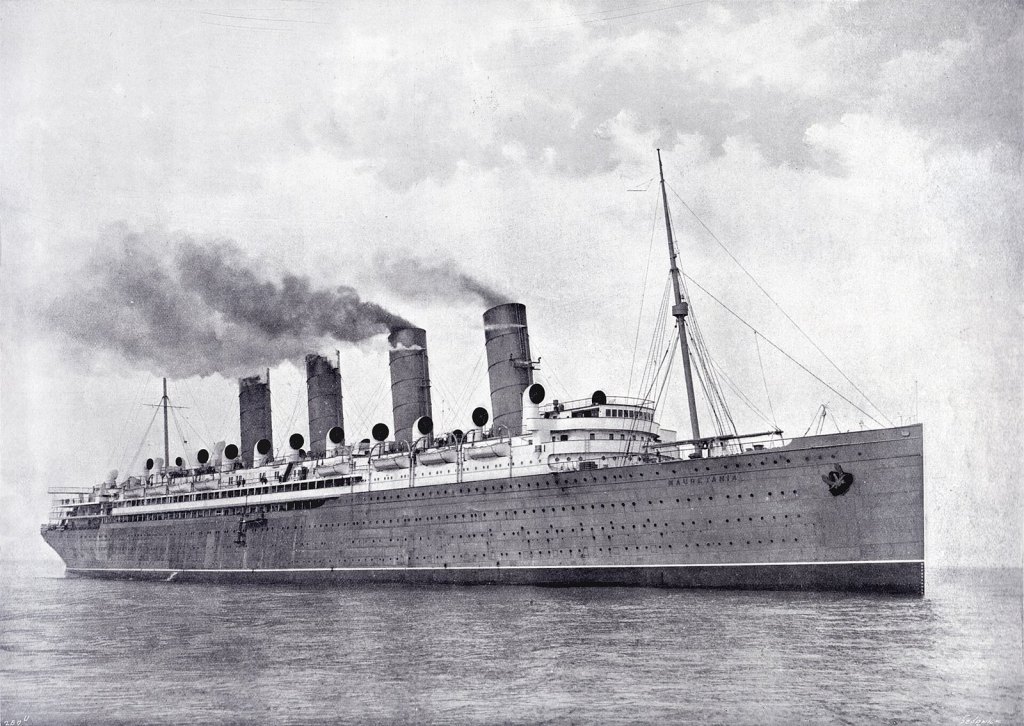
For twenty years Mauretania held the Blue Riband for the fastest crossings of the Atlantic. In 1935 she was sold for scrap. Before the breakers started, her furniture, panelling and fittings were auctioned at Southampton, and some of them are still in use today.
This article follows the ship from the end of her service to the breaking yard at Rosyth, and looks at what survived. The photographs here all show her in service, years before she was scrapped.
| Builder | Swan, Hunter and Wigham Richardson, Wallsend |
| Yard number | 735 |
| Launched | 20 September 1906 |
| Gross tonnage | 30,696 (as built) |
| Dimensions | 762.2 ft x 88.0 ft x 57.1 ft |
| Machinery | Steam turbines, four screws |
| Owner | Cunard Steamship Co, Liverpool |
| Last Atlantic crossing | September 1934 |
| Sold | April 1935, to Metal Industries, £77,000 |
| Arrived Rosyth | 4 July 1935 |
| Breaking began | 21 August 1935 |
The ship
Mauretania was built by Swan, Hunter and Wigham Richardson at Wallsend on the Tyne, as yard number 735, and launched on 20 September 1906. She and her running mate Lusitania were built for Cunard with the help of a British government loan, as a response to the fast German liners then dominating the Atlantic.
Her turbine machinery drove four propellers. Her maiden voyage, from Liverpool to New York, began on 16 November 1907. She took the eastbound record on the return voyage and the westbound record in 1909, and held them until the German liner Bremen entered service in 1929.

Her interiors were among the finest at sea. The Lloyd’s Register Foundation notes that her Edwardian interiors were designed by the architect Harold Peto, using 28 different types of wood, along with marble and tapestries.
War and refits
The Tyne Built Ships record gives her war service. She was requisitioned in August 1914 as an armed merchant cruiser but not used in that role, and served as a troopship and hospital ship from 1915 to 1918. She returned to civilian service on 21 September 1919.

In 1921 a fire damaged E deck. She went back to Swan Hunter for repairs, a general overhaul and conversion of her boilers from coal to oil. The ship that was sold in 1935 had therefore already been altered in important ways from the ship of 1907.
By the early 1930s she was used partly for cruising. Gavin Murphy’s account says she was painted white in 1930 for warm-water cruises to ports such as Bermuda, Havana and Nassau.
Murphy also records that during the war her panelling and marble were protected with coverings of wood and cloth.
Withdrawal
Murphy links her withdrawal to the merger of Cunard and White Star in 1934 and the plans for new liners for the combined fleet. Mauretania made her last eastbound Atlantic crossing in September 1934, from New York to Southampton, and was laid up at Southampton.
In April 1935 she was sold to Metal Industries for breaking up. The Tyne Built Ships record gives the price as £77,000.
The auction at Southampton
Before the ship left Southampton, her furnishings and fittings were put up for auction by Hampton and Sons of St James’s, London, in May 1935. Tennants, quoting the sale advertisement, says it offered the “Appointments, Furnishings, Panelling etc. of the World Famous Cunarder”.
The sale reached well beyond furniture. According to the Daily Telegraph report quoted by Tennants, even the bronze letters of her name on the starboard bow were sold one by one. One buyer, Martin Sutton, a Reading seed merchant who had sailed in her several times, bought the letter M for less than 10 guineas.
That letter stayed in the Sutton family until the 1950s, when it was bought by the father of the person who sold it at Tennants on 27 November 2019. It is about two feet high and made a hammer price of £9,000. Tennants believed it was the first Mauretania letter to appear at open auction since 1935.
A bar in Bristol
The largest group of fittings to survive went to Bristol. Gavin Murphy, writing in 2001, records that Ronald Avery, a Bristol wine merchant, bought panelling, plasterwork, mirrors, light fittings and a large glazed dome from the ship’s library at the sale. They were installed in the Avery building on Park Street in 1935.
In 2001 the building was a bar called the Met, with extensive Mauretania panelling on the ground floor and more upstairs and downstairs. Reused panelling like this is real material from the ship, but it has been fitted to a building ashore, so it does not reproduce the rooms as they were at sea.
The last voyage north
On 1 July 1935 Mauretania left Southampton for the last time, bound for Rosyth. Her former captain Sir Arthur Rostron, who had commanded Carpathia at the Titanic rescue, came to see her go but would not go on board. He said he preferred to remember her as she was when he commanded her.
On the way north she stopped off the Tyne for about half an hour, where crowds gathered and the Lord Mayor of Newcastle came aboard to say farewell. Her last master, Captain A. T. Brown, then took her on. She arrived at Rosyth on 4 July 1935.
Further north, the council at Amble in Northumberland sent a telegram: “Still the finest ship on the seas.” The ship replied: “To the last and kindliest port in England, greetings and thanks.”
According to Co-Curate’s account, her masts were cut down so that she could pass under the Forth Bridge. She reached the Metal Industries yard at about 6.30 in the morning in a half-gale, and a piper played a lament on the quay. On Sunday 8 July some 20,000 people paid to look round her, with the money going to local charities.
Metal Industries and Rosyth
Her buyer was one of the biggest shipbreakers in Britain. Ian Buxton’s history of the company, reviewed in The Northern Mariner, explains how it grew. It was registered in Glasgow on 15 December 1922 as the Alloa Shipbreaking Company and soon moved to Charlestown, near Rosyth Dockyard.
In 1925 it bought out the Rosyth Shipbreaking Company. When the Admiralty placed Rosyth Dockyard on a care and maintenance basis, the company leased one or more of the three graving docks, which let it break up very large ships. It took the name Metal Industries, and later scrapped many of the German warships raised from Scapa Flow.
The Tyne Built Ships record dates the start of breaking to 21 August 1935, about seven weeks after she arrived. Buxton’s book lists ships broken up at Rosyth and Charlestown from 1923 to 1963 with dates of sale, arrival and the start of demolition, which is why intervals like this are known.
How she was taken apart
Co-Curate describes the work as quick. She was cut down while still afloat in the dock, and the breakers used wooden battens and pencil marks on the hull to watch her balance as weight came off. Her funnels were gone within a month.
By 1936 little more than the lower hull was left. That was beached in the tidal basin at the Metal Industries yard and the rest of the structure cut up by 1937. In the same month that Mauretania arrived, July 1935, Metal Industries also bought out the Scapa Flow salvage operation run by Cox, according to the Northern Mariner review.
Objects that survive
Apart from the Bristol interiors and the bronze letter, other pieces are in institutional hands. The Lloyd’s Register Foundation records that her bell is in the offices of Lloyd’s Register in London.
Models also survive, though they were never part of the ship. The Lloyd’s Register Foundation describes a builder’s model at the Discovery Museum in Newcastle, shown with the turbine pioneer Turbinia at her bow.

Another, a 1:64 scale builder’s model 390 cm long, made in the Swan Hunter model shop around 1906, was on long-term loan to the Science Museum in London from 1938 to 2012. It was sold in May 2015, and an application was made to export it to Germany with a value of £500,000. The government’s Reviewing Committee found that it did not meet the Waverley criteria for a national treasure, and an export licence was issued.
The DCMS report also notes that the model was updated as the ship changed. Four-bladed propellers were added in 1909, and more lifeboats after the Titanic disaster in 1912.
Timeline
| Date | Event |
|---|---|
| 20 September 1906 | Launched at Wallsend. |
| 16 November 1907 | Maiden voyage from Liverpool. |
| 1909 | Takes the westbound Atlantic record. |
| 1915 to 1918 | Troopship and hospital ship. |
| 1921 | Fire repairs and conversion to oil firing. |
| 1929 | Records lost to Bremen. |
| September 1934 | Last eastbound crossing; laid up at Southampton. |
| April 1935 | Sold to Metal Industries for £77,000. |
| May 1935 | Fittings auctioned by Hampton and Sons. |
| 1 July 1935 | Leaves Southampton for the last time. |
| 4 July 1935 | Arrives at Rosyth. |
| 21 August 1935 | Breaking up begins. |
| 27 November 2019 | Bronze letter M sold at Tennants for £9,000. |
Sources and further reading
- Tyne Built Ships, Mauretania 1907.
- Newcastle University Co-Curate, Mauretania.
- Lloyd’s Register Foundation, RMS Mauretania: speed, style and sea supremacy.
- The Northern Mariner, Book reviews, volume 3, number 2 (PDF), including Ian Buxton, Metal Industries: Shipbreaking at Rosyth and Charlestown.
- Gavin Murphy, Mauretania history comes alive in Bristol, Gare Maritime, November 2001.
- Tennants Auctioneers, Toys and collectables sales results: Ship Ahoy!, November 2019.
- Department for Culture, Media and Sport, Export of Objects of Cultural Interest 2015 to 2016 (PDF), case 7.
Image credits. Featured image: Earlier view: Mauretania under easy steam off the Tyne in 1907, in her launch colours, as published in Engineering. Photo: Sedgwick, published in Engineering, 1907, Wikimedia Commons, Public domain. Other photographs are credited in their captions.
Have a correction or a photograph that helps identify this ship? Contact contact@shipsarchive.com.


_(51002861233).jpg)
