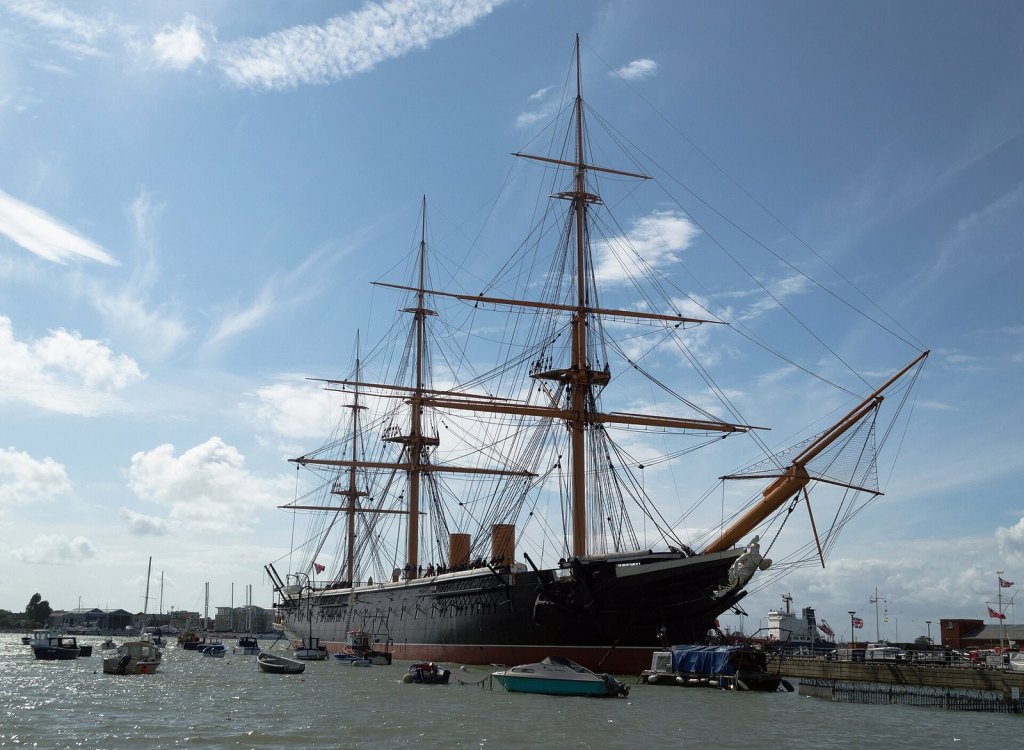
When HMS Warrior was commissioned in 1861 she was the most powerful warship in the world. Within a few years newer ironclads had overtaken her. That rapid change is what makes her interesting: she was the first step in a sequence that ran from wooden sailing ships to the steel battleship, and she still carries features of both ends.
She survives because she remained useful in lowly roles for more than a century after her fighting value had gone. This article looks at how she was built and what happened to her afterwards.
| Builder | Thames Ironworks, Blackwall, London |
| Launched | 29 December 1860 |
| First commissioned | 1 August 1861 |
| Length | 380 ft between perpendiculars |
| Breadth | 58 ft |
| Displacement | About 9,000 tons |
| Armour | 4.5 in wrought iron on 18 in of timber, amidships |
| Machinery | John Penn and Sons steam engine, single screw |
| Rig | Three masts, ship rigged |
| Fastest trial | 14.354 knots |
| Status | Museum ship, Portsmouth, since 1987 |
A reply to Gloire
The French had moved first. Gloire, completed in 1859, was a wooden ship with a complete belt of 4.5 inch iron armour along her side. Britain’s answer was bigger and built differently.
Warrior was built of iron, with armour added to the hull rather than to a wooden frame. The Science Museum’s 1911 catalogue describes her as the first iron-built armoured sea-going warship, built from 1859 to 1861. The usual description now, used by the National Historic Ships register and the Royal Navy museums, is the Royal Navy’s first iron-hulled armoured warship.
That wording is precise for a reason. Calling her simply the first ironclad would be wrong, because Gloire came first. What was new was the combination of iron hull, armour and a long, fast sea-going ship.

Armour where it mattered most
Warrior’s armour did not cover the whole ship. A central section, which held the main battery of guns and the machinery, was protected by 4.5 inch wrought iron plates. Behind the plates was 18 inches of timber, and behind that the iron skin of the hull.
The ends of the ship were left without armour. Armoured transverse bulkheads closed off the protected box at each end. Frederick Whymper, writing while she was still in service, noted that her engines and main guns were protected while the rest of the hull, though strong, was not armour covered.
A Science Museum model shows that the builders first planned to fix the armour into recesses formed by girders on the outside of the shell. That idea was dropped. Instead closely spaced vertical frames inside the shell plating left a shelf for the armour and its timber backing, and the plates were held on by bolts with flush conical heads, secured by nuts inside the hull.

The Times reporter who visited in May 1861 noticed the consequences. With no scuttles possible through armour, the lower deck inside the iron casing was dark, and she was expected to roll. He also noted that the portholes on the main deck had been narrowed to 30 inches from 50.
Guns
Warrior was a broadside ship, with guns firing through ports along her sides like a ship of the line. The Times reported in May 1861 that her armament had been fixed at two 100-pounder and four 40-pounder Armstrong breech-loaders, all on the upper deck, and thirty-six 68-pounder smoothbore guns of 95 hundredweight on the protected main deck.
A later report that year said that for her first cruise she would carry two 100-pounder Armstrongs and otherwise only 68-pounders. Her armament changed several times in service, so the number of guns quoted for her depends on the date.
The Admiralty also wanted to know how well her side would stand up to gunfire. The Times reported in August 1861 that Thames Ironworks was building a target 20 feet long and 10 feet high, with a gunport in the middle, from the same plates and teak as the ship, to be fired at at Shoeburyness until destroyed.
Leaving the Thames
Warrior was fitted out in the Victoria Docks. By August 1861 she drew 22 feet forward and 23 feet aft, within two feet of the depth of the dock, although guns, coal and stores would add another four feet or more. The Times reported that on 8 August she would leave under her own steam for Greenhithe, with four tugs in attendance.
At Greenhithe she was to swing to adjust her compasses and take on heavy stores and guns. She still had launching cleats on her bottom, which was described as foul, so she was to be docked at Portsmouth before proper sea trials. Nearly 1,000 men were still at work finishing her cabins and fittings.
The Times also described her ventilation. Two large pipes ran the length of the ship, with fans driven by a 30 horsepower auxiliary engine to force air through the coal bunkers and between decks. A furnace in the forward stokehold could melt iron to fill shells, intended to set wooden enemy ships alight.

Steam and sail
Her engine came from John Penn and Sons, and a single screw drove her. The Times noted in 1865 that Warrior and the later Achilles had engines made from the same patterns by Penn.
On trial over the measured mile she made 14.354 knots at full power. That was the figure The Times used in 1865, when it compared her with Achilles at 14.322 knots and Black Prince at 13.584, and called her still the fastest ship in the navy.
She was also fully rigged, with three masts. Steaming used coal quickly, so sail was still expected to carry a ship on long passages. The Times thought her masts, those of a 90-gun ship, looked too small for her and doubted she would do much under sail.
Royal Museums Greenwich holds a sail plan drawn for her 1863 refit and dated 13 December 1864, with alterations in 1875. Its lower deck plan of about 1861 shows sail bins next to shell racks, bag racks and coal chutes, a reminder that both forms of propulsion had to share the same hull.
In 1869 Warrior and Black Prince towed the new Bermuda floating dock from Madeira to Bermuda, a long tow that shows how the navy used its big ships in peacetime.

Service
Her first captain was Arthur Cochrane, who commanded her from 1 August 1861 in the Channel squadron until she paid off at Portsmouth in November 1864. One of her officers in 1863 and 1864 was a young gunnery lieutenant, John Fisher, later Admiral of the Fleet Lord Fisher.
The National Historic Ships register sums up her active career as 22 years: six years in full commission and eight as a first-line reserve. In the 1870s and early 1880s she was a coastguard ship at Portland and then Greenock. She entered Portsmouth under her own steam for the last time in 1883.
Hulk, depot and oil jetty
From May 1901 to July 1902 she was a store hulk for torpedoes. In 1902 she became depot ship for the Portsmouth destroyer flotilla. From April 1904 to September 1923 she was the workshop and power station for HMS Vernon, the torpedo school, moored between the old wooden ships Marlborough and Donegal.
For that work her original engines and boilers were removed and modern water-tube boilers fitted. Her boiler room became a machine shop. During the First World War her name was given to a new armoured cruiser, and she was renamed Vernon III. She took back the name Warrior in October 1923.
In 1929 she was towed to Pembroke Dock in Wales and became an oil fuel jetty, listed as Oil Fuel Hulk C77. She stayed there for about 50 years. Continued use, rather than any plan to preserve her, is what kept her from the breakers.
Restoration
A campaign to save her began in 1967, led by Sir John Smith and the Manifold Trust. The Maritime Trust took her on in 1979, and the Warrior Preservation Trust was set up in 1983. She was restored over eight years at Hartlepool at a cost of about £8 million and returned to Portsmouth in 1987.
Because her engines and boilers had been taken out in 1904, the machinery seen on board today is a reconstruction. The register lists a Heritage Lottery Fund grant of £725,000 for the upper deck in 2000 to 2001, and two further grants of about £2.6 million each in 2013 to 2015.
Timeline
| Date | Event |
|---|---|
| 29 December 1860 | Launched at Blackwall. |
| 1 August 1861 | Captain Arthur Cochrane takes command. |
| 8 August 1861 | Due to leave the Victoria Docks for Greenhithe under steam. |
| 1863 to 1864 | John Fisher serves as gunnery lieutenant. |
| November 1864 | Pays off at Portsmouth. |
| 1869 | Helps tow the Bermuda floating dock. |
| 1883 | Enters Portsmouth under her own steam for the last time. |
| 1902 | Depot ship for the destroyer flotilla. |
| April 1904 | Becomes part of HMS Vernon. |
| October 1923 | Resumes the name Warrior. |
| 1929 | Oil fuel jetty at Pembroke Dock. |
| 1979 | Taken over by the Maritime Trust. |
| 1987 | Returns to Portsmouth after restoration. |
Sources and further reading
- National Historic Ships UK, HMS Warrior, register entry 501.
- Science Museum, Catalogue of the naval and marine engineering collection (1911), Internet Archive.
- Science Museum Group, Rigged model of HMS Warrior.
- Royal Museums Greenwich, HMS Warrior (1860), sectional model.
- Royal Museums Greenwich, HMS Warrior (1860), sail plan.
- Royal Museums Greenwich, HMS Warrior (1860), lower deck plan.
- Peter Davis, HMS Warrior (1860), William Loney RN site, with commanding officers and extracts from The Times.
- Frederick Whymper, The Sea: Its Stirring Story of Adventure, Peril and Heroism, volume 2, Project Gutenberg.
- Royal Navy Museums, HMS Warrior.
Image credits. Featured image: HMS Warrior at Portsmouth in 2014. Photo: Lewis Hulbert, Wikimedia Commons, CC BY-SA 4.0. Other photographs are credited in their captions.
Have a correction or a photograph that helps identify this ship? Contact contact@shipsarchive.com.


.jpg)
_bulkhead_armour.jpg)

