In the early hours of 6 October 1941 a German bomber hit a British cargo ship lying at anchor at the southern end of the Gulf of Suez. The ship blew up and sank in minutes. Nine men died.
Thistlegorm lay largely forgotten for decades. Since the 1990s she has become one of the most visited wreck dives in the world, because her holds are still full of the vehicles and equipment she was carrying to the British forces in Egypt.
| Official number | 163052 |
| Builder | J. L. Thompson and Sons, North Sands, Sunderland |
| Yard number | 599 |
| Launched | 9 April 1940 |
| Completed | June 1940 |
| Owner | Albyn Line (Albyn, Black and Co), Sunderland |
| Gross tonnage | 4,898 |
| Length / breadth | 415.1 ft / 58.2 ft |
| Engine | Triple-expansion steam, 365 nhp, single screw |
| Sunk | About 01.30, 6 October 1941 |
| Depth | About 32 m |
A Sunderland tramp in wartime
Thistlegorm was built by J. L. Thompson and Sons at North Sands, Sunderland, as yard number 599. She was launched on 9 April 1940, completed in June and registered at Sunderland on 24 June 1940. Her owners were the Albyn Line, managed by Albyn, Black and Co, also of Sunderland.
Her three-cylinder triple-expansion engine was built by North Eastern Marine Engineering at Sunderland. The Wear Built Ships record gives cylinders of 23, 38 and 65 inches with a 42 inch stroke, 365 nominal horsepower and a speed of 10.5 knots. Lloyd’s Register for 1942 to 1943 gives the same builder, owner and gross tonnage of 4,898.
The Thistlegorm Project, which surveyed the wreck in 2017, says she was privately owned but partly financed by the government. She carried a 4.7 inch gun and a heavy machine gun on the stern, fitted after she was built.

The last voyage
According to the project, she made three voyages before the last one: to the United States for steel rails and aircraft parts, to Argentina for grain and to the West Indies for rum. She then had repairs at Glasgow.
She left Glasgow on 2 June 1941 bound for Egypt. The project gives Alexandria as her destination; the Wear Built Ships record describes the voyage as Glasgow to Suez.
Her master was Captain William Ellis. Nine naval gunners joined the crew to man the guns.
What she was carrying
The cargo was for the Western Desert Force, which became part of the new Eighth Army in September 1941. The project lists Leyland and Albion lorries, Morris Commercial trucks, Universal Carriers, Norton 16H and BSA M20 motorcycles, Bren guns, ammunition, Lee Enfield rifles, radio equipment, Wellington boots, aircraft parts and railway wagons.
On deck she carried two LMS Stanier Class 8F steam locomotives with their tenders, intended for Egyptian National Railways.
The sinking
By late September 1941 a large build-up of Allied troops was under way in Egypt. According to the project, German intelligence suspected that a troop ship was on its way, and two Heinkel He 111 bombers of KG 26 were sent from Crete to find it.
They did not find a troop ship. One of them found ships at anchor at Safe Anchorage F near the Strait of Gubal. It picked the largest, Thistlegorm, and dropped two bombs. Both hit No 4 hold, near the stern, at about 01.30 on 6 October.
The bombs started a fire, and the ammunition in the hold exploded. The explosion tore the ship in two. A witness on the cruiser HMS Carlisle said she sank in less than a minute.
Four merchant seamen and five naval gunners were killed. HMS Carlisle picked up the survivors. Captain Ellis was appointed OBE, and a crewman, Angus McLeay, received the George Medal and the Lloyd’s War Medal for Bravery at Sea for saving another member of the crew.
The project’s memorial list gives their names: Arthur Cain, Archibald Giffin, Alfred Oswald Kean, Donald Masterson, Joseph Munro Rolfe, Kahil Sakando, Christopher Todds, Alexander Neil Brian Watt and Thomas Woolaghan. The youngest was 17 and the oldest 68.
Rediscovery
Most of the cargo stayed inside the hull. The main exception was the two locomotives, which were thrown off the deck and now lie on either side of the wreck.
Jacques Cousteau found the wreck in the early 1950s using information from local fishermen. The project has also found her marked on a 1948 update to an Admiralty chart. Cousteau’s team raised several items, including a motorcycle, the captain’s safe and the ship’s bell, and the February 1956 National Geographic shows the bell still in place.
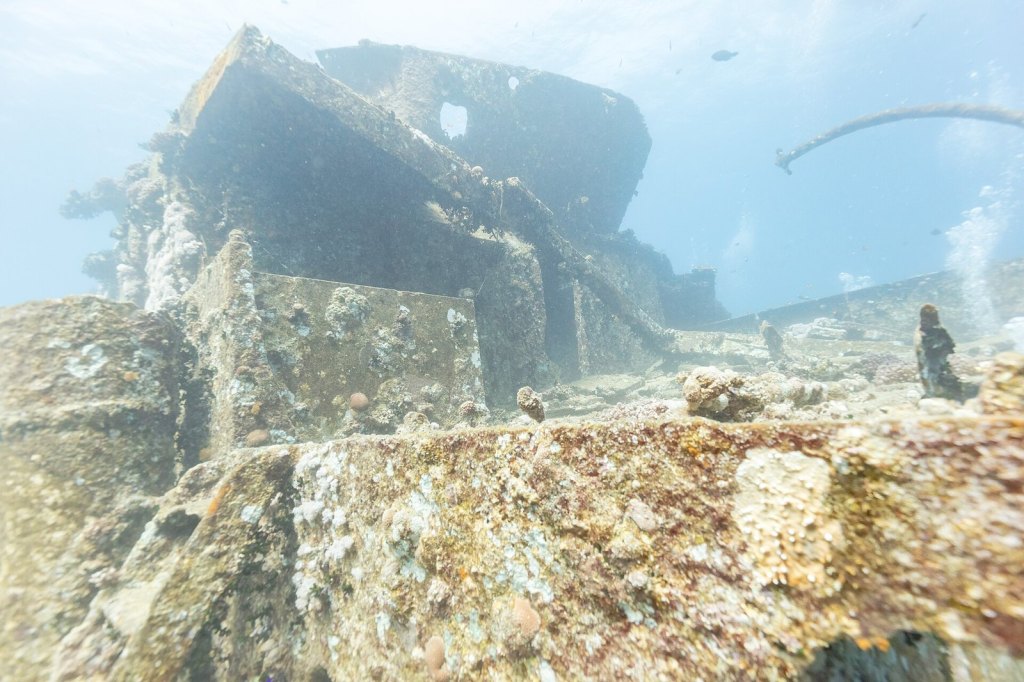
After that she was largely forgotten except by fishermen. When Sharm el-Sheikh developed as a diving resort in the early 1990s, divers returned. The explosion had removed much of the midships structure, and the wreck lies at about 32 metres at its deepest, within reach of ordinary recreational divers.

Not every lorry is a Bedford
For years most of the lorries in the holds were described as Bedfords. In 2014 the underwater photographer Alex Mustard, working with Tony Edge and Keith Francis of an RAF diving expedition, published a survey of the vehicles in the two forward holds. They found only five Bedfords, OYC water tankers, among 63 trucks and lorries there.
The others included 12 Fordson WOT3 trucks, ten Crossley Type Q lorries, two Leyland Retrievers, six Albion AM463 aircraft refuellers fitted with Zwicky equipment, and Albion bridging lorries. Much of the cargo was clearly for the Royal Air Force.
The loading was orderly. Nortons were on the lower level, carried three at a time in the backs of the Fordsons. BSAs were on the upper level, in Morris trucks. Mustard counted 27 Nortons for certain and thought 33 were probably loaded. What divers had called sidecars turned out to be RAF accumulator trolleys, and the supposed armoured cars were pundit lights, used to identify airfields.
Mustard explains why the errors had lasted so long. The ship’s manifest apparently listed the cargo only as motor transport. In the first years of diving, trophy hunters removed the name badges and other identifying parts. The team had to work from radiator shapes, wheel arrangements and cab outlines, checked with restorers on a historic military vehicle forum.
The holds also contain parts for Lysander and Bristol aircraft, accumulator trolleys, boots, rifles and airfield lights. Outside the holds are the Universal Carriers and the locomotives.
Recording the wreck
In 2017 the Thistlegorm Project, led by Dr Jon Henderson of the University of Nottingham with partner universities in Cairo and Alexandria, carried out a photogrammetric survey. The team took 24,307 photographs on 12 dives, a total of about 13 hours and 45 minutes in the water, and built a 3D model of the wreck and parts of the holds.
The survey recorded the forward holds on two levels, the captain’s quarters below the bridge and part of the engine room. It could not cover everything: on the port side of No 1 hold the main deck has collapsed onto the cargo, and that space was too tight to work in safely with a camera.
The site extends over 140 metres. Of the photographs, 15,668 covered the seabed and the outside of the hull. On the lower level of No 2 hold the survey counted 24 lorries and 27 Norton motorcycles, with up to six more Nortons under debris. Processing the model took about 65 days of continuous computing.

Damage and protection
The same project documented the damage that heavy use is causing. Dive boats of over 40 tonnes tie their lines directly to the wreck, and in strong currents those lines pull at railings and superstructure. Wire lines cut into the metal.
The project estimated that in summer about eight boats a day visit from Sharm el-Sheikh and Hurghada, putting around 200 divers and 600 dives on the wreck daily. It also reported continued removal of items, from steering wheels to personal effects, because the wreck had no legal protection.
Divers themselves do damage. Poorly controlled buoyancy brings divers into contact with fragile metal, and the project notes that air exhaled inside enclosed spaces is trapped there and speeds up corrosion.
Egypt ratified the UNESCO Convention on the Protection of the Underwater Cultural Heritage in September 2017, which the project hoped would lead to better protection. The 2017 model gives a dated baseline against which later change can be measured.
Timeline
| Date | Event |
|---|---|
| 9 April 1940 | Launched at North Sands, Sunderland. |
| 24 June 1940 | Registered at Sunderland. |
| 2 June 1941 | Leaves Glasgow on her final voyage. |
| About 01.30, 6 October 1941 | Bombed and sunk at Safe Anchorage F. |
| Early 1950s | Cousteau’s team dives the wreck. |
| Early 1990s | Recreational diving on the wreck begins. |
| October 2014 | Mustard’s vehicle survey published on Divernet. |
| 2017 | Thistlegorm Project photogrammetric survey. |
| September 2017 | Egypt ratifies the UNESCO underwater heritage convention. |
Sources and further reading
- The Thistlegorm Project, Wreck history.
- The Thistlegorm Project, 3D photogrammetry survey.
- The Thistlegorm Project, Project launch, October 2017.
- The Thistlegorm Project, Conservation.
- Alex Mustard, I-SPY the Thistlegorm, in a whole new light, Divernet, 21 October 2014.
- Wear Built Ships, Thistlegorm.
- Lloyd’s Register of Shipping 1942 to 1943, register page including Thistlegorm (PDF, Southampton City Council).
Image credits. Featured image: Part of the Thistlegorm wreck in the Red Sea, photographed in 2022. Photo: Diego Delso, Wikimedia Commons, CC BY-SA 4.0. Other photographs are credited in their captions.
Have a correction or a photograph that helps identify this ship? Contact contact@shipsarchive.com.