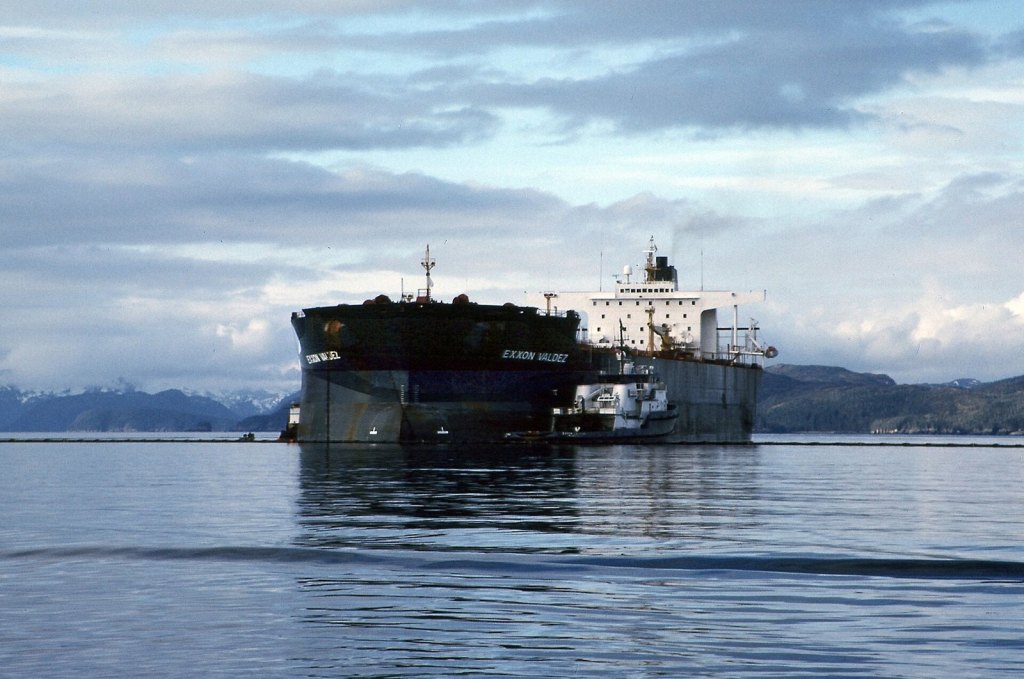
The Exxon Valdez is remembered for one night in March 1989. The ship herself had a longer history. She was less than three years old when she went aground, was repaired, traded for another two decades under five later names, became an ore carrier and was finally broken up in India in 2012.
This article follows the ship through that career. The spill is covered as the official investigations and the agencies involved describe it.
| Builder | National Steel and Shipbuilding Co (NASSCO), San Diego |
| Delivered | 11 December 1986 |
| Length overall | 987 ft |
| Beam | 166 ft |
| Draught | 64 ft 6 in |
| Deadweight | 209,200 long tons (builder) |
| Cargo capacity | About 1.5 million barrels, 11 tanks |
| Main engine | Slow-speed diesel, 31,650 bhp at 78.9 rpm |
| Crew | 21, with quarters for 31 |
| Grounded | Bligh Reef, 24 March 1989 |
| Fate | Beached at Alang, India, 2 August 2012 |
Built for the Alaska trade
NASSCO designed and built the ship as the first of two Alaska Class tankers for Exxon Shipping Company. When she was delivered on 11 December 1986 she was the largest ship built on the US West Coast.
The builder’s fact sheet sets out her intended trade. She was to load Alaskan crude at Valdez and carry it either to West Coast refineries or to Panama, where it would be moved on to the Gulf and East Coasts. The court record later gave her cost as $125 million.
She had a bulbous bow, a raised forecastle, a transom stern and all her accommodation aft. Her cargo was carried in eleven tanks. NASSCO gives her deadweight as 209,200 long tons; the contemporary Maritime Reporter account gives 211,469 tons. Different figures for deadweight are common because they depend on the draught and units used.
Machinery and crew
Propulsion was by a single slow-speed diesel, an IHI-Sulzer 8RTA84, rated at 31,650 brake horsepower at 78.9 revolutions per minute. Maritime Reporter gives her service speed as 16.5 knots. The engine was designed to burn heavy marine fuel.
Two 1,430 kW diesel generators and a 600 kW emergency generator supplied electricity, and she had auxiliary and waste-heat boilers. Four cargo pumps discharged the tanks. Maritime Reporter also notes a segregated ballast system, inert gas, collision avoidance radar and a back-up steering system.
The ship was designed for a crew of 21, with quarters for 31. A small crew on a very large ship was central to her economics. It also became part of the investigation into what went wrong.
The grounding
According to the Exxon Valdez Oil Spill Trustee Council, the loaded tanker left the Alyeska pipeline terminal at Valdez at 9.12 pm on 23 March 1989. A pilot, William Murphy, had the ship through Valdez Narrows, with the master, Captain Joseph Hazelwood, beside him. The pilot then left the ship.
Ice was reported in the shipping lanes, and Hazelwood took the ship out of the lanes to pass around it. He then handed the watch to the third mate, Gregory Cousins, with instructions to turn back into the lanes at a set point, and left the bridge. The turn was not made in time.
The ship grounded on Bligh Reef just after midnight on 24 March. The National Transportation Safety Board gives the time as about 00.09; the Trustee Council gives 12.04 am. She was carrying about 1,263,000 barrels of crude oil.
No one was injured. Eight of her eleven cargo tanks were ruptured. The NTSB estimated the damage to the ship at $25 million and the lost cargo at $3.4 million.
How much oil
Figures differ slightly by source. The NTSB recommendation letter gives about 258,000 barrels. The Trustee Council gives about 11 million gallons, 257,000 barrels or 35,000 tonnes. NOAA gives about 10.8 to 10.9 million gallons. All describe about a fifth of the cargo.
Most of it escaped quickly. NOAA’s incident record says the ship spilled about 10.9 million gallons of her 53 million gallon cargo of Prudhoe Bay crude within six hours of the grounding. The remaining four fifths of the cargo stayed in the ship.
What the investigators found
The NTSB identified several probable causes. The third mate failed to manoeuvre the ship properly, probably because of fatigue and an excessive workload. The master failed to provide a proper navigation watch, possibly because of impairment from alcohol. Exxon Shipping Company failed to supervise the master and to provide a rested and sufficient crew.
The Board also named the US Coast Guard’s failure to provide an effective vessel traffic system, and the lack of effective pilot and escort services.
The NTSB’s letter to Exxon set out the third mate’s day in detail. With cargo and ballast work going on while the ship was at the terminal, he could have had as little as 5 or 6 hours of sleep in the 24 hours before the grounding.
Hazelwood was tried in Alaska. The jury acquitted him of operating a vessel under the influence of alcohol but convicted him of negligent discharge of oil, a misdemeanour. He was fined $50,000 and sentenced to 1,000 hours of community service.
The response
NOAA records that at the height of the response more than 11,000 people, 1,400 vessels and 85 aircraft were involved. Shoreline cleanup ran from April to September 1989 and continued in the summers of 1990 and 1991.
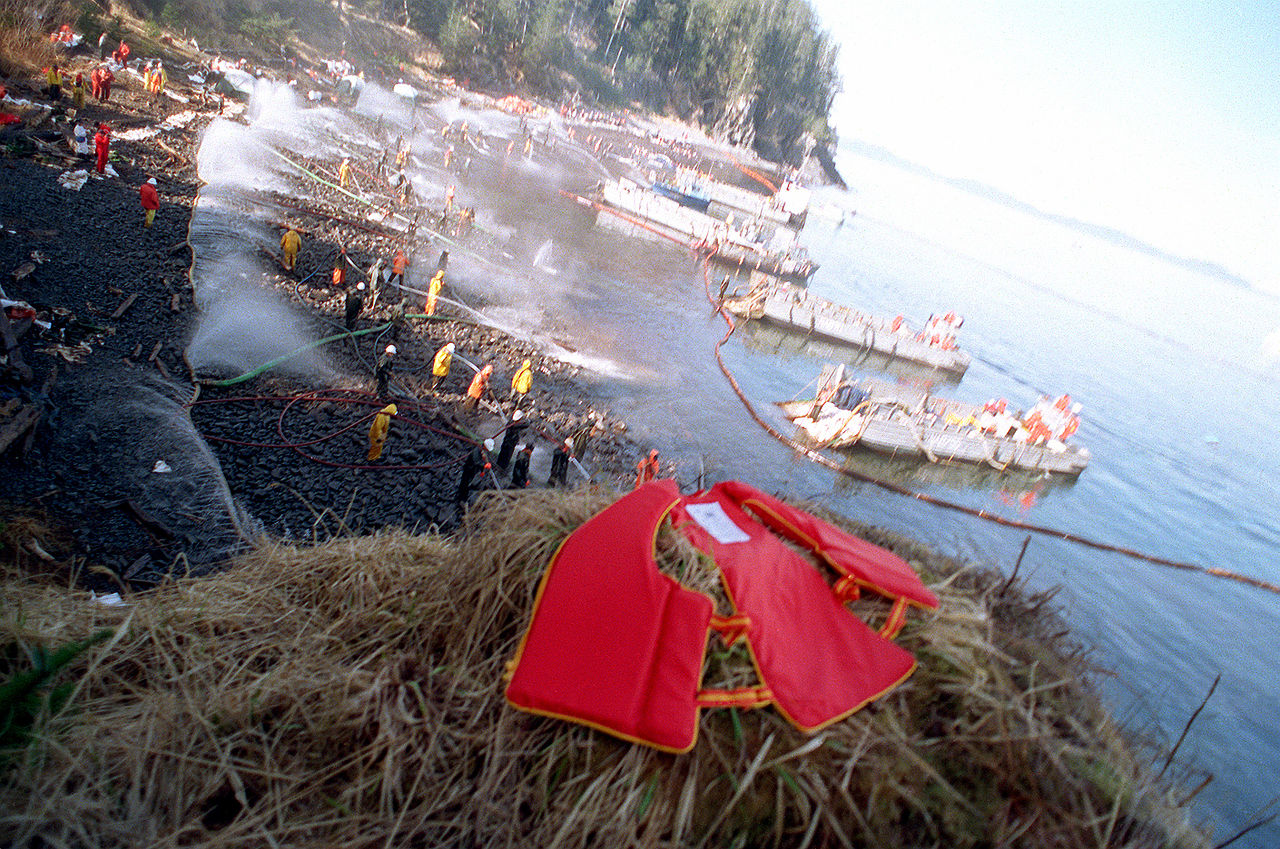
The Trustee Council puts the oiled shoreline at about 1,300 miles. About 200 miles were heavily or moderately oiled and about 1,100 miles lightly or very lightly oiled, out of more than 9,000 miles of shoreline in the region.
From Bligh Reef the oil eventually spread 460 miles, to Chignik on the Alaska Peninsula. The Trustee Council’s own figures for the peak of the cleanup, about 10,000 workers, 1,000 boats and 100 aircraft, are a little lower than NOAA’s. Cleanup went on for more than four summers, and not every beach was cleaned.
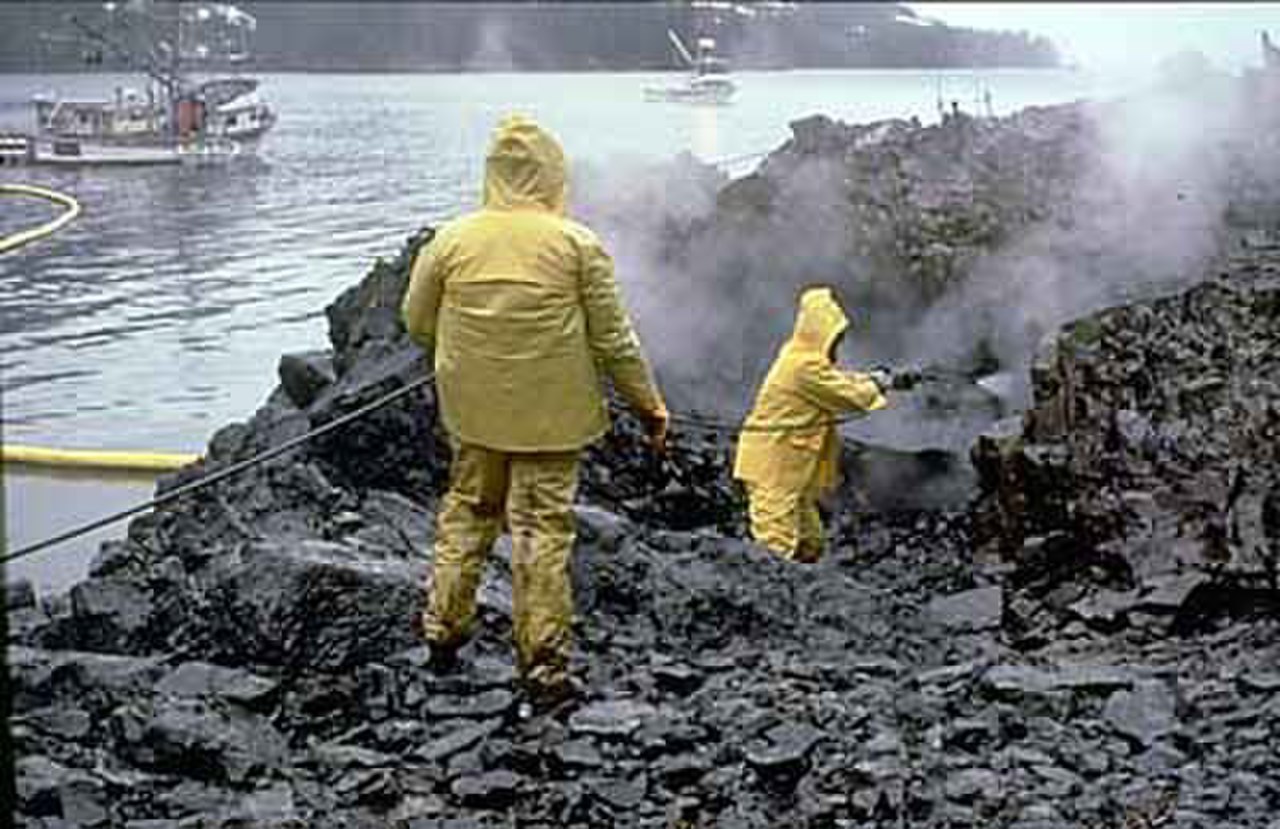
Some of the oil is still there. Surveys in 2001 estimated about 55,000 kg of Exxon Valdez oil in patches beneath beaches over about 7.8 hectares. A model updated after 2015 surveys estimates that 0.6 per cent of the original oil remains. NOAA Fisheries reports that this oil appears to be buried and not currently available to wildlife.

Repair and a new name
The damaged ship was taken south to her builder. On the way, damaged hull plating about 70 feet down was cut away, and a slick about 10 miles long trailing behind her held up her entry into San Diego Bay for a time. She entered dry dock at NASSCO on 30 July 1989.
Repairs took nearly a year and cost about $30 million. She came out as Exxon Mediterranean.
The Oil Pollution Act of 1990, signed on 18 August 1990, included section 5007. It barred any tank vessel that had spilled more than one million gallons of oil into the marine environment after 22 March 1989 from operating in Prince William Sound. In practice it applied to one ship. She passed Coast Guard inspections on 29 August 1990 and was moved to Mediterranean and Middle East trades.
SeaRiver and the court case
In 1993 Exxon placed its shipping operations in a subsidiary, SeaRiver Maritime, and the ship became Sea River Mediterranean, later shortened to S/R Mediterranean. In 2002 she was moved to Asian routes and then laid up.
SeaRiver challenged section 5007 in court. The Ninth Circuit Court of Appeals rejected the challenge in a judgment filed on 31 October 2002. It held that the provision was not a bill of attainder and did not breach due process or equal protection.
Ore carrier and last voyage
In 2005 she was reflagged to the Marshall Islands as Mediterranean. In 2008 SeaRiver sold her to Hong Kong Bloom Shipping, which renamed her Dong Fang Ocean under the Panamanian flag. She was converted from a tanker to an ore carrier at Guangzhou.
On 29 November 2010, NOAA reports, she collided with the bulk carrier Aali in the Yellow Sea off Chengshan, losing both anchors, and was towed to Longyan. In March 2011 she was sold to Global Marketing Systems (GMS) and resold to Best Oasis for $16 million, and renamed Oriental Nicety.
Her owners intended to break her up at Alang in Gujarat. A Delhi group, ToxicsWatch Alliance, petitioned the Indian Supreme Court over possible asbestos and PCBs. A court-ordered audit found no significant contamination, and the ship was cleared in July 2012. She was reported beached at Alang on 2 August 2012.
Timeline
| Date | Event |
|---|---|
| 11 December 1986 | Delivered to Exxon Shipping by NASSCO. |
| 9.12 pm, 23 March 1989 | Leaves the Alyeska terminal, Valdez. |
| Just after midnight, 24 March 1989 | Grounds on Bligh Reef. |
| 30 July 1989 | Enters dry dock at NASSCO. |
| 18 August 1990 | Oil Pollution Act signed. |
| 29 August 1990 | Passes Coast Guard inspections as Exxon Mediterranean. |
| 1993 | Becomes Sea River Mediterranean, later S/R Mediterranean. |
| 31 October 2002 | Ninth Circuit upholds section 5007. |
| 2005 | Marshall Islands flag; renamed Mediterranean. |
| 2008 | Sold; renamed Dong Fang Ocean; converted to ore carrier. |
| 29 November 2010 | Collision with Aali in the Yellow Sea. |
| March 2011 | Sold to Best Oasis; renamed Oriental Nicety. |
| 2 August 2012 | Beached at Alang, India. |
Sources and further reading
- National Transportation Safety Board, Safety Recommendations M-90-26 through M-90-31 (PDF), 18 September 1990.
- National Transportation Safety Board, Grounding of the US Tankship Exxon Valdez on Bligh Reef, NTSB/MAR-90/04 (PDF).
- Exxon Valdez Oil Spill Trustee Council, Questions and answers.
- NOAA IncidentNews, T/V Exxon Valdez, Bligh Reef, Prince William Sound.
- NOAA Office of Response and Restoration, After the big spill, what happened to the ship Exxon Valdez?
- NOAA Fisheries, Lingering oil from Exxon Valdez spill.
- General Dynamics NASSCO, Exxon tanker fact sheet.
- Maritime Reporter and Engineering News, Outstanding oceangoing ships of 1986, December 1986.
- US Court of Appeals for the Ninth Circuit, SeaRiver Maritime Financial Holdings v. Mineta, 309 F.3d 662 (Justia).
Image credits. Featured image: Exxon Valdez in Prince William Sound after the grounding in 1989, with a smaller vessel alongside. Photo: NOAA Office of Response and Restoration, Wikimedia Commons, Public domain. Other photographs are credited in their captions.
Have a correction or a photograph that helps identify this ship? Contact contact@shipsarchive.com.


.jpg)