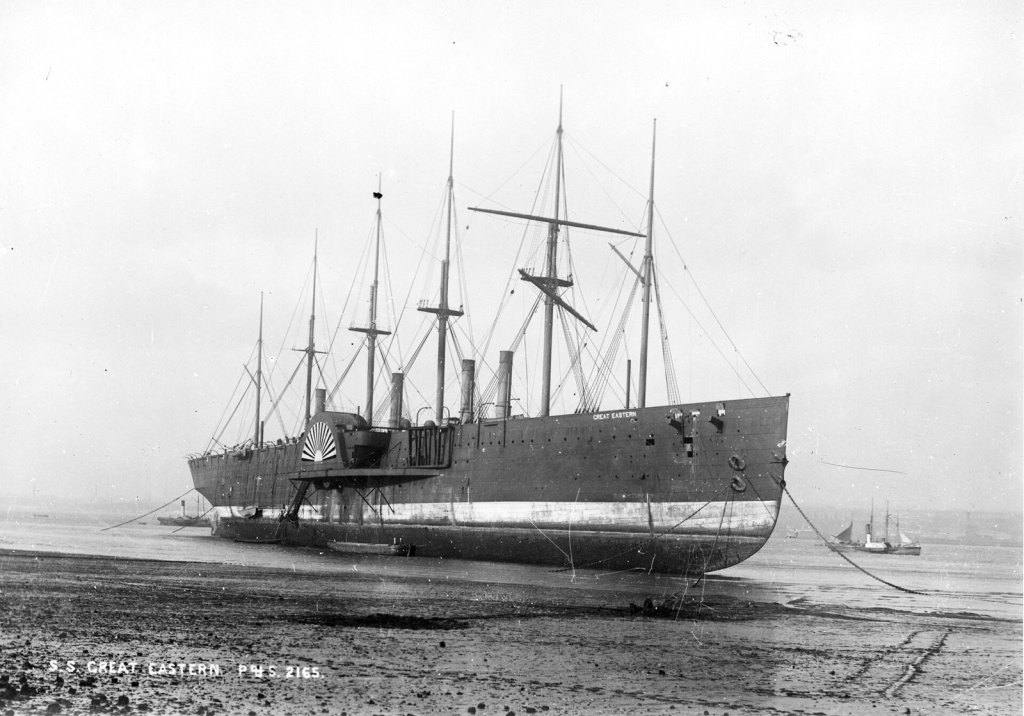
Great Eastern was the largest ship in the world when she was floated in 1858, and no ship matched her length until 1899. Her end came on the Mersey. In August 1888 she was beached on the Cheshire shore near New Ferry, and over the following months her fittings were sold at auction and her iron hull was taken apart.
This article covers the ship’s design and career briefly, then concentrates on the breaking. Contemporary newspaper reports, Brunel’s own description of the hull and later archaeological work allow the stages of her disposal to be set out with some care.
| Designer | Isambard Kingdom Brunel |
| Builder | John Scott Russell, Millwall, then under Brunel’s supervision |
| Ordered by | Eastern Steam Navigation Company |
| Built | 1854 to 1859 |
| Launch attempt | 3 November 1857 |
| Floated | 31 January 1858 |
| Length | 692 ft (211 m) |
| Beam | 83 ft (25 m) |
| Hull | Iron, double skin with watertight compartments |
| Propulsion | Paddle wheels and screw propeller, separate engines, plus sail |
| Last owners | Henry Bath and Co, Liverpool and London |
| Beached for breaking | 25 August 1888, south of New Ferry pier |
A ship sized for a single voyage
Brunel designed Great Eastern for the Eastern Steam Navigation Company to carry enough coal for a voyage to Australia round the Cape of Good Hope and back without refuelling. That aim set her size. Historic England describes her as six times bigger than any vessel yet built.
She was built at Millwall, on the Isle of Dogs, by John Scott Russell. The project ruined Scott Russell, who was bankrupted in 1855, and his working relationship with Brunel broke down. Construction then came under Brunel’s direct supervision. She was too long to launch stern first into the Thames, so she was built parallel to the river and launched sideways.
The launch
The launch ways were built in 1857 by the railway contractor Thomas Treadwell. The hull sat on two cradles, each 120 ft wide, which were to slide down ways at a gradient of one in twelve, extending 240 ft to the river. Checking drums at the head of each way were meant to stop her moving too fast.
To pull her down if she stuck, chains ran from the ship round sheaves on barges in the river and back to steam winches ashore. Hydraulic rams at the bow and stern could give her a start. Brunel wanted a quiet yard, but some 3,000 tickets had been sold to spectators without his knowledge.
The first attempt, on 3 November 1857, moved the ship about four feet. One man was killed and several were injured. Progress over the following weeks was slow, with failing equipment and bad weather, and she was finally floated on 31 January 1858. Brunel suffered a stroke aboard the ship on 5 September 1859 and died on 15 September.
Career at sea
The Thames Discovery Programme dates her first transatlantic voyage from 17 June 1860. She never made the long eastern voyages she was designed for, and as a passenger ship she was a commercial failure. In 1862 she struck a submerged reef, and her double hull kept her afloat.
Cable laying gave her size a purpose. In 1866, after a failed attempt in 1865, she laid the first lasting transatlantic telegraph cable, from Valentia Island in Ireland to Heart’s Content in Newfoundland. She then recovered and completed the cable lost the year before. Historic England records six more Atlantic cables and one across the Indian Ocean.

Museum accounts give different spans for this work. The Science Museum gives 1865 to 1873, and the National Maritime Museum of Ireland gives 1866 to 1878. After cable work ended she had no lasting employment. In 1886 and 1887 she lay at Liverpool as a floating advertisement for Lewis’s department store. The National Maritime Museum of Ireland adds that she ended her working life as a floating music hall and gymnasium.

The structure the breakers faced
Brunel described the hull himself in a passage quoted in his son’s biography. Up to well above the deepest waterline, it had a double skin with a space of about three feet between the plates. The material between the skins ran lengthways in webs connecting them, which gave great strength for the weight of iron used.
The space between the skins was divided by those webs and the bulkheads into about fifty watertight compartments. Main transverse bulkheads stood about 60 ft apart, and two longitudinal iron bulkheads ran fore and aft about 40 ft apart, carried up to the upper deck.

For a breaker, this meant that removing an outer plate exposed more structure, not an empty hold. The webs, bulkheads and inner skin all had to be cut and separated as well. The same features that let her survive the 1862 grounding made the hull slow and expensive to take apart.
The last voyage
Henry Bath and Co of Liverpool and London bought the ship for about £20,000. The Liverpool Echo of 27 August 1888 reported her last passage, from Greenock to the Mersey, under her own steam with tugs in attendance. Captain Collier commanded, with a crew of about 115, and the Liverpool pilot Mr Dudley took over off the Calf of Man.
She came over the bar early on Saturday 25 August and up the river on the flood tide, watched from crowded landing stages. Her paddle wheels had already been removed. She drew 15 ft forward and 21 ft aft. About an hour after high water she was beached on the Cheshire shore a short distance south of New Ferry pier, held by two kedge anchors from each bow.
The Echo expected the owners to take out the heavy machinery first. If the ship could be lightened in time for the next spring tides, she might be floated higher up the beach to make the work easier. The paper estimated the cost of breaking her at about £20,000, the same as the purchase price.
The auction
The ship and her contents were sold at auction, without reserve, by the auctioneer G. N. Dixon. The Echo of 26 November 1888 reported that the sale had ended on Saturday 24 November and had raised between £58,000 and £60,000. A steam launch that had carried visitors from the New Ferry stage to the ship went for £105.
According to Dixon, the bulwarks had been bought by a well-known Scottish wheel maker, and the wire rigging was to be shipped abroad and made into nails. E. W. Morrice, for Henry Bath and Co, said he expected a margin of profit for all concerned. He also asked buyers for patience over the delivery of their lots, a reminder that much of the physical work was still to come.
The auction figure was gross proceeds. It was not the purchase price and not the owners’ final profit, because the cost of dismantling, handling and delivery still had to be met.
How long the breaking took
Sources disagree on the date of her end because they record different stages. The newspapers establish arrival and sale in 1888. The Thames Discovery Programme places the breaking in 1889 and 1890. The National Maritime Museum of Ireland says she was broken up in 1889 and took 18 months to dismantle. Historic England says the early 1890s.
A period from 1888 to about 1890 fits the evidence best. No source used here gives a date on which the last of the hull left the shore.
The National Maritime Museum of Ireland repeats a story that the remains of workers missing since the build were found between the inner and outer hulls during breaking. The museum itself describes this as not fully verified, and it should be treated as unproven.
What survives
The National Maritime Museum of Ireland records that a mast known as Thursday became a flagpole at Anfield, the Liverpool football ground. In 2010 Mike Stammers of the Merseyside Maritime Museum found substantial iron plates and rivets on the foreshore at the site of the breaking yard.
The launch ways at Millwall survive too. Part of the southern way was uncovered in the 1980s and left on display, and the Thames Discovery Programme surveyed the remains on the foreshore in 2010. Historic England scheduled the site as an ancient monument on 31 July 2015. Between them, the two sites mark the beginning and the end of the ship.
Timeline
| Date | Event |
|---|---|
| 1854 | Construction begins at Millwall |
| 3 November 1857 | First launch attempt |
| 31 January 1858 | Floated in the Thames |
| 15 September 1859 | Death of Brunel |
| 17 June 1860 | First transatlantic voyage begins |
| 1862 | Strikes a submerged reef; double hull keeps her afloat |
| 1866 | Lays the first lasting transatlantic telegraph cable |
| 1886 to 1887 | Used for advertising at Liverpool |
| 25 August 1888 | Beached south of New Ferry pier |
| 24 November 1888 | Auction of the ship concludes |
| 1889 to 1890 | Main breaking work |
| 2010 | Remains found at the breaking site and surveyed at Millwall |
| 31 July 2015 | Millwall launch ways scheduled |
Sources and further reading
- Liverpool Echo, The Great Eastern in the Mersey, 27 August 1888, transcribed by Play Up, Liverpool.
- Liverpool Echo, Sale of the Great Eastern, 26 November 1888, transcribed by Play Up, Liverpool.
- Historic England, Site of the launch ways of the SS Great Eastern, list entry 1423608.
- Science Museum Group, Builder’s whole, rigged model of SS Great Eastern.
- Thames Discovery Programme, The Great Eastern rediscovered, Gustav Milne, 11 November 2010.
- Isambard Brunel, The Life of Isambard Kingdom Brunel, Civil Engineer, 1870, Project Gutenberg.
- National Maritime Museum of Ireland, The Great Eastern.
Image credits. Featured image: Great Eastern beached on the Cheshire shore of the Mersey for breaking, probably in 1888 or 1889. Photo: Unknown photographer, State Library of Victoria, Allan C. Green collection, Wikimedia Commons, Public domain. Other photographs are credited in their captions.
Have a correction or a photograph that helps identify this ship? Contact contact@shipsarchive.com.