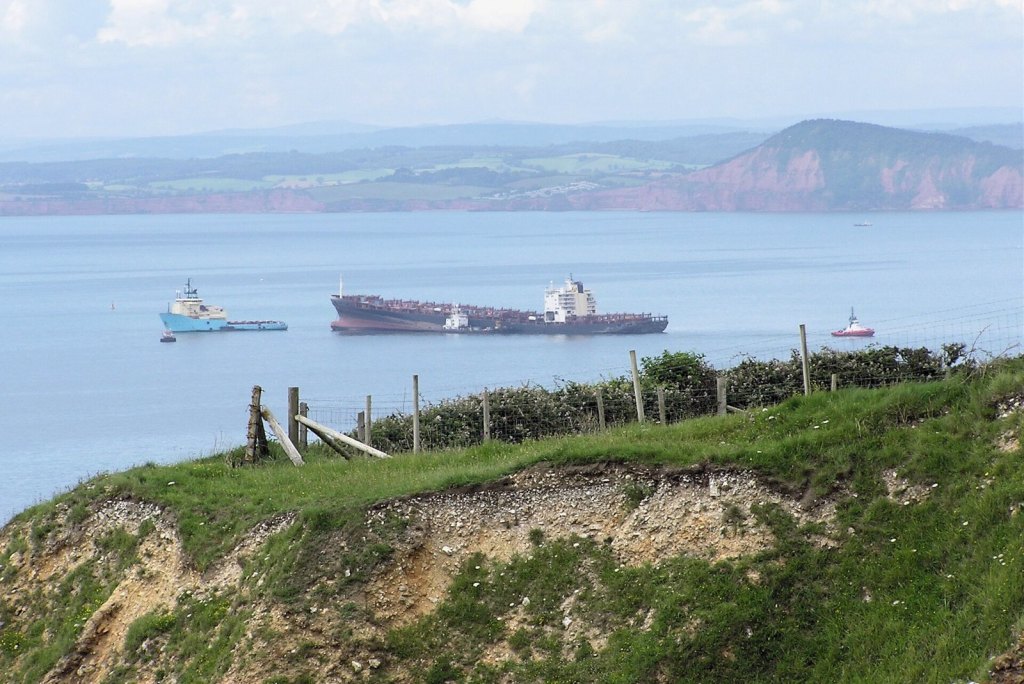
On 18 January 2007 the container ship MSC Napoli suffered a major failure of her hull in heavy weather in the western English Channel. All 26 crew abandoned ship and were rescued without injury. Two days later the damaged ship was deliberately run ashore in Branscombe Bay, East Devon, to prevent her breaking up and sinking in deeper water.
The Marine Accident Investigation Branch (MAIB) published its report in April 2008. It found that the hull had buckled in the engine room region, in an area that design rules of the time did not require to be checked for buckling strength. The findings led to wider checks on container ships of similar design.
| Type | Container ship, 4,419 TEU |
| Built | 1991, Samsung Heavy Industries, Koje, South Korea |
| Length overall | 275.66 m |
| Breadth | 38.18 m |
| Gross tonnage | 53,409 |
| Main engine | Sulzer 10RTA84C, 38,792 kW |
| Owner | Metvale Ltd |
| Manager | Zodiac Maritime Agencies |
| Flag | United Kingdom, from 2002 |
| Classification | Bureau Veritas to 2002, then Det Norske Veritas |
| Crew | 26, all rescued |
| Beached | 20 January 2007, Branscombe Bay |
The ship and her service
The ship was built in 1991 as CGM Normandie. She became Nedlloyd Normandie in 1995 and CMA CGM Normandie in 2001. Metvale bought her in September 2002 and placed her under the UK flag. She was chartered to MSC and renamed MSC Napoli in November 2004.
Her service speed when new was 24.1 knots; the charter speed was 21.5 knots. From November 2006 she ran between South Africa and north-west Europe. The MAIB report lists earlier damage: a dock indentation in January 2001, a grounding in the Malacca Strait in April 2001, berth damage at Jeddah that December, and a grounding at Jeddah in August 2002.
The Malacca Strait grounding was the most serious. About 90 m of the forward hull was replaced at a yard in Vietnam, using some 3,000 tonnes of steel. The MAIB found no evidence that this or any other previous damage had reduced the strength of the engine room region where the hull later failed.
A voyage under schedule pressure
Napoli left Cape Town on 29 December 2006, four days late. Calls at Hamburg and Le Havre were cancelled, with cargo transhipped at Antwerp. A turbocharger failure meant she reached Felixstowe six days behind schedule on 13 January. A second turbocharger later failed, and the engine governor was not working properly.
She left Antwerp at 0812 on 17 January, bound for Sines in Portugal. On 18 January she was on a course of 240° into a south-westerly storm of force 10 to 11, with waves of 5 to 9 m. The engine setting would normally have given about 17 knots, but she was making good about 11 knots.
Overnight the engine speed had been reduced from 82 to 71 rpm. The MAIB records that this was because of difficulty controlling the engine, not concern for the hull. Times in the report are ship’s time, UTC plus one hour.
The failure
Shortly after 1100, about 45 nautical miles off the Lizard, the ship met several large waves. At about 1105 a loud crashing or cracking sound was heard, followed at once by bilge and flooding alarms in the engine room. The report’s particulars give the time of failure as 1102. The master decided to abandon ship and a distress call was sent at 1125.
All 26 crew boarded the enclosed lifeboat. Once it was in the water, a crewman could not pull the release pin on the painter, the line holding the boat to the ship. The chief engineer cut it with a knife. Everyone in the boat became seasick in the heavy sea. Two Royal Navy helicopters lifted the crew to safety, and no one was injured.
Why the engine room mattered
Napoli was built with longitudinal framing in her cargo holds, changing to transverse framing in the engine room. The MAIB concluded that the bottom shell plating at frames 82 to 88, just forward of the engine room, buckled elastically. The failure then spread through the bottom, the double bottom and the sides.
The class rules in use, based on the IACS unified requirement S11, required buckling checks only in the midships region, 0.4 of the ship’s length. The failure point lay outside that zone. The hull therefore met the rules while having less buckling strength than the loads in that area demanded.
The investigation also examined whipping, the vibration of the whole hull after a heavy impact at the bow. Analysis by DNV for the MAIB found that a change of 5 knots altered the wave load by about 10 per cent. Speed in heavy seas therefore had a direct effect on the loads the hull had to carry.
Material defects found in the hull were minor and did not affect its strength. Some weld repairs had not been reported to the classification society, but these did not contribute to the failure.

Choosing a place of refuge
The ship was taken in tow towards Portland, but her condition worsened. The Secretary of State’s Representative for Maritime Salvage and Intervention (SOSREP) decided to beach her. On 20 January she was run ashore in Branscombe Bay, where the hull could be held and the cargo and fuel removed.
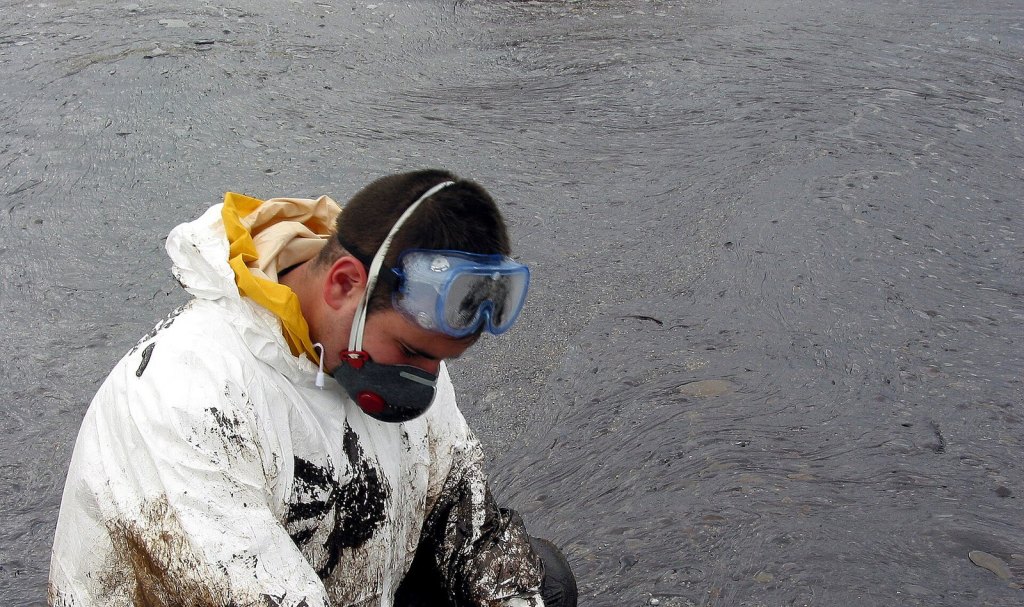
The Maritime and Coastguard Agency later recorded that an inquiry found the decision correct, because it averted a pollution catastrophe. The ship had about 2,318 containers and 3,800 tonnes of oil aboard. Around 302 tonnes of oil were lost in total, and about 1,000 oiled seabirds were collected, of which about 600 were released.
Of the containers, 114 were lost overboard and about 80 came ashore. Some 159 containers held dangerous goods. When containers washed up at Branscombe, crowds gathered on the beach and items were removed, which drew national attention and complicated the response.
Salvage and removal
Most of the fuel and containers were taken off over about five months. The ship was refloated on 9 July 2007, but the damage was too great to tow her intact, and she was beached again three days later. On 20 July explosives separated the hull into two parts.

The forward section was towed to Harland and Wolff in Belfast for breaking. The stern section was cut up where it lay off Branscombe and taken away by barge to Rotterdam. The MCA states that the last of the wreck was removed by July 2009, about two and a half years after the beaching, at a cost of more than £120 million.

Cargo declarations
Investigators weighed about 660 dry containers from the deck. Of these, 137, or 20 per cent, differed from their declared weight by more than 3 tonnes, the largest by 20 tonnes. Together they were 312 tonnes heavier than declared. Of 700 stowage positions checked, 53 were wrong. The MAIB did not find that these errors caused the failure.
Findings beyond one ship
Following the casualty, classification societies screened more than 1,500 container ships for similar weaknesses. By the time of the report, 12 had needed remedial work, 10 were borderline and 8 cases were still being examined.
The MAIB recommended that IACS require hull girder and buckling checks along the whole length of the hull, consolidate research into whipping and study instruments for measuring hull stress. Further recommendations went to the International Chamber of Shipping and to Zodiac. The report ends a story that many people know from the beach scenes at Branscombe. Its lasting importance is in the hull checks it prompted.
Other bodies acted before the report appeared. In May 2007 the MCA raised container weight and longitudinal strength checks at the Paris MOU port state control committee, and the UK agreed to lead a task force on a concentrated inspection campaign planned for 2010. The International Chamber of Shipping, with the World Shipping Council, began work on an industry code of best practice.
Steamship Mutual’s 2008 case history drew the threads together: tight liner schedules, hull bending limits, mixed framing systems, limited structural analysis of new designs and the effect of whipping.
Notes on the sources
The MCA’s tenth anniversary article places Branscombe in Dorset; it is in East Devon. The same article gives Durban as the destination, while the MAIB report gives Sines in Portugal. This article follows the MAIB for the voyage and the MCA for the environmental and salvage figures.
Timeline
| Date | Event |
|---|---|
| 1991 | Built by Samsung as CGM Normandie |
| April 2001 | Grounds in the Malacca Strait; forward hull later rebuilt |
| September 2002 | Bought by Metvale; UK flag |
| November 2004 | Chartered to MSC and renamed MSC Napoli |
| 29 December 2006 | Leaves Cape Town four days late |
| 17 January 2007 | Leaves Antwerp for Sines |
| 18 January 2007 | Hull fails off the Lizard; crew rescued |
| 20 January 2007 | Beached in Branscombe Bay |
| 9 July 2007 | Refloated, then beached again three days later |
| 20 July 2007 | Hull separated by explosives |
| August 2007 | Forward section towed to Belfast |
| 22 April 2008 | MAIB report 9/2008 published |
| July 2009 | Last of the wreck removed |
Sources and further reading
- Marine Accident Investigation Branch, Report on the investigation of the structural failure of MSC Napoli, report 9/2008. Contains public sector information licensed under the Open Government Licence v3.0.
- Marine Accident Investigation Branch, Structural failure of container vessel MSC Napoli, report page.
- Maritime and Coastguard Agency, Tenth anniversary of the MSC Napoli shipwreck disaster, 18 January 2017.
- Steamship Mutual, MSC Napoli: A Case History, Captain Simon Rapley, 1 October 2008.
Image credits. Featured image: MSC Napoli aground off Branscombe, East Devon, on 20 July 2007, the day explosives separated the hull. Photo: Adrian Pingstone, Wikimedia Commons, Public domain. Other photographs are credited in their captions.
Have a correction or a photograph that helps identify this ship? Contact contact@shipsarchive.com.