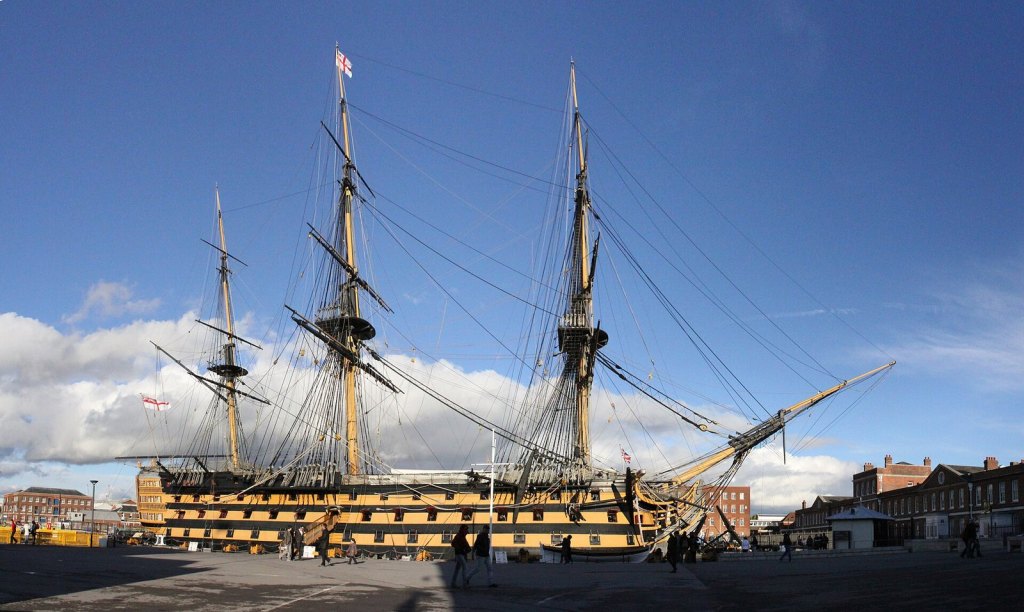
HMS Victory is the oldest naval warship still in commission anywhere in the world. She was launched at Chatham in 1765, fought in four major fleet actions and carried Vice Admiral Lord Nelson’s flag at Trafalgar in 1805. Since December 1922 she has stood in No. 2 Dock at Portsmouth, the oldest dry dock in the world.
Her survival is not simple. Victory has been repaired, rebuilt and re-rigged many times, and the ship that visitors board today is a mixture of original timber, later repairs and reconstruction. The National Historic Ships UK register and the conservation records of the National Museum of the Royal Navy make it possible to say with some precision which parts are which.
| Type | First-rate ship of the line |
| Designer | Sir Thomas Slade |
| Builder | Chatham Dockyard; work began in 1759 |
| Launched | 7 May 1765 |
| Cost | £63,176 |
| Gun deck length | 186 ft (56.7 m) |
| Beam | 52 ft (15.8 m) |
| Burthen | 2,162 tons |
| Guns at Trafalgar | 104 |
| Crew at Trafalgar | About 820 on the muster roll |
| Location | No. 2 Dock, Portsmouth, since December 1922 |
| Status | In commission; flagship of the First Sea Lord |
Design and building
Victory was designed by Sir Thomas Slade, Surveyor of the Navy, and work on her began at Chatham Dockyard in 1759, during the Seven Years’ War. The war ended before she was needed, so there was no pressure to finish her quickly. Royal Museums Greenwich gives her cost as £63,176. She was launched on 7 May 1765.
Accounts of the timber differ. Royal Museums Greenwich states that more than 2,000 oak trees were used, equal to about 60 acres of woodland. The National Historic Ships register gives about 6,000 trees, 90 per cent of them oak. The two figures may count different things, but neither source explains the gap, so both are recorded here.
The name was not universally welcome. The previous Victory, also a first rate, had been lost with everyone on board in the English Channel in 1744. Royal Museums Greenwich notes that sailors thought the name unlucky. It was kept, and it has since become the most famous ship name in the Royal Navy.
Early service
Victory spent her first years in reserve. She was commissioned in March 1778, after France entered the American War of Independence, and served as Admiral Augustus Keppel’s flagship at the indecisive First Battle of Ushant that year. She fought again at the Second Battle of Ushant in 1781 under Rear Admiral Richard Kempenfelt.
In 1782 she was Lord Howe’s flagship at the relief of Gibraltar and the action off Cape Spartel. In 1793 she became Lord Hood’s flagship in the Mediterranean, taking part in the occupation of Toulon and, in 1794, the siege of Calvi in Corsica, where Captain Nelson lost the sight of an eye. On 14 February 1797 she was Sir John Jervis’s flagship at the Battle of Cape St Vincent.
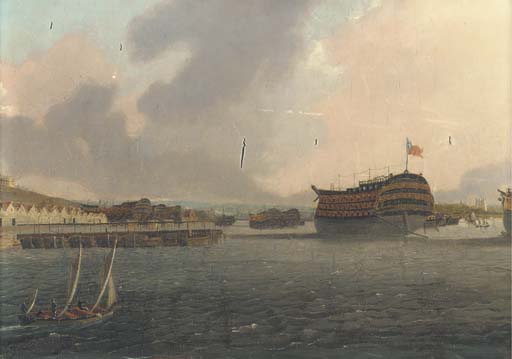
By the end of 1797 she was judged unfit for further front-line service. The National Historic Ships register records that from 1798 to 1800 she served as a hospital ship for prisoners of war in the Medway. The loss of the three-decker Impregnable left the Admiralty short of large ships, and Victory was chosen for a major rebuild instead.
The great refit
The refit at Chatham between 1800 and 1803 amounted almost to a rebuild. Extra gunports were cut, raising her armament from 100 to 104 guns. The magazine was lined with copper, the masts were replaced and her paint scheme changed from red to the black and yellow bands she carries today.
The armament carried at Trafalgar was arranged by deck. Thirty 32-pounders stood on the lower gun deck, twenty-eight 24-pounders on the middle deck and thirty 12-pounders on the upper deck. Twelve more 12-pounders were on the quarterdeck and two on the forecastle, with two 68-pounder carronades. The total was 104.
She sailed for Portsmouth in April 1803, and in May Nelson hoisted his flag in her as Commander-in-Chief of the Mediterranean Fleet. For the next two years she served in the Mediterranean, and in 1805 she led the pursuit of Admiral Villeneuve’s combined fleet across the Atlantic.
Trafalgar
On 21 October 1805 the British fleet of 27 ships of the line met a combined French and Spanish fleet of 33 off Cape Trafalgar. The wind was light. Nelson attacked in two columns, one led by Vice Admiral Collingwood in Royal Sovereign and the other by Nelson himself in Victory.
Victory fired into the French flagship Bucentaure as she broke through the enemy line, and then became locked alongside the French ship Redoutable. The two ships fought at very close range, and French marksmen in Redoutable’s rigging fired down onto Victory’s upper deck.
At about 1.15pm Nelson was walking the quarterdeck with Captain Thomas Hardy when a musket ball fired from Redoutable’s rigging struck him. It passed through a lung and a major artery and lodged in his spine. He was carried below to the orlop deck, the lowest deck above the hold, where the wounded were treated.

Nelson lived for about three more hours. The National Historic Ships register gives the time of his death as 4.30pm, when the result of the battle was already clear. His last recorded words were ‘Thank God I have done my duty’. The fighting, which had begun around midday, ended at about 5pm.
Seventeen French and Spanish ships were captured and one was set on fire. The Old Royal Naval College gives British losses as about 450 killed, against more than 4,000 French and Spanish. Victory lost 57 killed, the highest number in the British fleet, and 102 wounded.
Bringing Nelson home
Victory was so badly damaged in her masts and hull that she had to be towed to Gibraltar for emergency repairs. She then carried Nelson’s body home, reaching England in December 1805. The body was taken to Greenwich on 24 December and lay in state in the Upper Hall of the Royal Hospital from 5 to 7 January 1806.
The funeral was held at St Paul’s Cathedral on 9 January 1806. Victory herself was refitted again. Her crew at Trafalgar has been studied in detail by the museums at Portsmouth: the muster roll lists about 820 men, besides Nelson and Hardy, from at least 22 nations.
Reserve and harbour service
After further service in the Baltic under Sir James Saumarez and off the coast of Spain, Victory was placed in reserve in 1812 and moored off Gosport as a depot ship. Royal Museums Greenwich records that she lay permanently at anchor in Portsmouth Harbour from 1823.
From 1824 she was the flagship of the Port Admiral at Portsmouth, and from 1899 the flagship of the Commander-in-Chief. Over the 19th century she also served as a school for signalling and a venue for courts martial. Nelson’s fame drew visitors, and the place where he fell was marked with a plaque, while the place where he died was arranged as a shrine.
Her lower masts are not the ones she carried at Trafalgar. They are wrought iron and came from the 19th-century frigate HMS Shah, and were fitted in 1894. A steel bowsprit followed in 1936. The upper masts and rigging are reconstructions, and the modern rigging is made of polypropylene rather than hemp.
Saved in dry dock
By the early 20th century the ship was in poor condition at her moorings. In 1921 the Society for Nautical Research launched a campaign to save her, and in December 1922 she was moved into No. 2 Dock at Portsmouth. The register dates the end of the first restoration to 1924. King George V opened her to the public on 17 July 1928.
In 1941, during an air raid, a 250 kg bomb hit the masonry steps of the dock and exploded. It tore a hole about 2.5 m by 4.5 m in the hull planking and destroyed 4.5 m of the original elm keel. That section was repaired with teak in 1955. Teak replica guns were made for the ship from 1923, and some have since been replaced with glass-reinforced plastic copies.

How much is original
The answer depends on where you look. The National Historic Ships register says that about 500 planks of the lower gun deck are almost entirely original to her launch, that about 90 per cent of the orlop deck beams were present at Trafalgar, and that the keel is almost entirely as launched, apart from the bomb repair.
The rudder, nearly 12 m tall, is believed to be original in its main body, and many of the ship’s 173 pillars between decks date from her launch. Thirteen of the 104 guns carried at Trafalgar remain aboard. The fore topsail that was set in the battle also survives, still showing its battle damage. A survey of shipwright timber marks recorded 831 marks in all, 673 still in place on the ship and 158 on timber removed during repairs.
Other parts are modern. The figurehead fitted in 1992 was removed in 2009. The register acknowledges a high proportion of loss of historic fabric since 1922. The register describes the ship as an archaeological artefact, whose fabric holds evidence of construction, repair and conservation from 1759 to the present day.
The ship today
Victory remains a commissioned ship of the Royal Navy. Royal Museums Greenwich describes her as the flagship of the First Sea Lord and Chief of Naval Staff. Older pages of the National Historic Ships register still name the Second Sea Lord, but that arrangement is out of date. Her role is now largely ceremonial.
The National Museum of the Royal Navy is carrying out a conservation programme planned over many years, recording each timber before it is repaired or replaced. The ship remains open to visitors while the work continues.
Timeline
| Date | Event |
|---|---|
| 1759 | Work begins at Chatham Dockyard |
| 7 May 1765 | Launched |
| March 1778 | Commissioned; Keppel’s flagship at the First Battle of Ushant |
| 1781 | Second Battle of Ushant under Kempenfelt |
| 14 February 1797 | Jervis’s flagship at Cape St Vincent |
| 1798 to 1800 | Hospital ship for prisoners of war in the Medway |
| 1800 to 1803 | Great refit at Chatham |
| May 1803 | Nelson hoists his flag as Commander-in-Chief, Mediterranean |
| 21 October 1805 | Battle of Trafalgar; Nelson killed |
| December 1805 | Returns to England with Nelson’s body |
| 1812 | Placed in reserve |
| 1824 | Flagship of the Port Admiral, Portsmouth |
| 1921 | Society for Nautical Research campaign begins |
| December 1922 | Moved into No. 2 Dock, Portsmouth |
| 17 July 1928 | Opened by King George V |
| 1941 | Bomb damage during an air raid |
Sources and further reading
- Royal Museums Greenwich, HMS Victory. Design, cost, timber, name, service and present status.
- National Historic Ships UK, HMS Victory, register entry 499. Refit, surviving fabric, timber marks and later history.
- Royal Museums Greenwich, Model of HMS Victory, SLR0514. Dimensions, burthen and armament by deck.
- National Museum of the Royal Navy, Trafalgar Day and the Battle of Trafalgar. Course of the battle.
- National Museum of the Royal Navy, HMS Victory conservation log. Current conservation work.
- Portsmouth Historic Dockyard, HMS Victory: her crew at the Battle of Trafalgar. Muster roll and nationalities.
- Old Royal Naval College, The Battle of Trafalgar. Casualties, the return of Nelson’s body and the lying in state.
- National Museum of the Royal Navy, HMS Victory. Visitor information and the ship today.
Image credits. Featured image: HMS Victory in No. 2 Dock at Portsmouth Historic Dockyard. Photo: Cimosteve, Wikimedia Commons, CC0. Other photographs are credited in their captions.
Have a correction or a photograph that helps identify this ship? Contact contact@shipsarchive.com.


_-_The_Death_of_Nelson_-_00626_-_HMS_Victory.jpg)

