On 26 April 1956 the tanker Ideal X left Port Newark, New Jersey, for Houston with 58 containers on a deck built above her cargo tanks. She was not a purpose-built container ship, and boxes had been carried at sea before. Her voyage is remembered because it was the first sailing of a service planned around the container as a unit moving between truck and ship.
This article covers the ship’s origins, the 1956 voyage and the business behind it, and the rapid move to purpose-built container ships that followed. Several figures repeated about the voyage differ between sources, including the material of the boxes and the cost of loading. Those differences are set out where they arise.
| Built as | Potrero Hills, T2-SE-A1 tanker |
| Builder | Marinship, Sausalito, California, yard no. 68 |
| Keel laid | 30 October 1944 |
| Launched | 30 December 1944 |
| Completed | 20 January 1945 |
| Gross tonnage | 10,572 |
| Deadweight | 16,408 tonnes |
| Length overall | 159.57 m (524 ft) |
| Beam | 20.78 m |
| Machinery | Steam turbines, 7,240 bhp; 15 knots |
| Renamed Ideal X | 1955, for Pan-Atlantic Steamship Corporation |
| First container sailing | 26 April 1956, Port Newark to Houston |
| Containers carried | 58, each 35 ft long |
| Fate | Arrived at Hirao, Japan, for breaking on 20 October 1964 as Elemir |
A wartime tanker
The ship began as Potrero Hills, a T2-SE-A1 tanker built by Marinship at Sausalito, California, as yard number 68. According to Auke Visser’s record, her keel was laid on 30 October 1944, she was launched on 30 December 1944 and she was completed on 20 January 1945 for the War Shipping Administration. She measured 10,572 gross tons and 16,408 tonnes deadweight.
Visser’s record gives a length overall of 159.57 m and a beam of 20.78 m. The Port Authority of New York and New Jersey gives her length as 524 ft, which agrees. Her steam turbines developed 7,240 brake horsepower for a speed of 15 knots. The T2 was the standard American tanker design of the Second World War.

After the war she passed through private owners. Visser records the name Captain John D.P. in 1948 for Nautilus Shipping Corporation, a return to Potrero Hills in 1951 for Philadelphia Marine Corporation, and the name Ideal X in 1955 for Pan-Atlantic Steamship Corporation of Wilmington, Delaware.
Malcom McLean and Pan-Atlantic
The service was the idea of Malcom McLean, a North Carolina trucking operator. The Smithsonian account, drawing on Marc Levinson, gives his birth year as 1913; Jean-Paul Rodrigue’s study gives 1914. McLean had built a large trucking company and had no experience of shipping when he turned to the sea.
The Port Authority traces his interest to 1937, when he waited at Hoboken while his truckload of cotton bales was unloaded piece by piece into a ship. His first idea was to carry whole truck trailers on ships. He then concluded that it would be better to leave the wheels and chassis ashore and carry only the trailer bodies.
In 1955 McLean sold his trucking firm for about $25 million, according to the Port Authority, and bought Pan-Atlantic Steamship Corporation and the Gulf Florida Terminal Company from the Waterman Steamship Corporation. His plan was to use Pan-Atlantic’s ships and operating rights to carry containers. Ideal X took her new name under Pan-Atlantic ownership that year.
The deck above the tanks
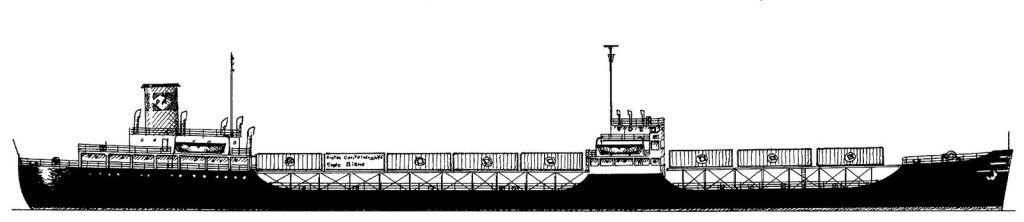
Ideal X was not rebuilt as a container ship below decks. A spar deck was built above her cargo piping to carry the containers, and she remained able to carry bulk petroleum. Rodrigue gives her load on the first voyage as 58 containers together with 15,000 tons of bulk petroleum in her tanks.
This arrangement let Pan-Atlantic test the container service without building or converting a ship solely for it. The tanks below continued to earn money from oil. The containers were carried as deck cargo, secured on the new deck, and lifted on and off by shore cranes at each end of the voyage.
The voyage of 26 April 1956
Ideal X sailed from Berth 24 at the foot of Marsh Street in Port Newark. According to the Port Authority, a crane placed a container on her deck every seven minutes, and the loading took less than eight hours. She sailed the same day. Rodrigue gives the boxes as 35 ft long, 8 ft wide and 8 ft high.
Sources differ on the material of the containers. The Smithsonian account describes them as 58 aluminium truck bodies, while the Port Authority’s 2015 article refers to steel containers. The count of 58 and the length of 35 ft are consistent across the sources.
She reached Houston five days later. The Smithsonian account describes trucks waiting there to collect the containers for delivery to factories and warehouses. That was the point of the service: the box went from ship to road without its contents being unpacked and handled again at the quay.
The cost of handling
The economic case rested on the cost of loading. The Port Authority puts the cost of loading break-bulk cargo in 1956 at $5.86 a ton, against 16 cents a ton to load a container. Rodrigue’s figure for conventional cargo is $5.83. Either figure implies a reduction of more than 95 per cent in the cost of getting cargo aboard.
Break-bulk cargo had to be moved from a truck into a warehouse, then from the warehouse to the quay, and then lowered into the hold and stowed by hand. Each step took labour and time, and each was a chance for damage or theft. A sealed container packed at the factory removed most of those steps.
From deck cargo to cellular ships
Ideal X showed the idea could work, but deck stowage on a tanker limited the number of boxes. Pan-Atlantic soon moved to ships designed around containers. In 1957 McLean bought six wartime break-bulk cargo ships and had cells fitted in their holds to stow containers in vertical stacks.
The first of these, Gateway City, sailed from Port Newark on 4 October 1957 with 226 containers. She carried her own gantry cranes with a lifting capacity of 60,000 pounds. With two cranes each handling 15 boxes an hour, she could be emptied and reloaded in about eight hours, according to the Port Authority. She carried nearly four times as many containers as Ideal X had the year before.
Charles Cushing, who sailed in Gateway City as a student at MIT in 1958 and joined McLean full time in 1960, worked on the basic features of later container ships: stacks of containers in cells below deck and further stacks above. Rodrigue records that the company became SeaLand in 1960, and that Maersk bought it in 1999. The Port Authority records that McLean extended his services to Puerto Rico in 1958, and to the West Coast through the Panama Canal and to Alaska in 1962.

Standard boxes and new ports
McLean’s 35 ft box was his own size. For containers to move freely between companies and countries, sizes and fittings had to be standardised. Talks on standards began in 1958. The Smithsonian account records that Sea-Land released its patents royalty-free, so that every container could use the same corner fittings.
Ports changed as well. The Port Authority opened its marine terminal at Elizabeth, New Jersey, beside Port Newark, on 15 August 1962, and describes it as the world’s first all-container port facility. The Port Authority links containerisation with the decline of the wharves on the Manhattan waterfront and the growth of the Newark and Elizabeth port into a principal gateway for the region’s trade.

The end of Ideal X
Ideal X herself had a short career with containers. Rodrigue states that she carried them until 1964. Visser records the name Elemir from 1959 for Oceanic Petroleum Carriers, while a Maritime Commission status card quoted in the same record gives October 1960 for the change. The exact date of the renaming therefore remains uncertain.
As Elemir she was damaged in heavy weather on 8 February 1964, on a voyage from Sasebo to Portland, Oregon. She was sold to Japanese shipbreakers and arrived at Hirao on 20 October 1964 to be broken up. She was about twenty years old.
Her importance lies less in the ship than in the system she tested. A standard wartime tanker, with a deck added above her tanks, showed that cargo could be packed once at its origin and moved by road and sea without being handled again. The cellular ships, standard boxes and container terminals that followed were built on that demonstration.
Timeline
| Date | Event |
|---|---|
| 30 October 1944 | Keel laid at Marinship, Sausalito, as Potrero Hills |
| 30 December 1944 | Launched |
| 20 January 1945 | Completed for the War Shipping Administration |
| 1948 | Renamed Captain John D.P. |
| 1951 | Renamed Potrero Hills again |
| 1955 | McLean buys Pan-Atlantic; the ship is renamed Ideal X |
| 26 April 1956 | Sails from Port Newark with 58 containers |
| May 1956 | Arrives at Houston five days later |
| 4 October 1957 | Gateway City sails with 226 containers |
| 1959 or October 1960 | Renamed Elemir; sources differ |
| 15 August 1962 | Elizabeth container terminal opens |
| 8 February 1964 | Damaged in heavy weather as Elemir |
| 20 October 1964 | Arrives at Hirao, Japan, for breaking |
Sources and further reading
- Port Authority of New York and New Jersey, The world in a box: the story behind modern shipping, 23 June 2015.
- Port Authority of New York and New Jersey, Port Newark: Malcom McLean’s box changed the world, 27 April 2016.
- Marc Levinson, Smithsonian Magazine, The shipping container idea before its time.
- Auke Visser, Potrero Hills. Build record, names and disposal.
- Jean-Paul Rodrigue, The Geography of Transport Systems, Ideal X, the first containership, 1956.
Image credits. Featured image: Profile drawing of Ideal X with the raised deck that carried containers above her tanks. A drawing, not a photograph. Image: Karsten Kunibert, Wikimedia Commons, Public domain. Other photographs are credited in their captions.
Have a correction or a photograph that helps identify this ship? Contact contact@shipsarchive.com.