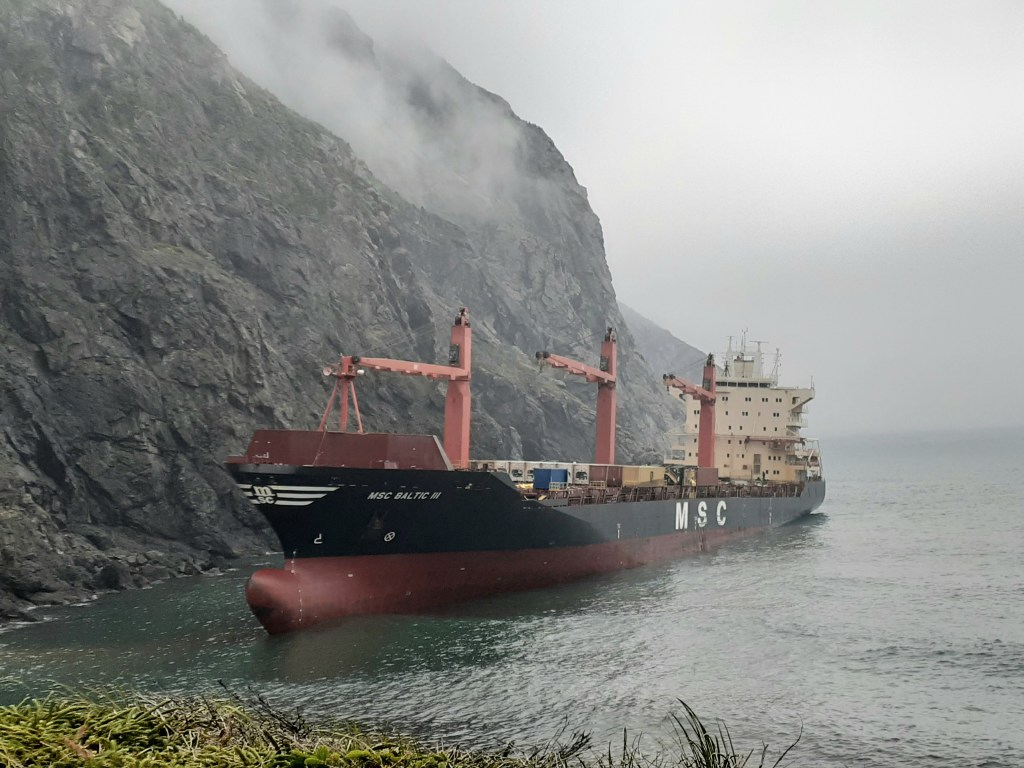
MSC Baltic III beside the cliffs near Lark Harbour, Newfoundland and Labrador, on July 28, 2025, after its grounding. IMR2000 / Wikimedia Commons, CC0 1.0. No changes.
MSC Baltic III is being brought towards land in sections, with cutting and removal advancing as access improves. The Canadian Coast Guard’s 9 October 2026 update records 6,964 tonnes removed, approximately 63% of the vessel’s total tonnage. It also reports renewed sheening and oiled shoreline material after rough seas. Both belong in the same account of progress.
The official operational update describes a wreck-removal operation that has become increasingly dependent on shore access. Resolve Marine has moved the bow and midship sections a cumulative 137 metres towards shore and begun pulling the stern, which has moved 25 metres. These are separate movements, not distances that should be added to describe one intact ship’s journey.
| Fact | Detail |
|---|---|
| Vessel | MSC Baltic III |
| Grounding | 15 February 2025 |
| Location | Cedar Cove, western Newfoundland |
| Crew rescued | All 20 |
| Removal contractor | Resolve Marine |
| Latest tally | 6,964 tonnes; about 63% |
| Status date | 9 October 2026 |
Contents: From grounding to removal · Building access · Pulling and cutting · Understanding 63% · Fuel and shoreline impacts · What remains · Sources
From grounding to wreck removal
The casualty began on 15 February 2025 when MSC Baltic III lost power and grounded outside the entrance to the Bay of Islands, Newfoundland and Labrador. A Fisheries and Oceans Canada briefing records the Canadian Armed Forces’ airlift of all 20 crew members. The successful rescue ended the immediate danger to those aboard, but left a damaged cargo vessel in an exposed coastal location.
That briefing is useful for the event and institutional responsibilities. It is not the source for the present quantity of fuel, cargo or wreckage remaining. Its operational description belongs to an earlier stage, and the Coast Guard’s dated live log supplies the subsequent sequence. Combining numbers from different stages without their dates would produce a misleading account of the site.
The distinction between refloating and wreck removal is now fundamental. Refloating seeks to restore sufficient buoyancy and control to move a vessel afloat. The operation described in October instead brings damaged sections towards a shore work area for dismantling. It is not a delayed version of a normal departure from a grounding. The ship’s physical arrangement is being progressively changed by the removal process.
The Coast Guard’s chronology shows why damage assessment cannot be treated as a single completed task. Its December 2025 and January 2026 entries record further deterioration after severe weather, including changes in buckling and cracking. Those are observations of the casualty over time. They do not, on their own, establish the original cause of the loss of power or substitute for a final casualty investigation.
Building a route between the wreck and the shore
Much of the work preceding the current tonnage milestone concerned access. The Coast Guard’s June and July entries describe improvements to the Cedar Cove road, work on a switchback route to the beach, cargo removal and preparations for equipment to handle contaminated water. This infrastructure explains how a remote casualty begins to function as a removal site.
A wreck is not a shipyard merely because cutters and lifting equipment have arrived. People need a workable route to their tasks, recovered material needs a route away, and pollution-control equipment must operate alongside both. Access arrangements also influence how often crews can reach the vessel. An exposed shore does not offer the uninterrupted working conditions implied by a simple count of calendar days.
Earlier in the response, a cableway connected shore and wreck. By the 9 September update, that system was being dismantled, with workers using a temporary gangway. The same entry records completion of a shoreline scrap pad supporting a crane for lightering operations. These details show a changing arrangement as the wreck moves closer, rather than a fixed setup used from start to finish.
The July log also separates cargo handling from hull dismantling. It records progressive removal of containers, while the 6 August entry states that cargo removal and superstructure deconstruction were complete. An older container count is therefore not an October inventory. More usefully, the sequence shows how clearing material and changing the wreck’s configuration prepared the way for subsequent pulling and cutting.
Why pulling and cutting proceed together
Pulling began on 31 July 2026, according to the Coast Guard’s 6 August notice. That entry described gradual shoreward movement followed by deconstruction as the wreck came ashore. The 9 September report added that further pulls were planned for high tides to obtain additional buoyancy. This is an important piece of the physical explanation supplied by the response authority itself.
Water support can reduce the load that has to be carried through contact with the seabed or shore. The precise benefit depends on the section’s immersed shape and condition. The public notices do not disclose a pulling-force calculation, chain loading or seabed-friction model, so none should be reconstructed from the distance moved. The confirmed point is narrower: the contractor was using tidal buoyancy as part of the operation.
The 2 October update records a 42-metre pull on 27 September that made the bow and midship sections accessible from the scrap pad. The next update reports a further 31 metres, bringing their cumulative movement to 137 metres. The stern had meanwhile entered its own pulling phase. This staggered progress explains why a photograph of one part of the wreck may not represent the access available elsewhere.
Cutting changes the next task as well as completing the present one. Once material is removed, the shape, weight distribution and accessible surfaces of the remaining structure are different. That is an engineering implication of dismantling, not a claim about an unpublished Resolve procedure. It helps explain why the operation cannot be understood as hauling an unchanged object along a measured track.
The shoreward distance also says little about the amount of material already taken away. A section can move substantially while still requiring extensive cutting. Equally, material can be removed without a large change in its position. Distance and recovered tonnage therefore describe different aspects of the work and are most useful when reported together.
What the 63% figure measures
The Coast Guard reported approximately 6,086 tonnes removed on 2 October, or close to 55% of total vessel tonnage. On 9 October the tally was 6,964 tonnes, approximately 63%. Subtracting the published totals gives an increase of 878 tonnes between the two reporting snapshots. This is a calculation from those figures, not an independently weighed total or a guaranteed weekly production rate.
The percentage describes vessel tonnage removed. It does not measure the proportion of expenditure, work hours, environmental recovery or remaining risk. A tonne recovered from an accessible location need not require the same effort as a tonne in a difficult part of the wreck. Shoreline cleaning may continue independently of the pace at which steel is removed.
Nor should the published percentage be reverse-engineered into an exact original ship weight. The authority rounds its percentages and qualifies its totals. Dividing one by the other would create a false precision that the source does not offer. The figure is useful as an operational measure within this response, without converting it into a substitute for verified original ship particulars.
It is also different from gross tonnage, the volume-based measure used in ship registration. Here the Coast Guard reports quantities in tonnes removed from the casualty. Describing the milestone as “63% complete” drops the very qualification that gives it meaning. The defensible wording is that about 63% of vessel tonnage had been removed by the date of the update.
Residual fuel keeps environmental work active
The latest notice reports sheening in Cedar Cove and shoreline impacts involving oiled vegetation and debris following rough seas. It states that residual fuel remains aboard, that accessible tanks continue to be cleaned and that on-water containment and recovery have increased as conditions permit. A removal milestone therefore cannot support a claim that the casualty is fuel-free or pollution-free.
Bulk fuel removal and removal of every residue are different tasks. Earlier official notices had already distinguished the bulk fuel taken away from material remaining inside the wreck. The October observations demonstrate why that distinction is operationally important: remaining contamination can still reach the surrounding water and shore even after the principal recovery stages have advanced.
Weather influences both the problem and the response. Rough conditions can coincide with fresh contamination while also restricting safe work on the water. The Coast Guard explicitly qualifies its aerial and on-water monitoring by weather. This does not mean monitoring has stopped; it means that the observation and recovery effort has practical limits that should remain visible in reporting.
There is also a difference between containment and recovery. Containment aims to restrict the spread of material; recovery removes material that can be reached. Shoreline inspections identify where further work is needed. These functions are complementary, and the presence of a boom should never be treated as proof that nothing has escaped beyond it. The official account’s shoreline findings are evidence of the continuing need for all three.
The live log does not provide a final residual-fuel inventory or a completed environmental assessment for October. Earlier estimates must not be carried forward as if unchanged. The safest useful account is the current one: some fuel remains, access governs tank cleaning, and contamination response continues alongside dismantling.
What remains after the latest milestone
The next meaningful reports will need to distinguish further movement of the stern, additional material removed and changes in pollution conditions. None is interchangeable with the others. A large cut may improve the tonnage tally without settling shoreline work, while favourable weather may allow tank cleaning without a conspicuous change in the wreck’s silhouette.
The Coast Guard’s May entry identifies its role as reviewing the owner’s proposed removal plan for public safety and environmental protection, with Resolve retained as contractor. That separation matters when reading updates: the regulator’s public summary is evidence of reported progress, not the contractor’s complete engineering method statement. It cannot answer every question about equipment capacity, cutting sequence or final disposal arrangements.
As of 11 October 2026, no completion date is established by the sources used here. The operation has moved well beyond the rescue and initial fuel-recovery phases, but the remaining structure and residual contamination still require active work. The 63% milestone is substantial because it records material actually removed. Keeping its scope precise makes it more informative, rather than less.
Sources and further reading
- Canadian Coast Guard, live operations, MSC Baltic III chronology; current forty-sixth update dated 9 October 2026, with earlier dated entries used for sequence: https://www.canada.ca/en/canadian-coast-guard/corporate/live-operations.html
- Fisheries and Oceans Canada, 2026 briefing, section E39; used for grounding, rescue and institutional context, not present inventories: https://www.dfo-mpo.gc.ca/transparency-transparence/briefing-breffage/2026/budget-implementation-act-loi-execution-budgetaire-eng.html#e39
- International Maritime Organization, explanation of gross and net tonnage: https://www.imo.org/en/about/conventions/pages/international-convention-on-tonnage-measurement-of-ships.aspx
Related reading: MSC Napoli: Structural Failure in the Channel and the Beaching at Branscombe · Rena on Astrolabe Reef: The 2011 Grounding and Its Aftermath


