Measured by length, the tanker best known as Seawise Giant was the largest ship ever built. After lengthening she measured 458.45 m overall, more than any ship before or since. She also carried more names than most ships: Oppama, Seawise Giant, Happy Giant, Jahre Viking, Knock Nevis and finally Mont.
Each name marks a change of owner or role, and the names are often used loosely, as if they were interchangeable. This article follows the ship in order and gives the name she bore at each stage. Where sources disagree on a date, as they do several times, the disagreement is stated.
| IMO number | 7381154 |
| Builder | Sumitomo Heavy Industries, Oppama, Yokosuka |
| Yard number | 1016 |
| Launched | 4 September 1975 |
| Completed | 26 March 1976 |
| Original size | 418,610 dwt; 376.7 m overall |
| Lengthened | 1980, by NKK at Tsu |
| Length after lengthening | 458.45 m |
| Beam | 68.8 m |
| Deadweight after lengthening | 564,763 tonnes |
| Propulsion | Single steam turbine |
| Final name | Mont |
| Broken up | Alang, India, from December 2009 |
Oppama: a ship nobody wanted
She was built by Sumitomo at its Oppama yard in Yokosuka, Japan, as yard number 1016. Guinness World Records says she was ordered in 1974. Her Greek owners refused to take delivery, citing vibration in the steam turbines, so she was launched without a name on 4 September 1975 and laid up when completed on 26 March 1976.
Lloyd’s Register first showed her as Porthos and then as Oppama, after the yard. In this form she was a large ultra large crude carrier but not an exceptional one: 418,610 deadweight tons and 376.7 m long. She lay unsold for more than three years.
The record of her early names is not tidy. The Hong Kong Maritime Museum says she was built as Porthos and renamed Oppama in 1976. Auke Visser’s supertanker records describe her as launched as Porthos and completed as Oppama, while quoting a ship index that says she was launched unnamed. She never traded under either name.
Seawise Giant: lengthened for C. Y. Tung
In December 1979 she was sold to Universal Petroleum Carriers, a company of the Hong Kong shipowner C. Y. Tung, and renamed Seawise Giant. A registry record gives 4 December 1979 for the change from Oppama.
Tung had her lengthened. According to Maritime Reporter in February 1981, NKK’s Tsu shipyard cut the hull about 120 m from the stem and fitted a new section of about 81 m between the two parts. Her length grew from 377 m to 458.45 m and her draught from 23.62 m to 24.56 m. Beam and depth were unchanged.
The work raised her deadweight from about 420,000 to about 560,000 tons, and she was classed by the American Bureau of Shipping. Guinness gives her final deadweight as 564,763 tonnes. Lloyd’s Register Foundation notes that size limited where such ships could trade, and many of the longest supertankers were scrapped young or converted to storage.
Her draught was the practical limit. The Hong Kong Maritime Museum notes that she was too big for the Suez and Panama Canals and could not enter any north European port. She could load and discharge only at deep offshore terminals, which suited the long haul from the Persian Gulf but little else.
The attack of May 1988
During the Iran-Iraq War, Iran exported oil through a terminal at Larak Island in the Strait of Hormuz, where crude brought down from Kharg Island by Iranian ships was loaded into foreign tankers. Seawise Giant was chartered to Iran as a mother ship there, storing oil offshore. Iraq attacked the terminal repeatedly, and she was damaged in raids in October and December 1987.
On 14 May 1988 Iraqi aircraft, flying more than 750 miles each way with refuelling in the air, attacked Larak again and set five tankers on fire. Seawise Giant was among them. She burned out of control and was later declared a constructive total loss.
Reports of casualties varied widely at the time. The New York Times, quoting Gulf shipping executives, reported 14 of her crew missing, while Lloyd’s Shipping Intelligence Unit in London said that all of about 50 people aboard were unaccounted for. Visser’s records give three dead. No figure can be stated with confidence.
Visser’s photographs show the ship on fire beside another of the tankers hit that day, Argosy, and a large hole in her side.
Happy Giant: rebuilt at Singapore
The wreck was towed to Brunei Bay. In 1989, according to Visser, she was sold as a hulk to Norman International of Norway and named Happy Giant. A registry extract dates the end of the name Seawise Giant to 31 December 1988, slightly earlier.
She was then towed to Singapore and rebuilt at the Keppel yard. The reconstruction began in October 1990, cost about $60 million and needed 3,200 tonnes of new steel and 32 km of new pipe. The burnt-out superstructure was cut away and a complete new deckhouse built.

Visser records that she sailed again in October 1991 as Happy Giant. Photographs of her at Singapore are often captioned Seawise Giant, including the one shown here, but by the time of her reconstruction that name no longer applied.
Jahre Viking: the Norwegian years
In 1991 she passed to the Norwegian company K/S Jahre Viking and was renamed Jahre Viking. Visser gives 1991 for the change; the registry extract gives 22 September 1990, while the ship was still under reconstruction. Whichever date is right, the name Jahre Viking covers her longest spell of trading as a tanker, through the 1990s until 2004.
Under this name she was widely described as the largest ship in the world, and most published photographs of her at sea date from these years. Lloyd’s Register Foundation, for example, illustrates Seawise Giant with a picture captioned with her later name, Jahre Viking.
Knock Nevis: floating storage off Qatar
In 2004 she came to Dubai Drydocks for conversion into a floating storage and offloading unit. The work, from early March and lasting about four months, included steel renewal, tank coating, new pipework and moorings and a helicopter deck. She was renamed Knock Nevis, for First Olsen Tankers.
As Knock Nevis she was moored at the Al Shaheen oilfield off Qatar, under contract to Maersk Oil Qatar. She could store about 4.2 million barrels. The contract expired on 12 August 2009. Fred. Olsen Production noted that before any new work the ship would need a Special Class Survey, a costly inspection for a hull of her age.

Mont: the last voyage
No new employment was found. In late 2009 she was sold for recycling and renamed Mont, the last of her names. On 19 December 2009 the Indian Express reported that Mont was waiting for clearance to arrive at plot V1 at Alang, owned by Priya Blue Industries.
The report said she would be inspected by customs, the Gujarat Pollution Control Board and the Atomic Energy Regulatory Board, and that breaking her up would take nearly a year. It valued the ship at Rs 125 crore. It also dated her war damage to 1986, which is wrong; the attack was in May 1988.

A ship index quoted by Visser records her beaching at Alang on 22 December 2009. Guinness World Records and the Hong Kong Maritime Museum give 2010 as the year she was scrapped, while the ship index gives 2009. Priya Blue now cites ST Mont, ex Jahre Viking and Knock Nevis, as the largest tanker ever recycled.
The anchor in Hong Kong
One of her anchors survives. It weighs 36 tonnes, with a 7 m shank, flukes 4.45 m across and a thickness of 1.13 m, and once had 20 shackles of chain. It was acquired by Anthony Hardy, now Emeritus Chairman of the Hong Kong Maritime Museum, and stored at the Government Dockyard on Stonecutters Island from June 2010.
On 27 March 2025 it was moved by road to the Central harbourfront. It is now the centrepiece of the museum’s Jockey Club Anchor Plaza behind Central Piers 9 and 10, which opened on 20 November 2025. The museum also holds a 3 m model of the ship as Seawise Giant, given by Island Navigation Corporation International.
Still the longest
No ship has exceeded her length. The Prelude floating liquefied natural gas facility, towed from Geoje in South Korea in 2017, is 488 m long, but it is an offshore installation rather than a ship built to trade. Among trading ships, the record set when Seawise Giant was lengthened in 1980 still stands.
Timeline
| Date | Event |
|---|---|
| 1974 | Ordered from Sumitomo, according to Guinness |
| 4 September 1975 | Launched at Oppama |
| 26 March 1976 | Completed and laid up as Oppama |
| December 1979 | Sold to C. Y. Tung; renamed Seawise Giant |
| 1980 | Lengthened to 458.45 m by NKK at Tsu |
| 14 May 1988 | Set on fire by Iraqi aircraft at Larak Island |
| 1989 | Sold as a hulk and named Happy Giant |
| October 1990 | Reconstruction begins at Singapore |
| 1991 | Sails again; renamed Jahre Viking |
| 2004 | Converted at Dubai to the storage unit Knock Nevis |
| 12 August 2009 | Storage contract off Qatar expires |
| December 2009 | Renamed Mont; beached at Alang |
| 2010 | Broken up |
| 20 November 2025 | Anchor unveiled in Hong Kong |
Sources and further reading
- Guinness World Records, Longest ship ever.
- Maritime Reporter and Engineering News, Jumboized Seawise Giant is now world’s biggest tanker, February 1981.
- TechnipFMC, Shell Prelude facility has sailed away to Australia, 2017.
- Hong Kong Maritime Museum via Google Arts and Culture, Model of st. Seawise Giant.
- Lloyd’s Register Foundation, Maritime science and technology: changing our world.
- Auke Visser, Seawise Giant. Names, ownership and lengthening.
- Auke Visser, The air attack on the Seawise Giant. Attack and reconstruction.
- Auke Visser, Knock Nevis. Conversion, registry extract and disposal.
- Fred. Olsen Production via Cision, FSO Knock Nevis, 12 August 2009.
- Priya Blue Industries, Why partner with Priya Blue.
- Press Trust of India via Indian Express, Crude oil carrier Mont awaits clearance to dock at Alang, 19 December 2009.
- Hong Kong Maritime Museum, Jockey Club Anchor Plaza officially opens to the public, 20 November 2025.
- The New York Times, Iraq hits 5 ships in Persian Gulf, 15 May 1988.
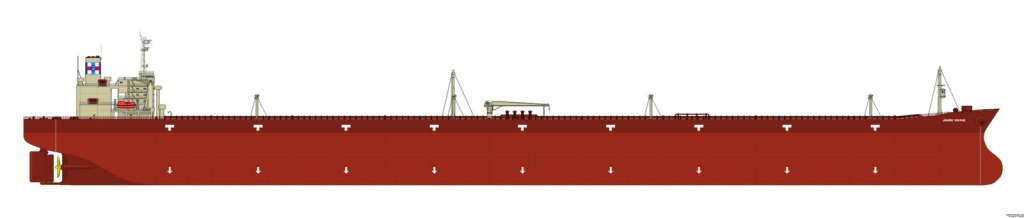
Image credits. Featured image: Profile drawing of the ship as Jahre Viking, the name she carried from the early 1990s until 2004. Photo: Shipsprofiler, Wikimedia Commons, CC BY-SA 3.0. Other photographs are credited in their captions.
Have a correction or a photograph that helps identify this ship? Contact contact@shipsarchive.com.