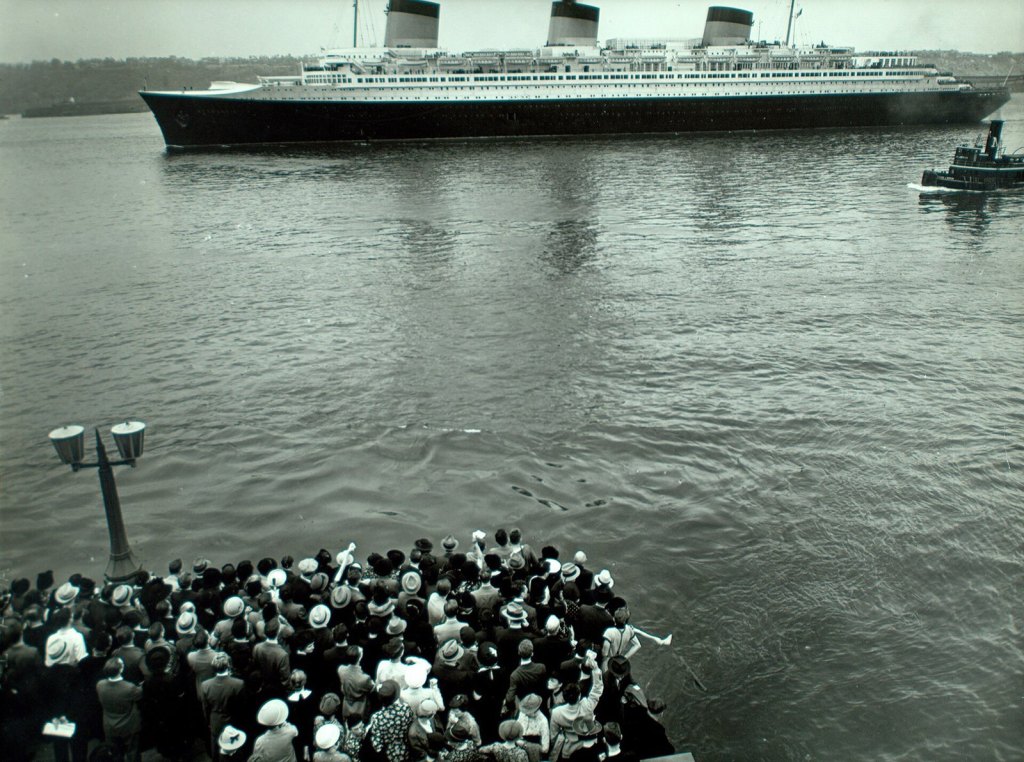
Normandie entered the North Atlantic service of the Compagnie Générale Transatlantique, the French Line, in 1935. She was then the largest liner in the world and the fastest. Within seven years she was lying on her side at a Manhattan pier, burnt out during a hurried conversion into a troop transport.
This article covers her design and service, the long lay-up in New York after war began in Europe, and the fire of 9 February 1942. It relies on the US Navy’s official history of the ship as Lafayette, contemporary engineering coverage and the French Line archive material published by Mémoire Normande. Where these sources give different figures, the difference is noted.
| Owner | Compagnie Générale Transatlantique (French Line) |
| Builder | Penhoët, Saint-Nazaire |
| Laid down | 26 January 1931 |
| Launched | 29 October 1932 |
| First arrival at New York | 3 June 1935 |
| Length | 1,029 ft 5 in (313.8 m), US Navy figure |
| Beam | 117 ft 9 in (35.9 m), US Navy figure |
| Gross tonnage | 79,000 (The Shipbuilder, 1935); 83,423 (Navesink) |
| Machinery | Quadruple-screw turbo-electric, 160,000 hp |
| Passengers | 848 first, 665 tourist and 458 third class |
| Naval name | Lafayette (AP-53), later APV-4 |
| Fire and capsize | 9 and 10 February 1942, Pier 88, New York |
| Fate | Sold in 1946; broken up at Port Newark by the end of 1948 |
A hull shaped for speed
Normandie was laid down at the Penhoët yard in Saint-Nazaire on 26 January 1931 and launched on 29 October 1932, when she was christened by Madame Lebrun, wife of the French president. Mémoire Normande gives the cost of building and fitting her out as 863 million francs. Her size required a new building way at the yard and new berths at Le Havre and New York.
Her hull form was the work of Vladimir Yourkevitch, a Russian émigré naval architect. A Naval History and Heritage Command caption credits that hull form with winning her the Atlantic speed record in June 1935. The Navesink Maritime Heritage Association notes the bulbous forefoot below the waterline, a feature that reduced resistance but was not then widely accepted.
The Shipbuilder and Marine Engine Builder published a souvenir number on the ship in June 1935. Its contents include chapters on model experiments, propeller experiments and protection against fire. The record suggests how much testing went into the design before she sailed, and that fire safety was treated as a design question from the start.
Turbo-electric machinery
The Shipbuilder described her as a quadruple-screw turbo-electric liner of 160,000 horsepower. In this arrangement, steam turbines drive electrical generators, and the current powers electric motors coupled to the propeller shafts. The French Line archive gives a maximum speed of 31 knots. The Navesink association distinguishes the nominal 160,000 hp from a maximum of about 200,000 hp.
Published tonnages differ. The Shipbuilder’s 1935 souvenir number gives 79,000 tons gross, while the Navesink association gives 83,423 gross tons. Dimensions also vary with the source and the way they were measured. The US Navy gives a length of 1,029 ft 5 in and a beam of 117 ft 9 in; the French Line archive rounds these to about 300 m by 36 m.
Mémoire Normande lists accommodation for 848 first-class, 665 tourist and 458 third-class passengers, with a crew of about 1,300. The Navesink association gives a crew of 1,345. Neither source explains the difference.
Maiden voyage and the Blue Riband
Sources disagree on the date of her maiden departure from Le Havre. Mémoire Normande gives 23 May 1935, and the Navesink association gives 29 May 1935 as her delivery date. The US Navy history records her arrival at New York on 3 June 1935. On that first crossing she took the Blue Riband for the fastest passage of the North Atlantic.
The French Line archive gives the crossing time as four days and three hours, at an average of about 30 knots. She was the only French liner to hold the Blue Riband. Pier 88 on the Hudson was built for her, and a new terminal was built at Le Havre between 1930 and 1935 to receive ships of her size.
Propellers and vibration
Early service brought complaints of vibration. In the winter of 1936, according to the French Line archive, the original three-bladed propellers, each weighing 23.2 tonnes and 4.78 m in diameter, were replaced with four-bladed propellers. The change was made to reduce the vibration.
The same archive notes that the third of her three funnels was a dummy. Her profile was therefore set by appearance as well as by the needs of the boilers. The archive’s account of the propeller change shows that the ship continued to be modified after she entered service.
Laid up in New York
Normandie was in New York when war broke out in Europe, and she was interned there on 3 September 1939. Crossing the Atlantic had become too dangerous, so she stayed at Pier 88. Her crew was largely sent home. Mémoire Normande records that 113 men remained aboard to keep the ship in working order.
On 15 May 1941 about 150 Coast Guardsmen were put aboard to guard against sabotage, although she stayed under the French flag. After the United States entered the war, the Coast Guard removed Captain Hervé Lehuédé and his crew on 12 December 1941 and took possession of the ship.
President Roosevelt approved her transfer on 20 December 1941. Two days later she was designated for conversion to a convoy unit loaded transport, and on 24 December the Maritime Commission turned her over to the Navy. On 27 December the Navy contracted with Robins Dry Dock and Repair Company, a Todd subsidiary, for the work. The name Lafayette was approved on 31 December, with the designation AP-53.
A conversion under pressure
Conversion went ahead alongside Pier 88. Commissioning was set for 11 February 1942 and sailing for 14 February. Captain Robert G. Coman, her prospective commanding officer, and Captain Clayton M. Simmers sought a delay, because much of the work was incomplete and the ship was crowded with contractors’ men.
On 6 February it was decided to reduce her top-hamper over 60 to 90 days, and many workmen were released. The next day that plan was abandoned and the sailing date of 14 February was confirmed. The Navy history describes the reversal as adding to the confusion aboard, as workmen were recalled to finish the conversion in time.
The fire on 9 February 1942
At about 1430 on 9 February, sparks from a torch used by Clement Derrick set fire to a bale of kapok life preservers stored temporarily in the main salon. Mémoire Normande gives the time as 14.35. Meetings planned that afternoon in New York and Washington to discuss the sailing date never took place.
A northwesterly wind carried the fire through the upper decks. According to the Navy history, the city fire department arrived about 15 minutes after the fire was discovered. The Hudson River Maritime Museum notes that the ship’s own fire system had been disconnected during the conversion, and that New York hoses did not fit the French connections still fitted aboard.
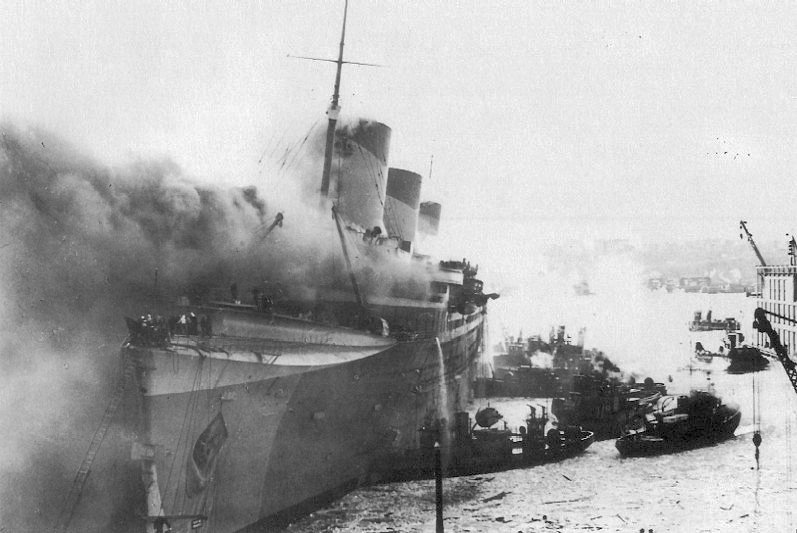
Firefighting involved city fire companies, city and private fireboats, the Navy and the Coast Guard. The Navesink association records that Yourkevitch, who was then working in New York, went to the pier to offer advice but could not reach the officers in charge. By about 1800 the fire was reported under control, with mopping up continuing until 2000.
Why she capsized
About 6,000 tons of water had been poured onto the ship, much of it high in the hull. Water entered through openings and ran to the lower decks, which defeated efforts to counter-flood, and her list to port increased. Mémoire Normande adds that the drain strainers were frozen. The ship had neither sea cocks nor scuttling valves, so she could not be flooded evenly and settled on the bottom.
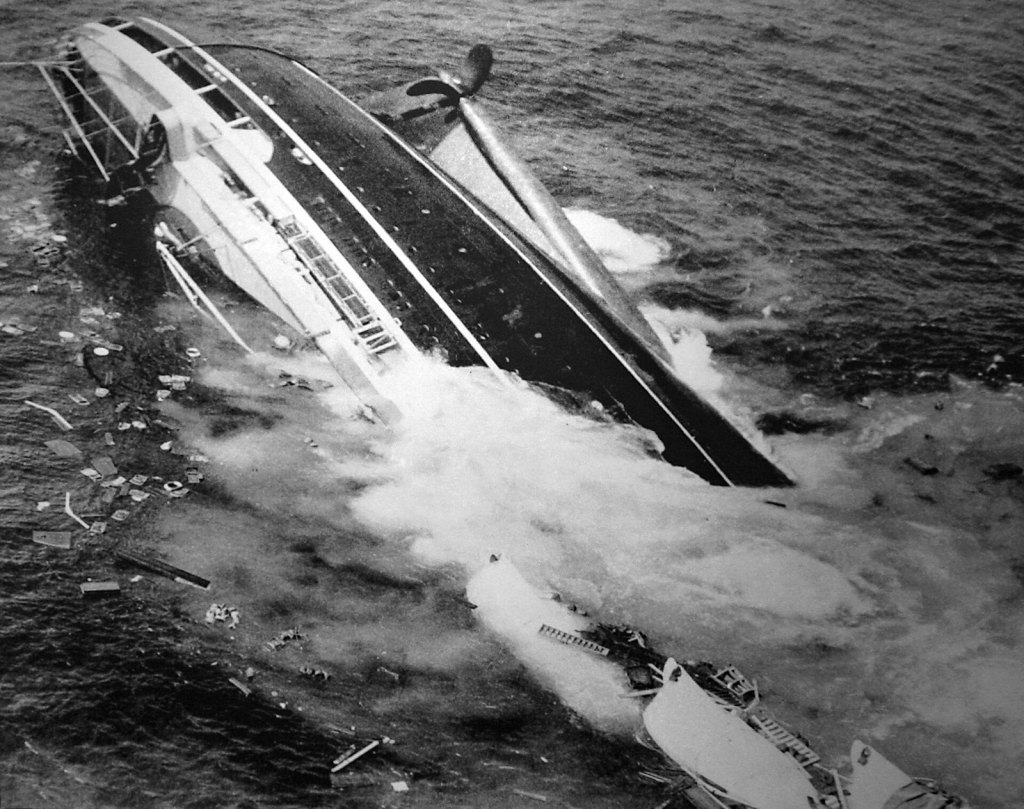
Shortly after midnight Rear Admiral Andrews ordered Lafayette abandoned. She capsized at about 0245 on 10 February, coming to rest on her port side at an angle of about 80 degrees. One man died: Frank Trentacosta, 36, of Brooklyn, a Robins employee on fire watch. Some 94 Coast Guard and Navy personnel, 38 firefighters and 153 civilians were treated or taken to hospital.
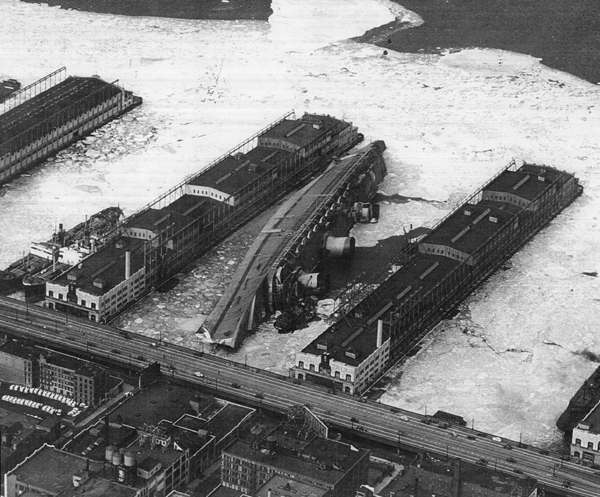
A congressional committee chaired by Patrick Henry Drewry found carelessness in the burning work that started the fire, a lack of coordination between the units aboard, divided authority without a unified command, and undue haste. An executive order of 26 February 1942 dealt with the protection of waterfront property, reflecting the wider concern the fire had caused.
Salvage and scrapping
Salvage was ordered on 11 June 1942. In one of the largest operations of its kind, the hull was righted on 7 August 1943. She was reclassified as an aircraft and transport ferry, APV-4, on 15 September 1943 and dry-docked the following month. Damage to the hull, deterioration of the machinery and the need for labour elsewhere stopped any further conversion.

Lafayette was struck from the Navy list on 11 October 1945. President Truman authorised her disposal in September 1946, and she was sold for scrap on 3 October 1946 to Lipsett, Inc., of New York. She was delivered on 28 November 1946 and broken up at Port Newark, New Jersey, by 31 December 1948.
Normandie’s commercial career lasted just over four years. Her loss is remembered as a case in which an emergency conversion, divided responsibility and the method of firefighting together destroyed a ship that was not otherwise at risk.
Timeline
| Date | Event |
|---|---|
| 26 January 1931 | Laid down at Penhoët, Saint-Nazaire |
| 29 October 1932 | Launched |
| 23 or 29 May 1935 | Leaves Le Havre on her maiden voyage; sources differ |
| 3 June 1935 | Arrives at New York; takes the Blue Riband |
| Winter 1936 | Four-bladed propellers fitted to reduce vibration |
| 3 September 1939 | Interned at New York |
| 15 May 1941 | Coast Guard guard placed aboard |
| 12 December 1941 | Coast Guard takes possession |
| 31 December 1941 | Name Lafayette (AP-53) approved |
| 9 February 1942 | Fire breaks out during conversion at Pier 88 |
| 10 February 1942 | Capsizes at about 0245 |
| 7 August 1943 | Righted after salvage |
| 15 September 1943 | Reclassified APV-4 |
| 11 October 1945 | Struck from the Navy list |
| 3 October 1946 | Sold to Lipsett, Inc. |
| 31 December 1948 | Breaking up completed at Port Newark |
Sources and further reading
- Naval History and Heritage Command, Lafayette (AP-53). Dictionary of American Naval Fighting Ships; conversion, fire, inquiry and disposal.
- Naval History and Heritage Command, NH 43678, SS Normandie. Photograph caption on Yourkevitch’s hull form.
- GG Archives, The Shipbuilder and Marine Engine Builder, Normandie souvenir number, June 1935. Tonnage, power and contents.
- Mémoire Normande, Le Normandie, 1935 to 1939. French Line archive material; in French.
- Hudson River Maritime Museum, The SS Normandie fire, 1942.
- Naval History and Heritage Command, 80-G-K-3875, Lafayette after salvage, about August 1943.
- Navesink Maritime Heritage Association, SS Normandie. Particulars, hull design and the fire.
Image credits. Featured image: Normandie at Pier 88 on the North River, Manhattan, photographed by Berenice Abbott on 14 September 1938. Photo: Berenice Abbott, Federal Art Project, via New York Public Library, Wikimedia Commons, Public domain. Other photographs are credited in their captions.
Have a correction or a photograph that helps identify this ship? Contact contact@shipsarchive.com.
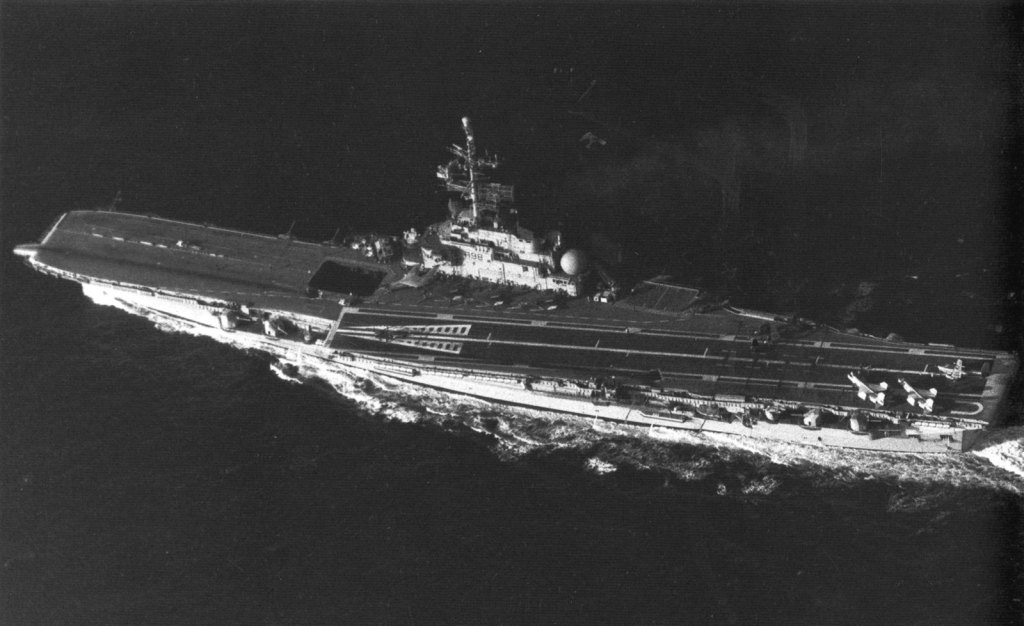


_is_tugged_down_New_York_Harbor_(USA)_after_being_salvaged,_circa_in_September_1943_(80-G-K-3864).jpg)
.jpg)