Most accounts of Titanic start with the iceberg. This one starts with the ship. Her hull, machinery and accommodation are described in unusual detail in the 1912 British inquiry report and in The Shipbuilder’s account of the propelling machinery, and those sources explain a good deal about what kind of ship she was.
She was the second of three large liners that Harland and Wolff built for the White Star Line, after Olympic. The design aimed at size, comfort and economy of operation rather than record speed.
| Official number | 131428 |
| Builder | Harland and Wolff, Belfast, yard no 401 |
| Keel laid | 31 March 1909 |
| Launched | 31 May 1911 |
| Registered | Liverpool, 25 March 1912 |
| Gross / net tonnage | 46,328 / 21,831 |
| Registered length | 852.5 ft |
| Breadth | 92.5 ft |
| Displacement | 52,310 tons at 34 ft 7 in draught |
| Boilers | 24 double-ended and 5 single-ended |
| Lost | 15 April 1912, North Atlantic |
Size and registration
Titanic was laid down on 31 March 1909, launched on 31 May 1911 and registered at Liverpool on 25 March 1912. Titanic Belfast’s fact file gives 2 April 1912 as the date she was handed over after trials.
The inquiry report gives a registered length of 852.5 feet, a breadth of 92.5 feet and a depth of 64 feet 9 inches. Her gross tonnage was 46,328 and her net tonnage 21,831. These are measures of enclosed volume, not weight. Her displacement, the actual weight of the loaded ship, was 52,310 tons at a draught of 34 feet 7 inches.
A length overall of about 882 feet 9 inches is often quoted. It is not stated in the inquiry report or the other sources used here, so the registered length is used in the table above.

Sixteen compartments, not a sealed box
Fifteen transverse watertight bulkheads, lettered A to P from forward, divided the hull into sixteen main compartments. Most of them reached D or E deck. The foremost bulkhead, A, went up to C deck but was watertight only to D deck.
There were twelve vertical sliding watertight doors in the bulkheads from D to O at the level of the boiler and engine rooms. They could be closed from the bridge. Doors higher up, on E and F decks, were horizontal sliding doors worked by hand.
The decks themselves were not watertight, apart from the weather deck and part of the orlop deck aft. That matters. Water entering several compartments at the bow could rise above the tops of the bulkheads and spill aft into the next compartment, because nothing above the bulkhead tops stopped it.
The double bottom gave a further layer of protection against grounding. The inner bottom stood about 5 feet above the keel and ran for most of the ship’s length.
Two engines and a turbine
Titanic had three propellers. The two wing propellers were each driven by a four-cylinder triple-expansion engine. Four cylinders did not mean four stages of expansion: each engine had one high-pressure cylinder of 54 inches diameter, one intermediate of 84 inches and two low-pressure cylinders of 97 inches, all with a 75 inch stroke.
The Shipbuilder gives the cylinder order from forward as low-pressure, high-pressure, intermediate and low-pressure. Each engine was designed to develop about 15,000 indicated horsepower at 75 revolutions per minute.
Steam leaving the reciprocating engines still held useful energy. Instead of going straight to the condensers, it went to a Parsons low-pressure turbine on the centre shaft. The turbine took steam at about 9 pounds per square inch absolute and exhausted it at about 1 pound into the condensers, developing about 16,000 shaft horsepower at 165 revolutions per minute.
The turbine was large. It weighed 420 tons, and its rotor alone was 12 feet in diameter and weighed 130 tons. Harland and Wolff had tried the same combination on the smaller Laurentic, and it had worked well there.
There was no astern turbine. When the ship manoeuvred, change-over valves sent the exhaust from the reciprocating engines straight to the condensers, and the centre propeller stopped. Going astern was done on the wing engines alone.
The inquiry report gives the registered horsepower of the whole plant as 50,000 and says it was probably capable of at least 55,000. The Titanic Belfast fact file gives her service speed as 21 knots.
Twenty-nine boilers and four funnels
Steam came from 24 double-ended and 5 single-ended boilers with 159 furnaces between them, working at 215 pounds per square inch. They were arranged in six boiler rooms, numbered from aft. No 1, the aftmost, held the five single-ended boilers. Rooms 2 to 5 held five double-ended boilers each, and No 6, the foremost, held four.
The boiler rooms took up about 320 feet of the ship’s length and the engine rooms about 123 feet. The furnaces worked on natural draught, with twelve Sirocco fans supplying air to the stokeholds.
Only three of the four funnels took smoke from the boilers. The fourth, aftmost funnel was used for ventilation and also carried the galley chimney. It balanced the profile, but it was not a dummy in the sense of being purely for show.
Electricity
Electric power came from four main generating sets of 400 kilowatts each at 100 volts, placed in a separate compartment aft of the turbine room. The ship carried 10,000 incandescent lamps, most of them of the tantalum type.
Two emergency sets of 30 kilowatts each stood much higher in the ship, in the turbine casing at D deck level, about 21 feet above the load waterline. They could take steam from boiler rooms 2, 3 or 5, and were meant to keep essential lights and power going if the main dynamo room flooded.
There were four lifts: three for first-class passengers, running from E deck to A deck, and one for second class, running up to the boat deck.
Passenger spaces
First-class public rooms were spread over several decks. The lounge, reading and writing room and smoking room were on A deck. The first-class dining saloon, on D deck between the second and third funnels, took up 112 feet of the ship’s length. A separate first-class restaurant, with its own pantry and galley, was on B deck.
Lower down, on F deck, were the swimming bath and the Turkish baths. Third-class passengers had two dining rooms on F deck as well, each in its own watertight compartment. Second-class accommodation lay mainly aft, with its own saloon, library and smoke room.
The working crew lived in very different conditions. The inquiry report describes quarters for 108 firemen on D deck forward, with a spiral staircase and a tunnel that let them reach the stokeholds without passing through passenger areas.
Lifeboats
Titanic carried 14 lifeboats of 30 feet, two smaller emergency cutters and four Engelhardt collapsible boats. The inquiry report gives their total capacity as 1,178 people. That met the Board of Trade rules of the time. The inquiry pointed out that the scale had been set in 1894 for ships of 10,000 tons and upward and had not been extended as ships grew to 45,000 tons.
The loss
Titanic sailed from Southampton on 10 April 1912 and called at Cherbourg and Queenstown. The inquiry report records that she struck the iceberg at 11.40 pm on 14 April and foundered at 2.20 am on 15 April.
The inquiry found damage low on the starboard side, about 10 feet above the keel, over a length of about 300 feet. It opened the forepeak, holds 1 to 3 and boiler rooms 6 and 5, six compartments in all. As the bow settled, water rose towards the tops of the bulkheads, and with the decks above not watertight there was nothing to stop it moving aft.

The British inquiry gave 2,201 people on board, of whom 711 were saved and 1,490 lost. It also noted that Carpathia picked up 712 people, one of whom died later, which accounts for the small difference between the two survivor figures.
Carpathia took on board 13 lifeboats, the two emergency boats and two collapsibles; the rest were abandoned as damaged or useless. The inquiry’s chapter on subdivision, and its criticism of the boat rules, are why its description of the ship is so detailed. It reads as an explanation of how a well built ship could still be lost.
Timeline
| Date | Event |
|---|---|
| 31 March 1909 | Keel laid at Harland and Wolff, Belfast. |
| 31 May 1911 | Launched. |
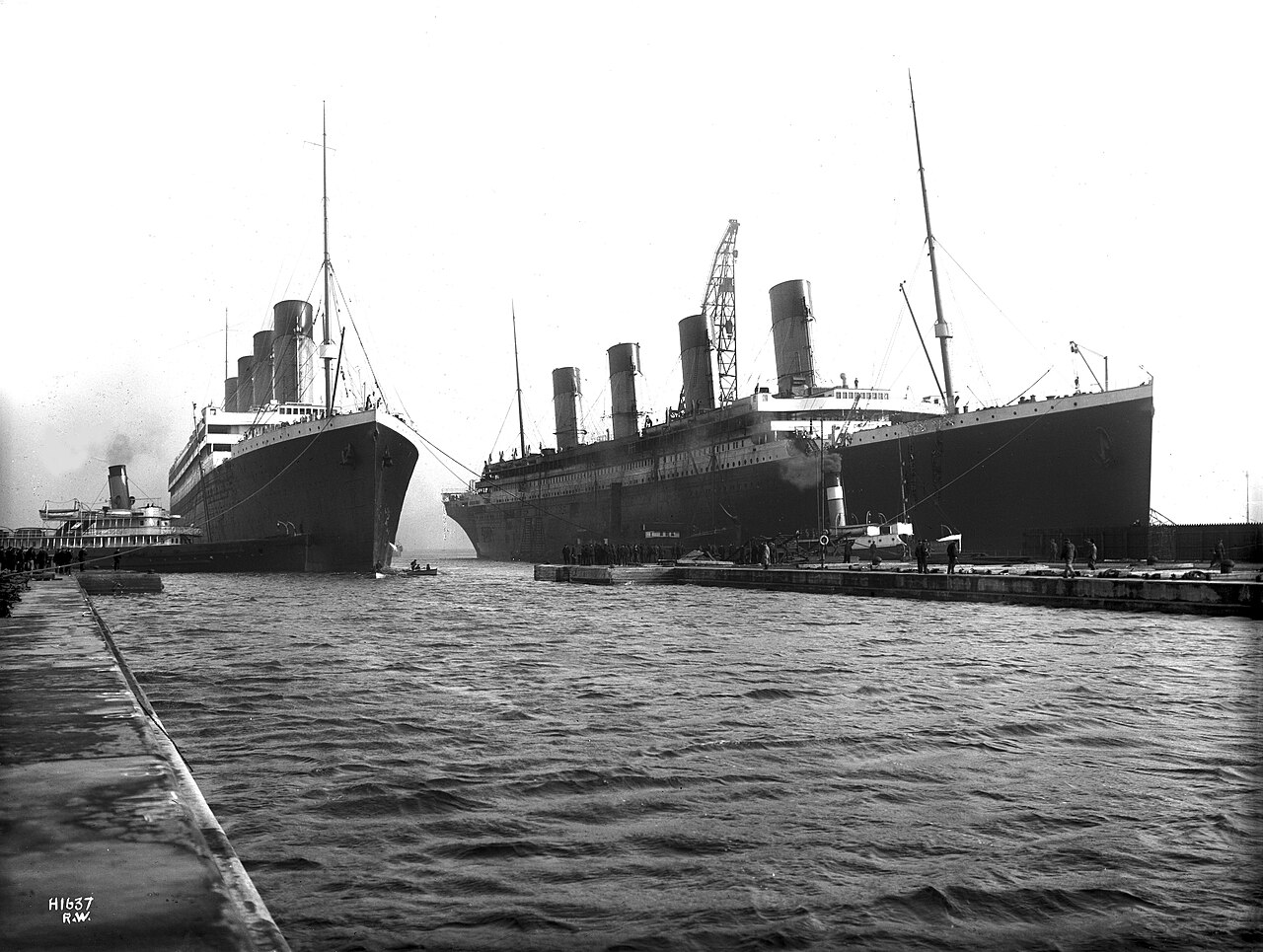
| 6 March 1912 | Moved out of dry dock so Olympic can have a propeller replaced. |
| 25 March 1912 | Registered at Liverpool. |
| 2 April 1912 | Trials and handover. |
| 10 April 1912 | Sails from Southampton on her maiden voyage. |
| 11.40 pm, 14 April 1912 | Strikes an iceberg. |
| 2.20 am, 15 April 1912 | Founders. |
| 30 July 1912 | British inquiry report signed. |
Sources and further reading
- British Wreck Commissioner’s Inquiry, Report on the Loss of the Steamship Titanic (Project Gutenberg edition).
- The Shipbuilder, Olympic and Titanic: The Propelling Machinery, reproduced by Encyclopedia Titanica.
- Titanic Belfast, Titanic fact file.
- Titanic Inquiry Project, British inquiry: description of the ship.
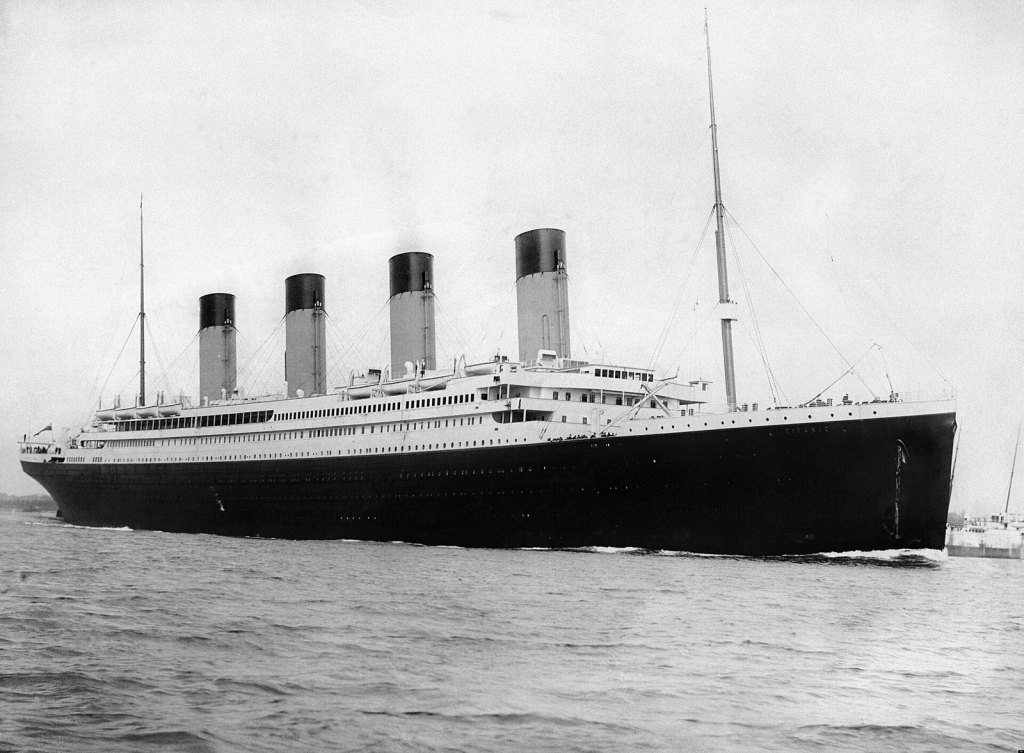
Image credits. Featured image: Titanic leaving Southampton on her maiden voyage, 10 April 1912. Photo: Francis Godolphin Osbourne Stuart, Wikimedia Commons, Public domain. Other photographs are credited in their captions.
Have a correction or a photograph that helps identify this ship? Contact contact@shipsarchive.com.