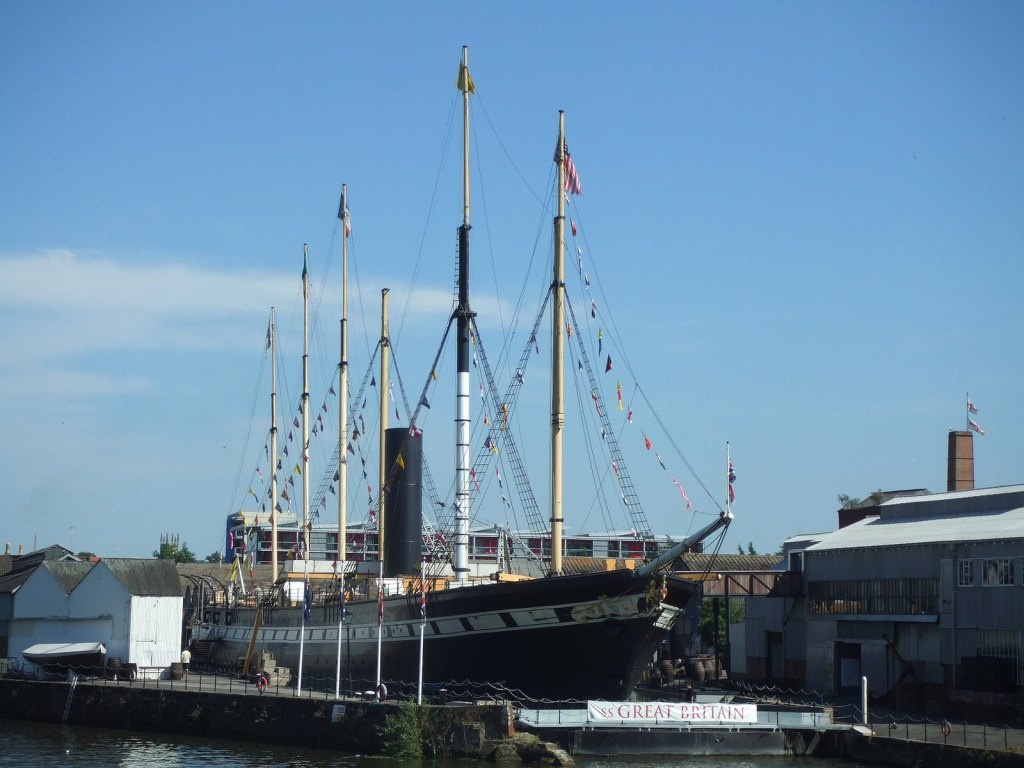
SS Great Britain was not the first iron ship, and she was not the first steamer driven by a screw propeller. What Isambard Kingdom Brunel achieved at Bristol was to combine the two in a hull large enough for the North Atlantic passenger trade, and then to prove that the combination worked at sea. When she left Liverpool for New York on 26 July 1845 she was 98 metres long, and she remained the longest passenger ship in the world until 1854. Her later life as an Australian emigrant ship, a sailing collier, a Falklands hulk and finally a museum ship has left a hull that carries evidence of almost every stage of that career.
| Name | SS Great Britain |
| Type | Iron screw steamship with auxiliary sail, built for the transatlantic passenger trade |
| Built for | Great Western Steamship Company |
| Designer | Isambard Kingdom Brunel |
| Builder | William Patterson, Great Western Dockyard, Bristol |
| Launched | 19 July 1843, by Prince Albert |
| Length | 98 metres (322 ft) |
| Beam | About 15.4 metres (50 ft 6 in) |
| Original machinery | Two inclined twin cylinder steam engines driving one six bladed propeller through a chain drive |
| Designed capacity | 360 passengers, 1,100 tons of coal |
| Maiden voyage | Sailed from Liverpool for New York on 26 July 1845 |
| Later roles | Australian emigrant ship, troopship, sailing cargo ship, storage hulk in the Falkland Islands |
| Scuttled | Sparrow Cove, near Port Stanley, 1937 |
| Return to Bristol | Entered her building dock on 19 July 1970 |
| Status | Museum ship in Bristol; part of the National Historic Fleet |
From timber paddle steamer to iron screw ship
After the success of the paddle steamer Great Western in 1838, the Great Western Steamship Company planned a larger consort for the Bristol to New York service. The first scheme was for a wooden paddle steamer, and oak had already been bought. Two visiting ships changed the design. Late in 1838 John Laird’s iron Channel packet Rainbow, then the largest iron hulled ship in service, called at Bristol. Brunel sent Captain Christopher Claxton and the shipbuilder William Patterson to sail in her and report. Both came back convinced that iron would give a hull that was stronger for its weight than timber, with more of its volume free for passengers, cargo and coal.
The second visitor arrived in 1840. Francis Pettit Smith’s Archimedes, the first steamship driven by a screw propeller, was lent to Brunel for trials, and the results persuaded him to abandon paddle engines that were already partly built. The directors agreed to new machinery designed for a propeller. The change widened the hull to take the engines and added to a long and costly building programme. Work in the specially built dry dock began in 1839, and the ship was not launched until 19 July 1843.
Size was the point of the change of material. A timber hull much beyond about 300 feet bends badly as waves pass along it, a movement known as hogging. Iron removed that ceiling. At 322 feet, Great Britain was more than 100 feet longer than any ship then afloat.
How the iron hull was put together
According to the museum’s own account, around 1,000 wrought iron plates, rolled at Coalbrookdale in Shropshire and brought to Bristol by barge, were fastened with well over 100,000 rivets. Each plate overlapped its neighbour and was held by a temporary bolt while a rivet, heated until it glowed white, was driven through and closed. As the rivet cooled it contracted and pulled the seam tight.
The Illustrated London News published a detailed description in 1843, based on the builders’ drawings. It describes a lapped, double riveted shell on ribs of angle iron 6 inches by 3½ inches, deck beams of angle iron carrying wooden decks, and a boiler platform resting on ten iron keelsons, the centre ones 3 feet 3 inches deep. A diagonal stay ran from the ship’s side to the sternpost to stiffen the stern around the propeller shaft. The hull had no projecting external keel, and the late decision to fit wider propeller engines left a distinctive bulge low on each side amidships.
The same description records that the hull was divided into five watertight compartments by iron bulkheads, and she also had a double bottom. Subdivision of this kind was unusual in a merchant ship of 1843. The American Society of Mechanical Engineers cited both features, together with her balanced rudder, when it named her a Historic Mechanical Engineering Landmark in 1984, describing her as the first iron hulled, screw propelled ship to cross an ocean.
Driving a propeller with chains
Large steam engines of the 1840s ran slowly, while a propeller needs to turn considerably faster. Great Britain had two inclined twin cylinder engines, with cylinders of 88 inch bore and 6 foot stroke, built to a modified patent of Brunel’s father, Marc. They turned at about 18 revolutions per minute. Spur gearing of the type tried in Archimedes had proved intolerably noisy, so Brunel used chains instead. An 18 foot primary wheel on the crankshaft drove a smaller wheel near the keel through four large inverted tooth chains, stepping the speed up threefold so that the propeller turned at about 54 revolutions per minute.
The main propeller shaft, forged by the Mersey Iron Works, was 68 feet long and 28 inches in diameter, bored through its length to save weight. The first propeller, of Brunel’s own design, had six blades and a diameter of 16 feet. A replica is now displayed in the dry dock beneath the stern.

The system worked, but not without trouble. The chain drums wore faster than expected. The maiden passage of about 3,100 miles to New York took 14 days and 21 hours; on the way home she lost propeller blades and completed the crossing under sail alone in about 20 days. Neither time was fast for the period. The voyage mattered because it showed that an iron screw ship of this size could cross the Atlantic and return.
Sail was part of the design
The 1843 description lists six masts and about 1,700 square yards of canvas, with the after masts hinged at deck level. For a ship whose bunkers held 1,100 tons of coal, sail was a working part of the propulsion system that stretched the fuel over a long passage, not a decorative survival from an earlier age.

The rig changed repeatedly. Her later owners reduced and altered it more than once, finishing with three square rigged masts for the Australian trade. In 1857 she received a new stern frame that allowed the propeller to be disconnected and hoisted clear of the water, removing its drag when the ship was under sail. Ewan Corlett’s analysis of her logs found that on one homeward passage in 1860 she sailed under canvas alone for more than half the time. Anyone comparing pictures of the ship should therefore expect different rigs and funnels above the same hull, depending on the decade.
Dundrum Bay and a change of owner
On 22 September 1846, outward bound for New York, she was run hard aground in Dundrum Bay on the coast of County Down after a series of navigational errors. The historian Helen Doe has argued that her master, James Hosken, was working from charts that did not show the new light at St John’s Point and mistook it for the Calf of Man light. The ship lay on the beach through the winter and was not refloated until August 1847.
The hull came through months on an exposed shore, which said a good deal for iron construction. The company did not. The salvage used up its remaining money, and in 1850 the ship was sold to Gibbs, Bright & Co. of Liverpool. The new owners renewed about 150 feet of the damaged keel, laid new keelsons along its full length and replaced Brunel’s engines with smaller, lighter oscillating engines by John Penn & Sons of Greenwich. The chain drive gave way to conventional gearing, and six smaller boilers working at 10 psi replaced the original three, which freed space for cargo.
Emigrants, troops and cargo
The gold rush in Victoria gave the ship a new trade. In 1852 she sailed for Melbourne with 630 emigrants, and she stayed on the Australian route for most of the next quarter of a century, with a deckhouse built over the upper deck to raise her passenger capacity well beyond the original 360. She was taken up as a troopship during the Crimean War and again in 1857 to carry reinforcements to Bombay during the Indian Mutiny. In 1861 she took the first English cricket team to tour Australia.
She was put up for sale at Birkenhead in 1876 and found no buyer until 1882, when Antony Gibbs, Sons & Co. removed her engines and converted her into a three masted sailing ship to carry coal to San Francisco and bring wheat home. On 8 February 1886 she left Penarth on what proved to be her last voyage. Badly damaged off Cape Horn, she put back to Port Stanley, where repairs were judged too expensive. She was sold to the Falkland Islands Company and used as a hulk for storing coal and wool. In 1914 her coal helped bunker the British squadron that defeated von Spee’s ships at the Battle of the Falkland Islands. In 1937 she was towed to Sparrow Cove, holed and left to settle in shallow water.
Bringing her home in 1970
The campaign to recover her began after the naval architect Ewan Corlett wrote to The Times in 1967. Corlett surveyed the wreck and concluded that she could be moved. The SS Great Britain Project chartered the submersible pontoon Mulus III and the German tug Varius II, and the businessman Jack Hayward gave £150,000 towards the cost. Divers patched the hull, the ship was refloated in April 1970 and secured on the pontoon, and the tow left the Falklands on 24 April. After a stop at Montevideo for inspection it crossed the Atlantic and reached the Bristol Channel in late June.
At Avonmouth she was floated off the pontoon. On 5 July 1970 tugs towed her up the Avon and under the Clifton Suspension Bridge, watched by a crowd estimated at 100,000. She waited for two weeks in the Floating Harbour, and on the evening of 19 July 1970 she entered the Great Western Dock, 127 years to the day after her launch from the same place.
Conserving a salt contaminated iron hull
The central conservation problem was chloride. Decades in salt water and salt air had loaded the corroded iron with chlorides, and as the hull dried it formed hygroscopic corrosion products, akaganéite and ferrous chloride, that keep corrosion going even in fairly dry air. Removing chlorides by washing was impractical for a structure of this size, so the work turned to controlling the air around the metal.
Laboratory research at Cardiff University, led by David Watkinson, measured how chloride contaminated iron corrodes at low relative humidity. Corrosion stopped at 12 per cent, was detectable at 15 per cent and did not increase significantly until about 35 per cent. Those results underpinned the solution now in place. The lower hull is enclosed beneath a glass plate at waterline level, and the space below is kept dry by dehumidifiers working to an operational target of 20 per cent relative humidity. A thin layer of water on the glass gives visitors the impression that the ship is afloat.

Engineers at the University of Bristol have since modelled and measured an air curtain for controlling conditions close to the hull surface, combining computational fluid dynamics with sensor data. None of this makes the iron permanently stable. It slows corrosion only for as long as the enclosure is maintained, which makes the dry dock plant as much a part of the ship’s survival as the iron itself.
The philosophy of the project also changed over time. The original aim was to restore her to her appearance in 1843; the aim later became the conservation of all surviving material from before 1970. The hull visitors now walk beneath therefore records the 1850s rebuild, the Australian years, the sailing ship conversion and the long decline in the Falklands, rather than a single moment in her history.
Timeline
| Date | Event |
|---|---|
| 1838 | Rainbow calls at Bristol; Claxton and Patterson report on her iron hull |
| 1839 | Construction begins in the dry dock at Bristol |
| 1840 | Archimedes visits Bristol; Brunel adopts screw propulsion |
| 19 July 1843 | Launched by Prince Albert |
| 26 July 1845 | Sails from Liverpool for New York on her maiden voyage |
| 22 September 1846 | Runs aground in Dundrum Bay, County Down |
| August 1847 | Refloated |
| 1850 | Sold to Gibbs, Bright & Co. |
| 1852 | First voyage to Melbourne, with 630 emigrants |
| 1857 | New stern frame fitted to allow the propeller to be lifted; trooping to Bombay |
| 1882 | Engines removed and the ship converted to sail |
| 1886 | Damaged off Cape Horn; becomes a hulk at Port Stanley |
| 1937 | Scuttled in Sparrow Cove |
| 24 April 1970 | Leaves the Falklands on the pontoon Mulus III |
| 19 July 1970 | Enters her building dock in Bristol |
| 1984 | Named an ASME Historic Mechanical Engineering Landmark |
Sources and further reading
- Bristol Dockyards (SS Great Britain Trust), Brunel’s SS Great Britain, 1843. Design, construction and riveting.
- Bristol Dockyards (SS Great Britain Trust), The SS Great Britain Homecoming, 1970. The tow up the Avon and the return to the dock.
- Illustrated London News, 1843, The Great Britain Steam Ship, transcribed by the Victorian Web. Contemporary structural description.
- American Society of Mechanical Engineers, Landmark 97: SS Great Britain.
- National Historic Ships UK, Register entry: ss Great Britain. Particulars and career summary.
- Cardiff University, REF2014 impact case study, Evidence based management strategies for heritage iron.
- University of Bristol, Heritage conservation with a surface air curtain. Research record.
- Ewan Corlett, The Iron Ship, Moonraker Press, 1975. Print source for the 1857 lifting screw and sailing performance.
Image credits. Featured image: SS Great Britain in the Great Western Dock, Bristol, where she was built and where she has been displayed since 1970. Photographed July 2006. Photo: Hugh Llewelyn, Wikimedia Commons, CC BY-SA 2.0. Other photographs are credited in their captions.
Have a correction or a photograph that helps identify this ship? Contact contact@shipsarchive.com.


.jpg)