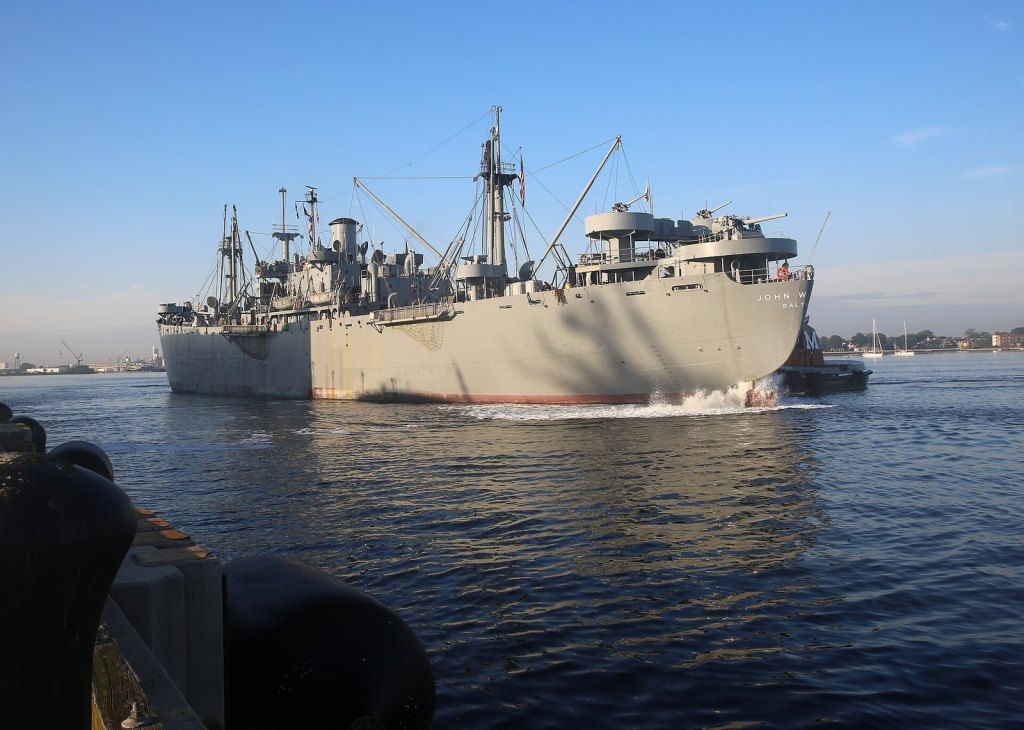
Of the 2,751 Liberty ships built in the United States during the Second World War, two survive in working order. SS John W. Brown, based in Baltimore, is the one on the east coast. She still raises steam, turns her original engine and takes passengers out on the Chesapeake Bay.
Her survival owes something to chance. She spent 35 years after the war tied up in New York as a school, which kept her out of the scrapyard and preserved her machinery in usable condition. Since 1988 volunteers have worked to restore her to her wartime appearance.
| Type | EC2 Liberty ship |
| Builder | Bethlehem-Fairfield Shipyard, Baltimore |
| Launched | 7 September 1942 |
| Length overall | 441 ft 7½ in (134.6 m) |
| Beam | 57 ft (17.4 m) |
| Draught | 27 ft 9 in (8.5 m) |
| Gross tonnage | 7,176 |
| Deadweight | 10,865 tons |
| Displacement | 14,245 tons |
| Engine | Three-cylinder triple expansion, 2,500 hp at 76 rpm |
| Speed | 11 knots |
| Cargo | Five hatches; about 8,500 long tons |
| Owner | Project Liberty Ship, Baltimore |
A ship built for speed of production
The Liberty ship began as a British design. Its basis was the tramp steamer Dorington Court, built by J. L. Thompson and Sons at Sunderland. A British mission took the plans to North America in 1940 to have similar ships built there, and the American version was adapted for mass production with welded hulls and prefabricated sections.
The result was simple, slow and robust. The ship was meant as an emergency type with a short expected life. The National Register nomination describes how the programme advanced welding and prefabrication, with whole deckhouses, double-bottom sections and bow units built separately and lifted into place.
Production times fell sharply as yards learned the methods. The record, the nomination notes, was held by Robert E. Peary, assembled and launched four days and fifteen and a half hours after her keel was laid. Liberty ships carried between 38 and 62 merchant seamen and 21 to 40 naval personnel for the guns and communications. Some 200 were sunk during the war.
John W. Brown was built at the Bethlehem-Fairfield yard in Baltimore in 41 days and launched on Labor Day, 7 September 1942. Six Liberty ships were launched that day at different yards, all named after labour leaders. Her namesake was a labour leader from Maine who had died in 1941.
The engine
Her engine is a direct-acting, condensing, three-cylinder triple expansion steam engine, built by Worthington Pump and Machinery at Harrison, New Jersey. Steam passes in turn through a high-pressure, an intermediate and a low-pressure cylinder, expanding at each stage so that more of its energy is used before it reaches the condenser.
The cylinders are 24, 36 and 76 inches in diameter. The National Register nomination gives an output of 2,500 indicated horsepower at 76 rpm, a fuel consumption of 30 tons of Bunker C oil a day and a speed of 11 knots. Two oil-fired boilers supply the steam, and the whole plant is operated by hand.

Thirteen wartime voyages
Her maiden voyage began on 29 September 1942, when she left Baltimore for New York to load supplies for the Soviet Union, delivered through the Persian Gulf. She went by the Panama Canal and round Cape Horn and the Cape of Good Hope, sailing alone for much of the way. The round trip took eight months, and she came home with a cargo of bauxite.
In 1943 she was converted to carry up to 500 troops in addition to cargo. Five-tier bunks were fitted in the first two holds, and the third held officers’ quarters, a sick bay, an operating room and a brig. Six extra gun tubs, new companionways, doors and ventilators were added on deck and in the tween decks.

Most of her later wartime voyages were to the Mediterranean. The National Register nomination lists landings at Sicily, Salerno, Anzio and southern France. A 1990 account in Naval History magazine records half a dozen trips into the Anzio beachhead, and troops of the 45th Infantry Division carried for the landings in southern France in August 1944.
Her guns were manned by a Navy Armed Guard detachment, as on all American merchant ships of the period. Accounts agree that her gunners shot down at least one enemy aircraft, but differ on where. Project Liberty Ship places it in southern France; the Naval History account places it at Anzio.
She also carried Italian and German prisoners of war from Italy to Bizerte in North Africa. After the end of the war in Europe in May 1945 she brought American troops home. In all she made 13 voyages during the war.
Thirty-five years as a school
After the war John W. Brown was operated as a freighter by the States Marine Corporation. Her last transatlantic voyage, from London to New York, came late in 1946. In November 1947 the Maritime Commission lent her to the New York City Board of Education to replace the ferry Brooklyn as a stationary schoolship.
Students learned deck, engine and catering skills using her real cargo gear, engine room and galley. Her tween decks became classrooms and workshops, and some cabins were combined to make offices and larger messes. Project Liberty Ship and Naval History give her school years as 1946 to 1982; the National Register nomination gives November 1947 for the transfer, which this article follows.

The Board of Education closed the school on 30 June 1982, citing maintenance costs, and the ship was taken to the reserve fleet in the James River in Virginia. During her years in New York her engine had been disconnected from the shaft but turned over each week, which helped keep it in working order.
Saving her
Project Liberty Ship was founded in New York in 1977 with the aim of acquiring the ship. In October 1982 Representative Mario Biaggi introduced a bill to transfer her to the group, and President Reagan signed it on 18 October 1983. She was listed on the National Register of Historic Places in March 1985, while lying at Newport News.
In March 1988 she made a 26-hour run from a shipyard in Norfolk to Pier 1, Clinton Street, in Baltimore. The move took her off the National Register, because the correct relocation procedure had not been followed. She was renominated at her new berth and relisted in November 1997.
The early work was basic. During a drydocking in July 1988 the through-hull fittings were welded shut for safety, because the original expansion joints in the cooling water system were at risk of failing and flooding the engine room. Each boiler had 396 hand-hole covers to remove for inspection, and one boiler was found to have many holed tubes.
Restoration has taken some 350,000 hours of work by 3,500 volunteers, many of them former shipyard workers, merchant seamen and men who had served or travelled in Liberty ships. Members of the Armed Guard veterans’ group refitted the gun tubs and installed a 5-inch gun aft. In 1991 she made her first cruise on the Chesapeake Bay under steam.
Armament and particulars
Sources differ on her wartime guns. The National Register nomination thought she most likely carried a 3-inch gun forward, a 5-inch gun aft and ten 20 mm anti-aircraft guns. Project Liberty Ship lists three 3-inch/50 guns, one 5-inch/38 and eight 20 mm guns. The guns now on board were fitted during restoration.
Her length is also given in two ways: 441 ft 7½ in in the National Register nomination and 441 ft 6 in by Project Liberty Ship. Totals for the Liberty programme vary too. The nomination and Naval History give 2,751 ships, while the American Bureau of Shipping history gives 2,710, depending on what is counted.
A working ship
John W. Brown remains a working ship, not a static exhibit. Project Liberty Ship runs day cruises and has taken her to ports beyond the Chesapeake, including New York, Boston and Halifax. Volunteers maintain her deck and engine departments and serve meals from the galley.
She also teaches. A STEM internship introduces students to her boilers, engine, cargo gear and refrigeration. At the second Steam School, held on 8 to 10 November 2019, 16 guests lit the boilers, raised steam and operated the main engine and the steam cargo winches under supervision.
The ship that was meant to last five years has now passed 80. Her value lies less in rarity than in use: the gear still works, and the people who keep it working can show how a wartime merchant crew moved a ship and her cargo.
Timeline
| Date | Event |
|---|---|
| 7 September 1942 | Launched at Bethlehem-Fairfield, Baltimore |
| 29 September 1942 | Maiden voyage begins |
| 1943 | Converted to carry troops as well as cargo |
| 1943 to 1944 | Mediterranean landings at Sicily, Salerno, Anzio and southern France |
| Late 1946 | Last transatlantic voyage |
| November 1947 | Lent to the New York City Board of Education |
| 1977 | Project Liberty Ship founded |
| 30 June 1982 | School closes; ship goes to the James River reserve fleet |
| 18 October 1983 | Transfer bill signed |
| March 1985 | Listed on the National Register |
| March 1988 | Moves to Baltimore |
| 1991 | First Chesapeake Bay cruise under steam |
| November 1997 | Relisted on the National Register |
Sources and further reading
- National Park Service, National Register of Historic Places registration form, S. S. John W. Brown. Particulars, alterations and history.
- Project Liberty Ship, Ship history. Launch, wartime voyages, crew and armament.
- American Bureau of Shipping, Workhorse of the Fleet, 2019. Origins and development of the Liberty ship.
- Project Liberty Ship, Steam School 2, November 2019.
- Naval-History.net, The Marine Steam Engine by Richard Sennett. Principles of the triple expansion engine.
- Project Liberty Ship, Steam School. Course content and boilers.
- Project Liberty Ship, STEM internship program.
- National Park Service, SS John W. Brown. Wartime service and prisoners of war.
- Theodore A. Dietz, Naval History, Technical report: new life for a Liberty, January 1990.
- Maryland Historical Trust, S.S. John W. Brown, Medusa record B-4611.
Image credits. Featured image: SS John W. Brown at Norfolk, Virginia, in May 2016. Photo: Bill Mesta, U.S. Navy, Wikimedia Commons, Public domain. Other photographs are credited in their captions.
Have a correction or a photograph that helps identify this ship? Contact contact@shipsarchive.com.


_in_May_2016.JPG)