On her maiden voyage in July 1952, United States crossed from New York to Bishop Rock at an average of 35.59 knots. That was a sustained passage over three and a half days, not a short burst on a measured mile. It took the Blue Riband from Cunard’s Queen Mary, and no passenger liner in service has bettered it since.
This article looks at the design choices behind that speed: weight, machinery layout, propellers and fire safety. It also covers why the ship left service in 1969 and what is happening to her now.
| Designer | Gibbs & Cox, under William Francis Gibbs |
| Builder | Newport News Shipbuilding and Dry Dock Co, hull 488 |
| Keel laid | 8 February 1950 |
| Christened and floated | 23 June 1951 |
| Maiden voyage | Left New York 3 July 1952 |
| Length | 990 ft (about 302 m) |
| Beam | 101 ft 6 in, moulded |
| Gross tonnage | 53,300 (Mariners’ Museum); MARAD gives 53,330 |
| Machinery | 8 boilers, 4 Westinghouse steam turbines, 4 shafts |
| Power | About 240,000 shp |
| Passengers | 1,984 in commercial service |
| Out of service | 14 November 1969 |
A liner with a military brief
The ship was designed by the U.S. Maritime Commission with United States Lines and the U.S. Navy. The Maritime Administration (MARAD) says she was meant to work as a passenger liner but could be quickly converted into a troopship. In that role she could have carried 14,000 troops and 1,444 crew, with space for a 400-bed hospital.
That brief shaped the design. MARAD lists watertight doors up to A deck and a beam narrow enough for the Panama Canal among her defence features. The SS United States Conservancy says the beam of 101 feet left about two feet of clearance on each side in the locks.
The government paid a large share of the cost because of this military value. The Mariners’ Museum gives the building cost as $78 million. She was the last vessel delivered under a Maritime Commission contract, in June 1952, nearly two years after that agency had ceased to exist.
The troopship role was never used. United States spent her whole career as a commercial liner, and the conversion capability remained a paper provision.
Built in a dry dock
Her keel was laid at Newport News on 8 February 1950. The Conservancy says she was the first major liner to be built in a dry dock rather than on a slipway. This simplified construction and also suited Gibbs, who wanted the details of the design kept secret.
Building in a dry dock also meant the engine spaces could be completed before she was floated. The ship was christened and floated on 23 June 1951. The Conservancy says more than 3,100 shipyard workers took her from keel to delivery in two years and three months.
Saving weight
The superstructure was built almost entirely of aluminium. MARAD says this saved 8,000 to 10,000 tons compared with steel. Less weight high in the ship also helps stability, so the saving was useful twice over.
The Conservancy says more aluminium went into her than into any previous construction project. Her 24 lifeboats were aluminium as well, which made them lighter to handle.
Gross tonnage measures enclosed volume, not weight, so it says little about how heavy a ship is. The useful point is that the same engine power could drive a lighter hull faster. That was the reasoning behind the aluminium.

Machinery in two separate groups
MARAD lists eight boilers and four steam turbines. The Conservancy’s account of the maiden voyage names them as four Westinghouse turbines capable of over 240,000 shaft horsepower. Its design history gives a higher figure of 247,785 horsepower, so the round figure is the safer one to quote.
The machinery was split between two engine rooms, so that the ship could keep some power if one was disabled. The Conservancy says both funnels worked, each serving its own group of boiler and engine rooms several decks below.
For a ship that might carry troops in wartime, this mattered. Flooding of one large machinery space could stop a ship with a single engine room. Two separate groups reduced that risk, although damage in the wrong place could still be serious.
Four propellers, two designs
United States had four propellers. Two had four blades and two had five. The Conservancy says the layout was chosen after testing for its hydrodynamic performance, and that the design was overseen by Elaine Kaplan, an engineer at Gibbs & Cox.
Each propeller was made of manganese bronze and weighed about 60,000 pounds. The published sources do not explain in detail why the mixed arrangement worked better, so it is safest to say that it was tested and selected for this hull.
Fire safety
Gibbs wanted a ship that would not burn. The Conservancy says he insisted that no wood be used in her construction or fittings. One exception was the grand pianos, made of a fire-resistant mahogany.
Even the shuffleboard pucks were plastic rather than wood. Behind the bridge was a damage control room with controls for the fire alarms, watertight doors and fire-screen doors.
Lifesaving equipment went beyond the legal minimum. The Conservancy says her lifeboats and rafts could hold 4,060 people, more than 1,000 above the number she could carry when fully booked.

The record crossing
United States left New York on 3 July 1952 with about 1,700 passengers. The Conservancy says Commodore Harry Manning raised speed steadily during the crossing, even into a North Atlantic gale.
She passed Bishop Rock, off the Isles of Scilly, at 6.16 am on 7 July. The passage from the Ambrose lightship had taken 3 days, 10 hours and 40 minutes, at an average of 35.59 knots. The Mariners’ Museum says this beat Queen Mary’s record by more than 10 hours.
On the return voyage she also took the westbound record, in 3 days, 12 hours and 12 minutes, at an average of 34.51 knots. She was the first American ship to hold the Blue Riband for about a century.
Two other speed figures are often quoted. The Conservancy gives 38.32 knots on trials. MARAD mentions a reported top speed of 42 knots. A trial speed and a reported maximum are not the same as an ocean passage average, and the 35.59 knots of 1952 is the figure that the record rests on.
The Mariners’ Museum notes one qualification. The eastbound crossing time was beaten in 1990 by the fast ferry Hoverspeed Great Britain. That vessel was not in passenger service at the time, so United States is still regarded as the holder of the Blue Riband for liners.
Service and withdrawal
United States sailed for United States Lines for 17 years. Her passengers included four U.S. presidents and many well-known figures. The Conservancy says that in 1963 she also carried the Mona Lisa to America for exhibitions in Washington and New York.
Jet airliners took her market. MARAD says United States Lines withdrew her in 1969 after losing many passengers to transatlantic jet travel. The Mariners’ Museum records that the decision was taken while she was at Newport News for her annual overhaul, and gives 14 November 1969 as the date she left service.
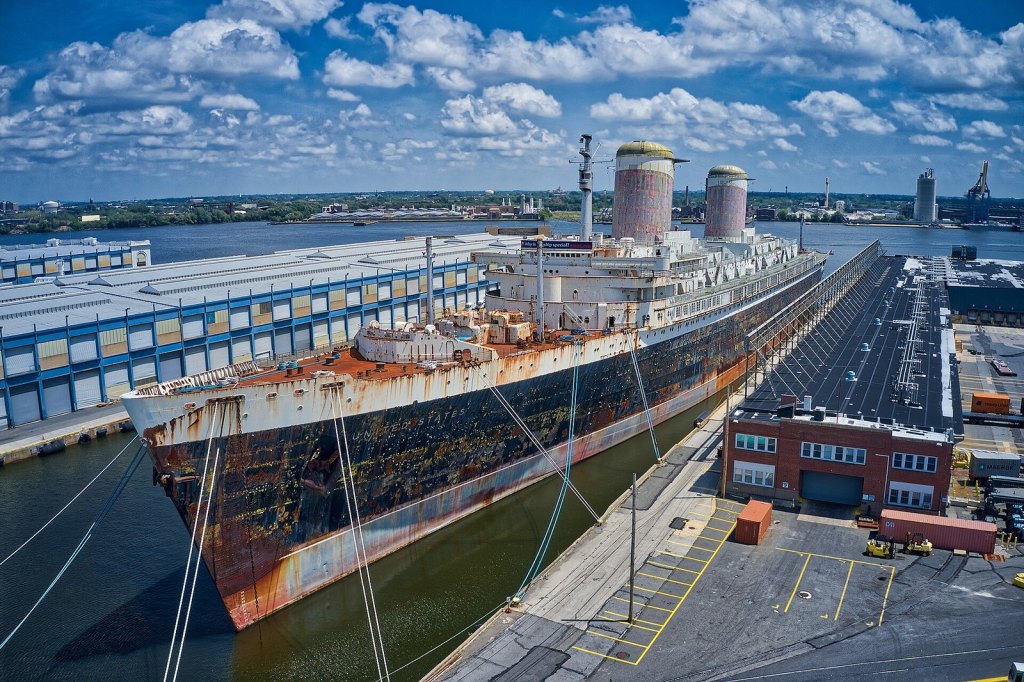
Several plans to return her to service followed, but none came to anything. She was laid up at a number of places on the East Coast, and from 1996 she lay at a pier on the Delaware River in Philadelphia.
Mobile and the reef plan
Foley News reports that the ship left Philadelphia under tow on 19 February 2025 and reached Mobile Bay on 3 March 2025. Okaloosa County, Florida, had bought her for $1 million to use as an artificial reef.
At Mobile, workers removed fuel tanks, windows, paint, wiring and other hazardous materials. The same report says environmental clean-up on board was finished in May 2026.

In a press release of 9 October 2026, Okaloosa County said she would be sunk about 22 nautical miles south-west of Destin-Fort Walton Beach in the second week of November 2026. The county noted that the date depends on the weather and may change.
Parts of the ship are being kept. In August 2025 the Conservancy announced that both funnels would be removed for its planned museum, and Foley News reports that they have since been taken off. The Conservancy says the museum will also show one of her five-bladed propellers and her radar mast.
What the design achieved
United States was fast because several decisions worked together. Aluminium kept the weight down, a very powerful plant drove four shafts, and the propellers were tested for this hull. Her safety features came from the same design approach, partly because of the Navy’s interest.
Her record still stands for passenger liners, but her career was short. The aircraft ended the market for fast Atlantic crossings within 17 years of her maiden voyage.
Timeline
| Date | Event |
|---|---|
| 8 February 1950 | Keel laid at Newport News |
| 23 June 1951 | Christened and floated |
| June 1952 | Delivered |
| 3 July 1952 | Maiden voyage leaves New York |
| 7 July 1952 | Passes Bishop Rock at 35.59 knots |
| 14 November 1969 | Leaves commercial service |
| 1996 | Moored at Philadelphia |
| 19 February 2025 | Leaves Philadelphia under tow |
| 3 March 2025 | Arrives at Mobile, Alabama |
| November 2026 | Planned sinking as a reef off Florida |
Sources and further reading
- SS United States Conservancy, The SS United States: An American Story 66 Years in the Making, maiden voyage, turbines and record time.
- U.S. Maritime Administration, SS United States, design partners, aluminium, machinery, troopship capacity and withdrawal.
- SS United States Conservancy, History: Design & Launch, dry dock construction, engine rooms and building time.
- SS United States Conservancy, Design Begins for New SS United States Museum and Visitor Experience, August 2025, funnels and museum plans.
- SS United States Conservancy, The SS United States’ Propellers, blade numbers, material and Elaine Kaplan.
- SS United States Conservancy, Fast Facts, beam, trial speed, fire safety and later history.
- SS United States Conservancy, The Ship, lifeboats, bridge and damage control room.
- The Mariners’ Museum and Park, Commemorative Plaque, United States, catalogue record with dates, dimensions and record times.
- Okaloosa County, Okaloosa County Sets Timeline for SS United States Deployment, press release, 9 October 2026.
- Foley News, SS United States Prepares For Final Voyage, October 2026, tow to Mobile, preparation work and purchase price.
Image credits. Featured image: United States at her Philadelphia berth in August 2020, photographed from a drone. Photo: Chuck Homler, FocusOnWildlife, Wikimedia Commons, CC BY-SA 4.0. Other photographs are credited in their captions.
Have a correction or a photograph that helps identify this ship? Contact contact@shipsarchive.com.