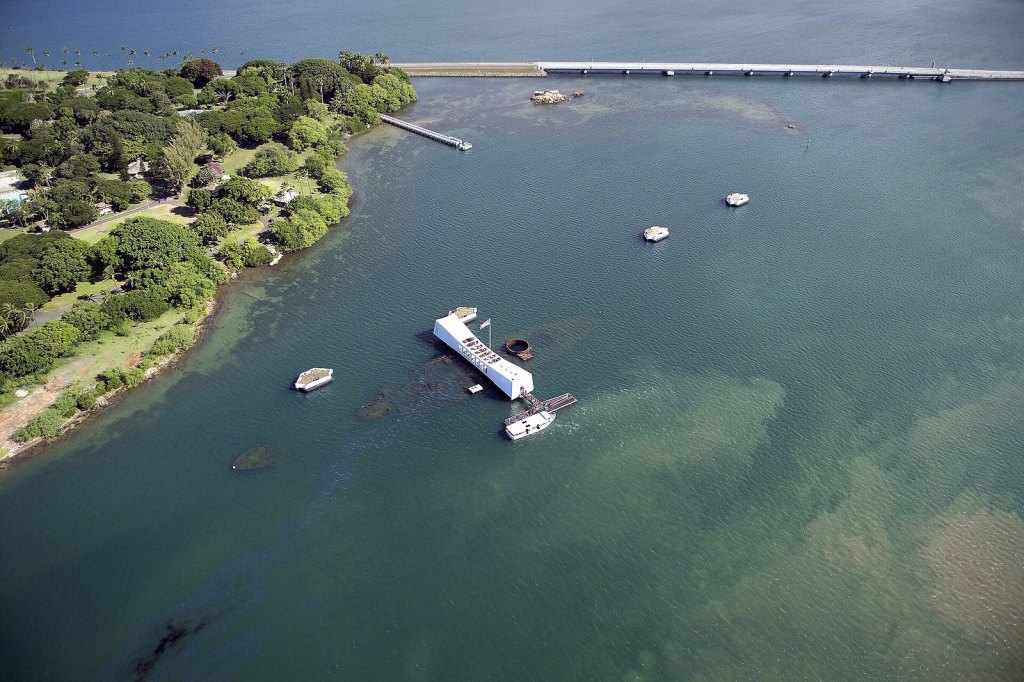
USS Arizona was sunk at her mooring in Pearl Harbor on 7 December 1941, with the loss of 1,177 of the 1,512 men on board. More than 900 of them remain inside the hull. The wreck is a war grave, and since 1962 a memorial has spanned it, open to visitors under the care of the National Park Service.
This article sets out the ship’s career, the attack as recorded by the Naval History and Heritage Command, and the long work of salvage, commemoration and scientific study that followed. Where official accounts differ, the differences are noted rather than smoothed over.
| Type | Pennsylvania-class battleship |
| Hull number | Battleship No. 39 (BB-39) |
| Builder | New York Navy Yard, Brooklyn |
| Laid down | 16 March 1914 |
| Launched | 19 June 1915 |
| Commissioned | 17 October 1916 |
| Displacement | 31,400 tons |
| Length | 608 ft (185.3 m) |
| Beam | 97 ft 1 in (29.6 m) |
| Speed | 21 knots |
| Main armament | Twelve 14-inch guns |
| Lost | 7 December 1941, Pearl Harbor |
| Killed | 1,177 of 1,512 on board |
| Memorial dedicated | 30 May 1962 |
Building and early career
Arizona was laid down at the New York Navy Yard in Brooklyn on 16 March 1914 and launched on 19 June 1915, sponsored by Esther Ross. She was commissioned on 17 October 1916 under Captain John D. McDonald. She was armed with twelve 14-inch guns in four triple turrets and twenty-two 5-inch guns, and had a designed complement of 1,081.
During the First World War she served with Battleship Division 8 from Norfolk, Virginia. She crossed to England in November 1918, after the Armistice, and on 13 December formed part of the escort for the transport George Washington, which carried President Woodrow Wilson to Brest for the Paris Peace Conference.
She joined the Pacific Fleet in 1921. From May 1929 she was modernised at Norfolk Navy Yard. Her cage masts were replaced by tripod masts, she received new boilers and turbines, and torpedo bulges were added to her hull. She returned to full commission on 1 March 1931, and on 19 March carried President Herbert Hoover from Hampton Roads to Puerto Rico and the Virgin Islands, returning on 29 March.

Pearl Harbor, December 1941
On 23 January 1941 Rear Admiral Isaac C. Kidd took command of Battleship Division 1, with Arizona as his flagship. The fleet was then based at Pearl Harbor. On 5 December, after exercises at sea, Arizona moored at berth F-7 alongside Ford Island. The next day the repair ship Vestal came alongside her port side to carry out maintenance.
On the morning of Sunday 7 December, Rear Admiral Kidd and the ship’s commanding officer, Captain Franklin Van Valkenburgh, were both on board. Japanese aircraft from six carriers attacked the fleet shortly before 8am. Arizona’s air raid alarm sounded at about 7.55am and the crew went to general quarters.
The Naval History and Heritage Command records two direct bomb hits. The one most likely to have destroyed the ship was an 800 kg bomb dropped by a Nakajima B5N2 from the carrier Hiryu. It glanced off the face plate of Turret II, penetrated the deck and exploded in the black powder magazine, which set off the adjacent smokeless powder magazines.
The explosion tore through the forward part of the ship and started fires that burned for two days. The blast killed 1,177 of the 1,512 men aboard, more than half of all those killed in the fleet that day. Kidd and Van Valkenburgh were among the dead. Kidd was the first American flag officer killed in the Pacific war.
Both men were awarded the Medal of Honor posthumously. A third award went to Lieutenant Commander Samuel G. Fuqua, the ship’s first lieutenant and senior surviving officer, for his conduct in fighting the fires and getting survivors off the ship. Many other members of the crew, sailors and Marines, were later recognised for their actions.

Salvage and the decision to leave the ship
Arizona was placed ‘in ordinary’ on 29 December 1941 and struck from the Naval Vessel Register on 1 December 1942. The recovery of the dead from inside the hull soon became impossible. The University of Arizona’s account of the ship records that the bodies of at least 900 men remained aboard.
Salvage work in 1942 removed what could be used. The foremast came off on 5 May and the mainmast on 23 August. The superstructure was cut away, and the two after turrets were taken out for use in coast defence batteries on Oahu. The guns of Turret II were removed, but Turret I was left in place. The last salvage work ended in October 1943.
The Naval History and Heritage Command’s wreck site page describes the removal of Turrets I and II, which conflicts with its own ship history and with the University of Arizona’s account. This article follows the majority. The same page records that the remains of 105 crew members were recovered during the salvage.
Becoming a memorial
In the first years after the war the wreck was largely ignored. On 7 March 1950 Admiral Arthur W. Radford, Commander in Chief of the Pacific Fleet, instituted the raising of the national flag over the wreck. A Pacific War Memorial Commission had been formed in 1949, and in 1958 legislation signed by President Eisenhower authorised the Navy to build a memorial and to accept donations towards it.
Contributions came from the Hawaii legislature and many private donors, including the proceeds of a 1961 concert by Elvis Presley. Construction began in 1960 and the memorial was dedicated on Memorial Day, 30 May 1962. It was designed by the architect Alfred Preis and stands across the middle of the sunken hull.
The structure is 184 ft long and is divided into an entry room, an assembly room and a shrine room, where the names of those killed are carved on a marble wall. Preis explained that the form sags in the centre but stands strong at each end, expressing initial defeat and ultimate victory.
The ship is no longer in commission, but the national flag flies from a pole attached to the severed mainmast. In 1980 the Navy handed operation of the memorial to the National Park Service, which opened a visitor centre on shore. Some survivors of the attack have since chosen to have their ashes interred in the wreck with their shipmates.
The wreck under water
The hull lies upright in shallow water, with parts of the deck just awash. In 1983 the Park Service’s Submerged Cultural Resources Unit carried out a ten-day survey with Navy divers of Mobile Diving and Salvage Unit One. They found that the hull had expanded outward at the point of the explosion, and that internal bulkheads had collapsed and sealed the exits.
A corrosion study followed in 1986, and the Park Service’s Submerged Resources Center dived on the ship from 1998 to 2001. Corrosion rates were measured at between 1.1 and 6.0 thousandths of an inch per year. Remotely operated vehicles were sent inside in 2003 and 2004, and annual monitoring has continued since.

Diving conditions are difficult. The Park Service archaeologist Jessica Keller has described visibility of only 3 to 5 ft on many days, rising to 25 or 30 ft on the best. Sponges, corals, fish and small creatures such as nudibranchs and seahorses live on the ship, and the deck has become a sheltered habitat.
Oil still leaking
Oil has escaped from the wreck in small drops ever since the sinking, forming a sheen on the surface that visitors often call the black tears. Estimates of the oil remaining differ. The Naval History and Heritage Command gives several hundred thousand gallons, a 2016 Park Service account about half a million, and a 2025 study about 600,000 gallons.
That study, led by the University of Houston and the Woods Hole Oceanographic Institution and published in October 2025, analysed samples collected by the Park Service in 2016 and 2018. It found heavy fuel oil refined from California crude. The chemistry varied between leak points, because oil changes as it moves through the wreck before it escapes.
The researchers concluded that the oil is not leaking at a highly concerning rate. They also noted that any decision to remove oil from a wreck has to weigh the risk of a spill against the harm of disturbing the site, including its cultural and historical value, and that careful monitoring is sometimes the better choice.
The salvage platforms
Two concrete and steel platforms were fixed to the hull in 1942 to moor the vessels used in salvage. In late October 2023, Park Service staff found that the smaller platform had shifted and partly collapsed. Navy divers of Mobile Diving and Salvage Unit One and Park Service archaeologists then surveyed both platforms and the hull.
The Navy decided to remove the platforms to prevent damage to the ship, the memorial and the environment, since a collapse onto the hull could have released oil. Removal began on 3 September 2025. The Navy reported that large portions of both platforms had been removed by 30 September, and the Historic Hawai‘i Foundation reported no impact on the ship.
One of Arizona’s two bells was found in 1944 at the Puget Sound Navy Yard, awaiting scrap, by a University of Arizona graduate, Wilber Bowers. It was sent to the university in 1946 and hangs in its bell tower. The other bell remains at the memorial site. Every visitor arrives by boat and leaves the same way, past a wreck that remains, first of all, the resting place of more than 900 men.
Timeline
| Date | Event |
|---|---|
| 16 March 1914 | Laid down at the New York Navy Yard |
| 19 June 1915 | Launched |
| 17 October 1916 | Commissioned |
| 13 December 1918 | Escorts President Wilson to Brest |
| 1921 | Joins the Pacific Fleet |
| 1929 to 1931 | Modernised at Norfolk |
| 7 December 1941 | Destroyed at Pearl Harbor; 1,177 killed |
| 29 December 1941 | Placed in ordinary |
| 1 December 1942 | Struck from the Naval Vessel Register |
| October 1943 | Salvage work ends |
| 7 March 1950 | Flag raising over the wreck instituted |
| 30 May 1962 | Memorial dedicated |
| 1980 | National Park Service takes over the memorial |
| 1983 | First detailed underwater survey |
| October 2023 | Smaller salvage platform found partly collapsed |
| September 2025 | Platforms largely removed |
Sources and further reading
- Naval History and Heritage Command, Arizona II (Battleship No. 39), Dictionary of American Naval Fighting Ships. Career, attack and casualties.
- National Park Service, USS Arizona. Memorial design, history and status.
- National Park Service, Battleship Row. Ships moored at Ford Island on 7 December 1941.
- University of Arizona Libraries, Pearl Harbor Memorial. Salvage, memorial funding and the 1980 transfer.
- Naval History and Heritage Command, USS Arizona (BB-39) wreck site. Salvage dates, surveys, corrosion and the bells.
- National Park Service, Underwater at the USS Arizona. Diving conditions, marine life and oil, 2016.
- Woods Hole Oceanographic Institution, USS Arizona provides blueprint for addressing oil leakage, 2 October 2025.
- National Park Service, Science and research at USS Arizona. Corrosion and monitoring projects.
- Stars and Stripes, Historical salvage platform attached to USS Arizona is collapsing, 9 November 2023.
- Defense Visual Information Distribution Service, USS Arizona preservation. Navy record of the platform removal, 2025.
- Historic Hawai‘i Foundation, U.S. Navy removes failing platforms from the USS Arizona, 6 October 2025.
Image credits. Featured image: The USS Arizona Memorial spanning the sunken hull of the battleship at Pearl Harbor. Photo: National Park Service, Wikimedia Commons, Public domain. Other photographs are credited in their captions.
Have a correction or a photograph that helps identify this ship? Contact contact@shipsarchive.com.


_-_NH_57658.jpg)
_on_10_December_1941.jpg)

.jpg)